
Gainesville, GA · Hall County
Dumpster Rental in Gainesville, GA — Delivered Fast, Priced Flat
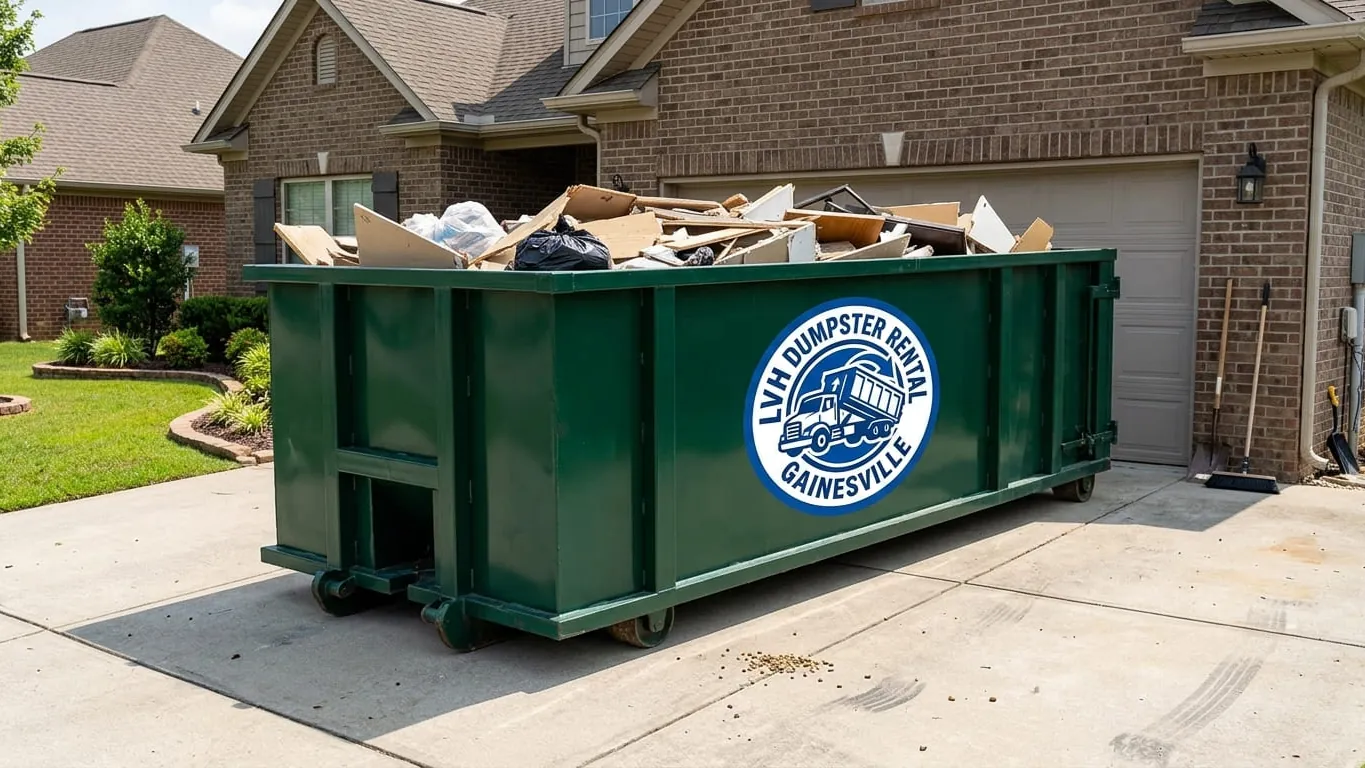
10 through 40 yard roll-off dumpsters for homeowners, contractors and businesses across Gainesville and North Georgia. One phone call, one flat price, and a driver who protects your driveway. Locally owned since 2013.
- Same-day & next-day delivery
- Flat rates that include disposal
- Driveway protection boards as standard
- Fully insured and locally owned
Fully insured· Flat-rate quotes· Locally owned since 2013
Why LVH Dumpster Rental
The dumpster company Gainesville calls back
Most people renting a dumpster are already having a stressful week. The kitchen is in pieces, the roof is half off, or a family member has passed and there is a house full of forty years to sort out. The last thing anyone needs is a hauler who quotes one price, invoices another, and drops a container across the mailbox.
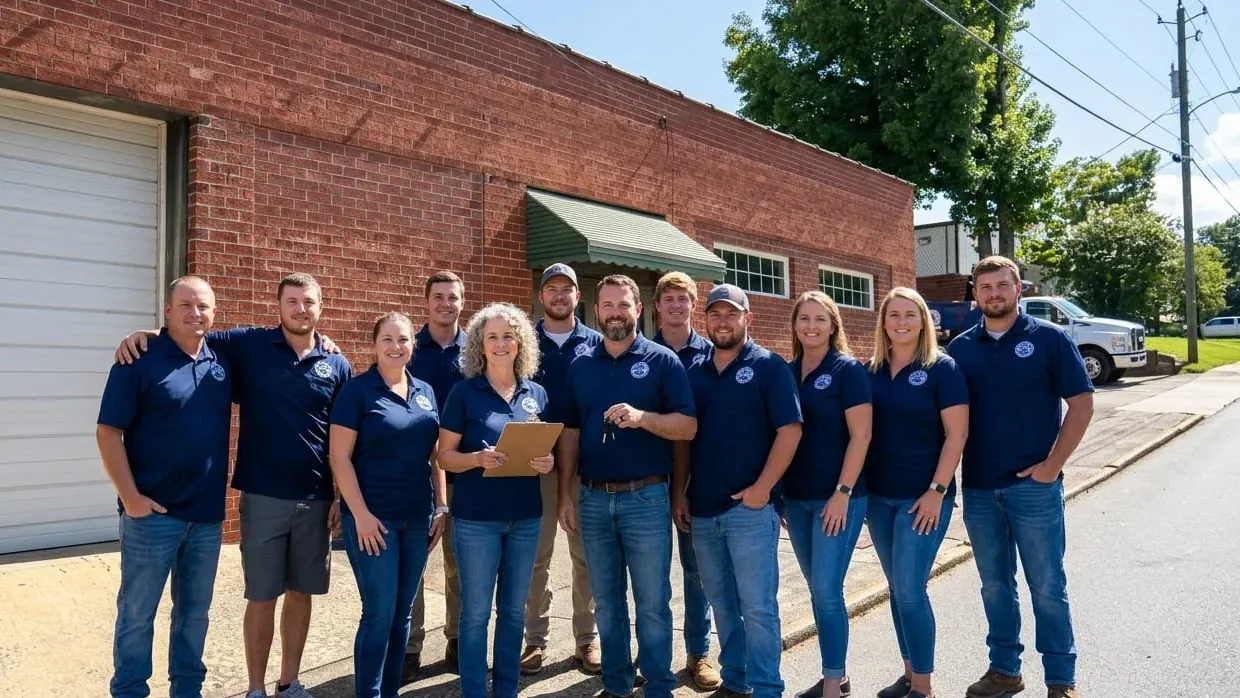
We started LVH Dumpster Rental in 2013 with one truck and one rule: tell people the truth about what it costs and show up when we said we would. 13 years later that has not changed. Dale Vickery still answers the phone most mornings, and our drivers still walk the drop before they back in.
We run out of 344 Northside Dr, and the U.S. Census Bureau geocoder puts that address inside the incorporated City of Gainesville — Hall County, Census Tract 9.02 — so our yard here in Gainesville is a city address rather than a county one, and we are not routing a truck in from another market when you need a container this afternoon. I-985, US 129, US 23 and SR 365, Jesse Jewell Parkway (SR 369), SR 11, SR 13, SR 53 and SR 60 put every part of the county inside a comfortable morning. It also means we know whose rulebook your address sits under, and in Hall County that is most of the job, because the city and the county give completely different answers. First, the City has already written our job description for us. Inside the city limits you get once-weekly collection under Sec. 4-3-5 — one city-supplied 96-gallon cart, out by 7 a.m., Solid Waste on (770) 532-0493 — and then Sec. 4-3-9 lists what the city will not collect: “discarded building materials, dirt, broken concrete, bricks, rock or debris,” sinks, tubs, shower stalls and toilets, “cabinets, doors, windows, roofing debris, lumber, siding,” landscape timbers, crossties, carpet and floor coverings. The City wrote our job description into its own ordinance — everything on that list is what goes in our containers. Crossties and landscape timbers are on it too, and we take them — tell us when treated timber is in the load, because it has to go to a facility permitted to receive it rather than to an inert site. Second, Hall County provides no residential curbside collection at all. What exists instead is twelve compactor sites and the landfill, and residents haul their own household waste to them: bagged garbage in bags of 39 gallons or less, no yard trimmings, no tires, no liquids — and commercial haulers who charge for disposal are excluded outright. A basement cleanout or a roof tear-off has nowhere to go in that system. Third, where a load can legally go is a real question here. Georgia recognizes three landfill classes — municipal solid waste, construction and demolition at Ga. Comp. R. & Regs. 391-3-4-.07(4)(b), and inert at 391-3-4-.07(4)(c) — and the Hall County landfill at 1700 Oakbrook Drive rejects yard debris and bulk concrete and asphalt, on a $20 minimum covering up to 665 pounds and $60 a ton over that, as published. Over the top of all of it sits the fire code, and Georgia is on the International Fire Code, 2024 edition, adopted by the Safety Fire Commissioner at Ga. Comp. R. & Regs. 120-3-3-.04 under O.C.G.A. §§ 25-2-13 and 25-2-14. 2024 IFC § 304.3.4 keeps any container of 1.0 cubic yard (200 gallons) or more five feet clear of combustible walls, openings and combustible roof eave lines. Every roll-off we own is over that threshold, so five feet is a measured number here rather than a rule off a national blog. Past the codes it is street knowledge: which long, sloping driveways off Browns Bridge Road, Green Street and the north Hall roads will take a 30 and which want a 20 set back on boards; what Cecil red clay does to a lawn in February; that these houses have basements and crawlspaces, so the basement, the crawlspace and the attic are the job rather than the garage; and which addresses sit inside the city limits and which sit in unincorporated Hall County.
Read more about who we are and how we got started, or jump straight to what we haul.
- Founded2013
- Container sizes10 – 40 yd³
- Typical deliverySame or next day
- Areas served18+
What we haul
Dumpster rental services in Gainesville and North Georgia
Eleven container services, one flat-rate promise. Whatever the job, the price we quote on the phone is the price on your invoice.
Residential Dumpster Rental
Driveway placement for the basement, attic and garage cleanouts a north Georgia house produces.
Learn more →Commercial Dumpster Rental
Containers for businesses and contractors — Hall County runs no curbside collection at all.
Learn more →Construction Dumpster Rental
Mixed C&D in one roll-off, with next-day swap-outs across Hall County.
Learn more →Roofing Dumpster Rental
Weight-rated cans sized by squares and layers, tarped between sessions.
Learn more →Roll-Off Dumpster Rental
10, 15, 20, 30 and 40 yard roll-offs across Gainesville and Hall County.
Learn more →Same-Day Dumpster Rental
Call before the cut-off and we can usually get a container to you this afternoon.
Learn more →Junk Removal Dumpsters
Clear a basement, attic, garage or outbuilding on your own schedule.
Learn more →Estate Cleanout Dumpsters
Discreet, patient container service for families clearing a lifelong home.
Learn more →Demolition Debris Removal
Containers and fast swaps for porches, outbuildings, sheds, garages and interior gut-outs.
Learn more →Concrete & Heavy Debris
Dedicated heavy cans for concrete, block and brick — the county landfill rejects bulk concrete and asphalt.
Learn more →Yard Waste & Brush Removal
Clean separate loads — Georgia bans yard trimmings from lined municipal solid waste landfills.
Learn more →Choose your size
Five sizes, sized for real projects
Not sure which one? Tell us what you are clearing out and roughly how much of it there is. Ninety percent of the time we can size it correctly over the phone in under two minutes. The first question here is what the debris weighs rather than how much room it takes, because broken concrete, block, brick and mortar, a chimney taken down, a retaining wall pulled out, a driveway apron replaced, and wet red clay spoil are all weight jobs long before they are volume jobs. Dense material wants a small can, every time. The job that genuinely wants a 30 or a 40 is the opposite: a basement and attic cleared to the walls, or a multi-room remodel — furniture, cabinets, carpet, insulation and trim — because that debris takes up enormous space and weighs comparatively little. In between sits the 20, which is the default around here: a basement-and-attic clear-out, or a remodel that runs to two or three rooms. Bear in mind that an open can catches whatever falls on it, and north Georgia has no dry half of the year to hide in — NOAA’s 1991–2020 normals for the Gainesville station run about 53 inches of rain spread right through the calendar, with roughly 1.9 inches of snow on top of it. Water sitting in an open container is weight you pay to haul, and a soaked mixed load is the most expensive thing a customer here can build. Keep the load below the rails, and tarp it.
10 Yard Dumpster
Concrete, block, brick and soaked debris — the box that reaches payload before it looks full.
View this size → 15yd³15 Yard Dumpster
A single room, a small tear-off, or a garage cleared to the walls.
View this size → 20yd³20 Yard Dumpster
A whole-house declutter — the Gainesville default — or a multi-room remodel.
View this size → 30yd³30 Yard Dumpster
A large remodel, a basement strip-out or a full estate cleanout.
View this size → 40yd³40 Yard Dumpster
Commercial gut jobs and construction — it needs the most room to set down.
View this size →How it works
Four steps, no paperwork
- 1
Call us
Tell us the project, your address and when you want it. Two minutes on the phone and you have a flat price.
- 2
We deliver
Our driver walks the drop, lays protection boards and sets the container exactly where you want it.
- 3
You load it
Take your time within your rental window. Keep it level with the top rail and we handle the rest.
- 4
We haul it
Call or text when you are done. We pull it, sort what can be recovered and dispose of the rest properly.
Local knowledge
What makes hauling in Gainesville different
Red clay, a lake with a federal landowner, and streets the City writes down
Placement is where most of the trouble starts here, and in North Georgia it is genuinely about the ground. Gainesville sits at about 1,214 feet on rolling Piedmont upland, and the soil under nearly every driveway in Hall County is the Cecil series — fine, kaolinitic, thermic Typic Kanhapludults, with a red clay subsoil running 35 to 70 percent clay and more than 60 inches to bedrock. Two things follow. The first is that Cecil clay is low shrink-swell: it is kaolinitic rather than smectitic, so it does not swell and shrink the way the heavy clays further west do, and nobody here needs to worry about a container heaving a foundation. The second is what it actually does. Wet Cecil clay is slick and it ruts; dry Cecil clay is hard as brick; and with about 53 inches of rain spread evenly through the year, the ground here is very often just wet enough. A loaded 20 yard box puts several tons on four small contact patches, so a lawn or an unpaved verge is not a load-bearing surface after rain. The answer is plywood or timber mats under the rails, the driveway rather than the grass, and occasionally a smaller box loaded flat and low. Figure on roughly 60 ft of straight approach, 10.5 ft of width and 20+ ft of clear sky for the hoist arm, plus room for the basement walkout, the meter and the heat pump. There is one more landowner to think about on the west side of the county, and it is a federal one. Lake Sidney Lanier is a Corps of Engineers reservoir — Buford Dam, an earth-fill dam 192 feet high and 1,630 feet long, sluice gates closed on 1 February 1956 — and the U.S. Army Corps of Engineers owns most of the land around it in fee title, roughly 56,782 acres across about 760 miles of boundary. On a lake lot, the property line is not the water. The Shoreline Management Plan requires Corps authorization for things as ordinary as vegetation removal, land-formation modification, mowing and general lawn care, chemical application, fires, and excavation or silt removal. We do not tell anyone whether a particular job needs Corps authorization — that is the Lake Lanier Project Management Office on (770) 904-3262, and note that shoreline management sits with the Mobile District while Section 404 and 408 permits go to the Savannah District. What we do is find out where the federal boundary runs before a container goes anywhere near the back of the lot.
Then the rules national guides get wrong for this address. Start with who owns the road. I-985, US 129, US 23, SR 365, SR 369 — Jesse Jewell Parkway — SR 11, SR 13, SR 53 and SR 60 are state routes maintained by the Georgia Department of Transportation. Streets inside the city are the City’s, under Code Chapter 4-4. Roads in unincorporated Hall County are the County’s, under Code Chapter 12.20. Inside the city the street rules are unusually explicit, and worth reading before you decide where a box goes. Sec. 4-4-2(a) prohibits blocking or impairing a public street “without first having secured permission from the governing body”; Sec. 4-4-2(c) reaches the person who gives the instruction, not only the driver who follows it; Sec. 4-4-2(d) makes each day a separate and distinct offense; and Sec. 4-4-7 lets the public works director remove an intrusion into a street or sidewalk at the owner’s expense. Sec. 4-4-2(b) is the one that catches red-clay sites: allowing “dirt, silt, sediment or debris” to be tracked into a city street is itself a violation, which is why a gravel exit and mats under the rails are worth the trouble. On your own driveway none of that is engaged, and Sec. 4-3-4 assumes commercial containers stay on private property unless the governing body grants permission otherwise. In unincorporated Hall County we have found no published county provision that names roll-off containers in a county right-of-way, so we make no claim in either direction — call the County first. And before anything gets dug — fence posts, a stump, footings, a septic line — call Georgia 811. Under the Georgia Underground Facility Protection Act, O.C.G.A. Title 25, Chapter 9, notice runs not less than two and not more than eight business days, and the clock starts at 7 a.m. on the first business day after your request. Setting a container down is not excavation; digging to make room for one is. Tell us the cross streets and we will tell you where the can goes, or read the permit and placement guide.
Two markets, one city limit line — and houses with a downstairs
Gainesville is an old town in a county that is growing fast, and the two facts pull in different directions. The city was incorporated in 1821 as the seat of Hall County, which was itself created in 1818. Green Street filled in with Victorian and Neo-Classical houses from around 1880. Chicopee went up in 1927 as a Johnson & Johnson mill village and is on the National Register; New Holland is the other mill village. A large share of downtown is 1936–38 reconstruction. Around all of that, Hall County added roughly 23,400 people between the 2020 census and the July 2025 estimate. So there are two housing stories in one service area, and one number tells you how different they are: Hall County is 68.6 percent owner-occupied, and the City of Gainesville is 39.2 percent, with a median gross rent of $1,299 as published by the Census Bureau. County work is owner work — a basement finally emptied, a kitchen out, a deck off the back of a lake house. City work skews to landlords, property managers and turnover. Underneath both of them is the thing that reverses every assumption people bring from further south. These houses have basements and crawlspaces. Deep, well-drained residuum on a side slope is exactly the ground that produces a daylight basement, and north Georgia has been building them for a century; Georgia’s residential code carries full provisions for basement walls, basement wall drainage and crawlspace ventilation, and IRC R403.1.4 puts exterior footings at least twelve inches below undisturbed grade and below whatever frost depth the local building official has established. So the clear-out that matters here is not the garage. It is the basement, the crawlspace and the attic — and all three mean carrying material up or down a stair before it reaches the container, which is an argument for a 10, 15 or 20 close to the walkout rather than a 30 parked at the road.
Weather is the other thing outsiders assume about this address, and the sourced answer is more useful than the assumption. Hall County is more than 250 miles from the Georgia coast; nothing arrives here off the water. What arrives is wind, ice and, occasionally, the rain field of a decayed tropical system — Helene put 7 to 8 inches of rain across Hall County in September 2024 and took trees down on Wiley Road at Clarks Bridge Road, on Price Road at Old Wilkie Road, and on Highway 323. In February 2014 NWS Peachtree City recorded a quarter to better than half an inch of ice near Atlanta and two to five inches of snow north of a Rome–Gainesville line. And this town carries a tornado record no other city in the country does: NOAA’s list of the twenty-five deadliest tornadoes in United States history names Gainesville, Georgia twice — 6 April 1936, 203 deaths, the fifth deadliest in United States history, with 1,600 injured when two F4 tornadoes merged over downtown, and 1 June 1903, 98 deaths, ranked seventeenth. We say it once because it explains the building stock, not because it is a selling point. The weather office is NWS Peachtree City on (770) 486-1133. Then there are the two dates that decide what a renovation container is legally carrying. Asbestos: notification in Georgia goes to Georgia EPD under Ga. Comp. R. & Regs. Chapter 391-3-14, ten working days ahead, with a RACM survey by an agent of a Georgia-licensed abatement contractor required first, at $0.10 per square foot plus $0.10 per linear foot, minimum $25, capped at $50 for residential and small projects and $1,000 otherwise; the duty officer is (404) 363-7026. 1978: the lead Renovation, Repair and Painting rule applies to pre-1978 housing, and Georgia is an EPA-authorized state — the twelfth, effective 5 July 2011 — so your contractor certifies with EPD under Chapter 391-3-24, not with EPA. On Green Street, in Chicopee and across the 1930s rebuild, that is the default condition of a renovation rather than an edge case. We do not accept asbestos in our containers, ever. See our notes on home cleanouts, basement and crawlspace cleanouts and storm and tornado debris cleanup.
How Georgia actually handles disposal, and what cannot go in the box
Georgia’s solid waste rules sit with Georgia EPD, a division of the Department of Natural Resources, at Ga. Comp. R. & Regs. Chapter 391-3-4, under the Comprehensive Solid Waste Management Act at O.C.G.A. Title 12, Chapter 8. Two parts of that chapter land directly on a hauler. The first is 391-3-4-.06, the permit by rule, which requires that vehicles and containers used to collect and transport waste be “covered, substantially leakproof, durable, and of easily cleanable construction,” that contents not “fall, leak or spill” in transit, and that all waste be deposited only at permitted facilities. That is a state condition, not a courtesy, and Hall County Code Sec. 8.60.160 says the same thing about covering a load on a county road. The second is 391-3-4-.07, which is where the three landfill classes live: municipal solid waste, construction and demolition at .07(4)(b), and inert at .07(4)(c) — the inert class taking earth, concrete, cured asphalt, rock, bricks, yard trimmings and land-clearing debris. Which class a load belongs to decides where it can legally go, which is why sorting at the container is not fussiness. Then the statewide bans. Georgia bans yard trimmings from lined municipal solid waste landfills under O.C.G.A. § 12-8-40.2, effective 1 September 1996, with the definition at § 12-8-22(42). And O.C.G.A. § 12-8-40.1 caps scrap tire storage at 25 tires anywhere in the state and keeps unprocessed tires out of landfills. Tires never ride with us.
Locally the picture is unusually clear, and it closes in from four directions at once. You cannot burn it. Georgia EPD runs a summer open burn ban from 1 May to 30 September under Ga. Comp. R. & Regs. 391-3-1-.02(5), and Hall County is one of the counties it covers; even in the open season the County allows only fallen leaves and small limbs from your own property, in a pile no bigger than six feet by six feet, fifty feet from any structure, with a Fire Marshal permit — and Hall County prohibits burning “building materials, furniture, plastic, rubber, tires, and garbage” at any time of year. You cannot put yard debris in the county landfill, which rejects “yard debris (trees, stumps, leaves, grass clippings)” along with “large construction debris (concrete/asphalt),” pressurized tanks, chemical, hazardous and liquid waste, mobile homes and boats. You cannot take it to a compactor site, which is for bagged household garbage in bags of 39 gallons or less plus recyclables, prohibits yard trimmings and tires, and excludes commercial haulers who charge for disposal. And the City will not collect it under Sec. 4-3-9. That is the whole argument for a container, and every part of it is written down. The landfill itself is at 1700 Oakbrook Drive on (770) 531-6851, open Monday to Friday 8 a.m. to 4 p.m. and Saturday 8 a.m. to 2 p.m., at a $20 minimum covering up to 665 pounds and $60 a ton over that, as published. Full detail in the Georgia disposal and recycling rules.
Weight at one end, the published gate rate at the other
Broken concrete, block, brick and mortar all run around 2,400–2,800 lbs per cubic yard, so a heavy load reaches legal transport weight in a container that still looks half empty. That material belongs in a 10 yard, twice, not a 30 once — see concrete and heavy debris. The local versions are a basement floor broken out, a chimney taken down, a retaining wall pulled, a driveway apron replaced, and a set of old footings dug up. There is a Georgia wrinkle on top of the weight: the Hall County landfill will not take bulk concrete and asphalt at all, so a clean load of concrete, brick, rock and cured asphalt is routed to an inert facility under 391-3-4-.07(4)(c) instead — which is exactly why we ask you to keep it clean rather than mixing a bag of drywall into it. Wet debris is the quiet one, and here it is rain plus clay: soaked drywall, carpet, insulation and cardboard weigh several times what the same pile weighed dry, and wet red clay spoil is heavier again. With disposal charged by the ton at the gate, a rain-filled container is the most expensive thing on the job. Brush and limb wood behave the same way, and in Georgia they are also a legal question rather than a preference — yard trimmings are banned from lined municipal landfills under O.C.G.A. § 12-8-40.2, so they travel as their own clean load or they do not travel at all. A tear-off is the same conversation from the other direction: it is counted in squares and layers rather than roof area — see roofing dumpsters and the tear-off sizing guide.
The other half of the job is the curb, and here the curb stops early on both sides of the city limit line. Inside the city, Sec. 4-3-9 names building materials, roofing debris, lumber, siding, carpet, tubs, toilets and crossties as the owner’s or contractor’s responsibility, and appliances and oversized refuse are special pickups on a service charge under Sec. 4-3-8. Outside it, Hall County runs no curbside collection at all — twelve compactor sites, bagged household garbage in bags of 39 gallons or less, and commercial haulers excluded. Here is the whole argument in one line: a household collection allowance is for household goods, and a renovation is not household goods. So we load heavy over light, keep everything below the top rail where it can be covered before an afternoon storm, bag the insulation, and pull clean cardboard and scrap metal out first — both have a market, neither needs paying for by the ton, and Hall County Code Sec. 8.60.190 requires recovery of recyclable corrugated cardboard anyway. See yard waste removal, the yard waste and brush guide and the construction debris disposal guide.
- 13+Years serving Hall County
- 18Communities and neighborhoods served
- 13In-depth local guides published
- 5Container sizes, 10 to 40 yard
What customers say
Straight talk from Gainesville and North Georgia
Dale was the only one who told me straight that the county runs no curbside pickup and that the compactor sites would not take a remodel anyway. He priced it flat, put the box on boards so the clay never got churned up, and it was on the drive at seven.
A 1926 house, and everything came out heavier than it looked — mortar-bed tile, cast iron, solid-stock cabinets. He had us in a ten rather than the twenty I asked for, and he was right. He also told us the landfill will not take bulk concrete, which the last outfit did not.
We are on a lot that runs down toward the lake and the ground was soft the whole week. They walked it first, set the box well back on the level part on plywood, and tarped it between sessions. Nothing sank and nothing went anywhere near the shoreline.
My mother had been in the same house since 1978 and we had a month. They set a 20, swapped it twice, and never once made us feel rushed. The driver told us what could not ride and where it had to go instead, which saved us a rejected load.
Reviews are shown as supplied by customers. Ratings and counts shown elsewhere on this site are illustrative pending live review syndication.
Service area
Dumpster delivery across Hall County
We deliver daily from our 344 Northside Dr yard. Pick your area for local placement notes, landmarks and permit guidance — or see the full service area.
Dumpster Rental FAQs
How fast can you deliver a dumpster in Gainesville?
Most of the time, same day if you call before nine, and next morning otherwise. We run our own trucks out of 344 Northside Dr, with I-985, US 129 and Jesse Jewell Parkway minutes away, so we are not waiting on a dispatcher in another state. The predictable rushes here are worth planning around. Spring severe weather runs March through May and puts a fortnight of roof, fence and tree work on the books over a weekend. A winter ice event can do the same thing and take a day of routing away at the same time. And 1 May is its own event, because that is the day Georgia EPD’s summer open burn ban lands and every brush pile in Hall County suddenly needs another route. Drive time matters more than the address here: a run up to Lula or out to Gillsville is a different morning from a run to the square or Green Street. If you know your dates, book ahead and we will hold the slot.
What does a flat rate actually include?
Delivery, pickup, an agreed rental period and a set tonnage allowance with disposal included. No fuel surcharge, no environmental fee, no admin fee. The only way the number changes is if you go over the weight allowance or keep the container longer than agreed, and we tell you both limits before we deliver.
Do I need to be home for delivery or pickup?
No. Plenty of our customers text us a photo of where they want it and go to work. All we need is clear access, a spot free of cars and low branches, and permission to be on the property. If the only way in is a narrow drive, a long curving approach down to a daylight basement, a gravel pad, or a turn tight enough that the truck has to swing wide, tell us when you book and we will schedule accordingly. Mention anything soft underfoot in particular — wet Cecil clay is slick, it ruts, and a lawn or verge will hold a truck for about as long as it takes to regret it. If the property is in a homeowners association, say so on the first call, because the association rules govern placement there and it is easier squared away before we roll than after. If the lot fronts Lake Lanier, say that too: the Corps of Engineers owns most of the land around the lake in fee title, so we want to know where the federal boundary runs before we set anything down. And say so if the building is empty — on an unattended job the weather is the risk, so we will talk you through keeping the load below the rails where it can be tarped.
Will the dumpster damage my driveway?
We put protection boards under the wheels and rails on every residential delivery, which spreads the load instead of concentrating it on four small contact patches. The reason that matters more here than people expect is the ground itself. Hall County driveways sit on Cecil red clay — deep, well drained, 35 to 70 percent clay in the subsoil, and low shrink-swell, so it is not a soil that heaves. What it does instead is bear well when it is dry and go slick and rut badly when it is wet, and with about 53 inches of rain spread through the year it is wet a lot. A loaded 20 yard container is several tons on four small contact points; the driveway is the right answer and the lawn is not. There is a second reason to care, and it is written into the city code: Sec. 4-4-2(b) makes allowing “dirt, silt, sediment or debris” to be tracked or deposited into a Gainesville street a violation in its own right, which is why we would rather lay a gravel exit and mats than clean red clay off the pavement afterwards. We photograph the existing condition on delivery either way. Older or hairline-cracked concrete gets extra boards, and so does newer flatwork, which settles under a point load rather than scuffing. On a gravel pad we are fine while it is dry, but for a day or two after heavy rain we would rather come back than cut ruts into it. Our placement guide explains it fully.
Do I need a permit for a dumpster in Gainesville?
On your own driveway or your own property in Gainesville, we are not aware of any permit requirement for a container, and the city code rather assumes private placement — Sec. 4-3-4 says commercial containers “must remain on private property unless the governing body grants permission” for a public alley, street or sidewalk. If any part of it will sit in a city street, sidewalk or verge, that permission comes first. Sec. 4-4-2(a) prohibits blocking or impairing a public street “without first having secured permission from the governing body,” Sec. 4-4-2(c) makes the person who gives the instruction liable alongside whoever carries it out, Sec. 4-4-2(d) makes each day a separate and distinct offense, and Sec. 4-4-7 lets the public works director remove an intrusion into a street or sidewalk at the owner’s expense. City Public Works is the desk to call. If your address is in unincorporated Hall County, the road is the County’s and there is no city counter — we have found no published county provision that names roll-off containers in a county right-of-way, so we make no claim either way and we would ask the County before putting anything on the road. If it is in Oakwood, Flowery Branch, Clermont, Lula or Gillsville, that municipality runs its own counter and you should ask there. On the fire side Georgia is on the 2024 International Fire Code, adopted at Ga. Comp. R. & Regs. 120-3-3-.04 under O.C.G.A. §§ 25-2-13 and 25-2-14, and § 304.3.4 keeps any container of 1.0 cubic yard or more five feet clear of combustible walls, openings and combustible roof eave lines — which applies on a private driveway as much as anywhere. Before anything gets dug or demolished, call Georgia 811; the Georgia Underground Facility Protection Act at O.C.G.A. Title 25, Chapter 9 sets notice at not less than two and not more than eight business days, with the clock starting at 7 a.m. on the first business day after the request. Requirements and fees change, so confirm with the desk before you book — or read our permit and placement guide.
What can I not put in the dumpster?
Wet paint, solvents, adhesives, motor oil, fuel, tar, pesticides, pool chemicals, automotive fluids, asbestos-containing material, propane and other pressurized cylinders, batteries, medical waste and refrigerant appliances. Two Georgia bans are worth knowing by name. Yard trimmings are banned from lined municipal solid waste landfills under O.C.G.A. § 12-8-40.2, in force since 1 September 1996, with the definition at § 12-8-22(42) — so leaves, limbs, grass and prunings travel as their own clean separate load, never mixed into a renovation container. And O.C.G.A. § 12-8-40.1 caps scrap tire storage at 25 tires statewide and keeps unprocessed tires out of landfills; the City has Sec. 4-3-15 and Hall County has Chapter 8.65 on top of that. Tires never ride with us. The Hall County landfill and the compactor sites both refuse hazardous, chemical and liquid waste and pressurized tanks, and we could not verify a standing county household hazardous waste program — paint and refrigerant are handled for a fee at the landfill, so call (770) 531-6851 before you bring anything chemical. Asbestos never rides with us either: in Georgia that is Georgia EPD’s program under Ga. Comp. R. & Regs. Chapter 391-3-14, with ten working days’ notice, a RACM survey by an agent of a Georgia-licensed abatement contractor beforehand, and a fee of $0.10 per square foot plus $0.10 per linear foot, minimum $25; the duty officer is (404) 363-7026. And no, burning is not the shortcut: Hall County prohibits burning “building materials, furniture, plastic, rubber, tires, and garbage” at any time of year, and Georgia EPD’s summer open burn ban stops outdoor burning altogether from 1 May to 30 September. Everything else on a normal cleanout or renovation is fine. Rules do change, so ask us before it goes in.
Still not sure?
Two minutes on the phone beats twenty minutes reading. Tell us the job and we will size it, price it and book it.
(470) 691-8287Helpful Local Resources
Useful official sources for permits, disposal rules and recycling in Gainesville and Hall County. We keep these handy because half the questions we get are really questions for one of these offices.
- City of GainesvilleCity collection, the Sec. 4-3-9 exclusion list that names building materials, roofing debris, lumber, siding, carpet, tubs, toilets and crossties, and the city right-of-way.
- Hall CountyNo residential curbside collection at all — twelve compactor sites, the landfill, and what each will and will not take.
- Georgia EPDSolid waste under Ga. Comp. R. & Regs. Chapter 391-3-4, asbestos notification under Chapter 391-3-14, and lead RRP certification under Chapter 391-3-24.
- Georgia DNRThe parent department that Environmental Protection sits within, and the state agency behind Georgiathe state agency behind Georgia’s waste programmesrsquo;s waste programs.
- Georgia 811Free utility locates before you dig — two to eight business days under the Georgia Underground Facility Protection Act.
- Safety Fire CommissionerGeorgia’s adoption of the 2024 International Fire Code, including the five-foot separation for containers of 1.0 cubic yard or more.
- Georgia DCAThe state minimum standard codes, including the residential footing provisions that put footings below the frost depth.
- US EPAThe Renovation, Repair and Painting rule — Georgia is an authorized state, so certification runs through EPD.
- National Weather ServiceForecasts, warnings and climate data for Hall County, from the Peachtree City office.
- NOAA Storm Prediction CenterTornado climatology and the record that puts Gainesville twice among the deadliest tornadoes in United States history.
- USACE Mobile DistrictLake Lanier — the Corps owns the shoreline in fee title, and the project office answers shoreline questions.
- US Census BureauPopulation, housing and boundary data for Gainesville and Hall County.
Talk to a real person
Need a dumpster in Gainesville today?
Tell us what you are clearing out and we will tell you the right size and the flat price to put it in your driveway. No forms, no waiting on an email — just call and we will sort it out in a couple of minutes.
Serving Gainesville, Hall County and North Georgia · Mon–Fri 6:30am–5pm, Sat 7am–1pm