Roll-off
Roll-Off Dumpster Rental in Gainesville, GA
Ten to forty yards, delivered across Hall County and set where the truck can actually work. Red clay, long sloping driveways, narrow lake-peninsula lanes and a federal property line on the shore of Lake Lanier all decide where a container can go.
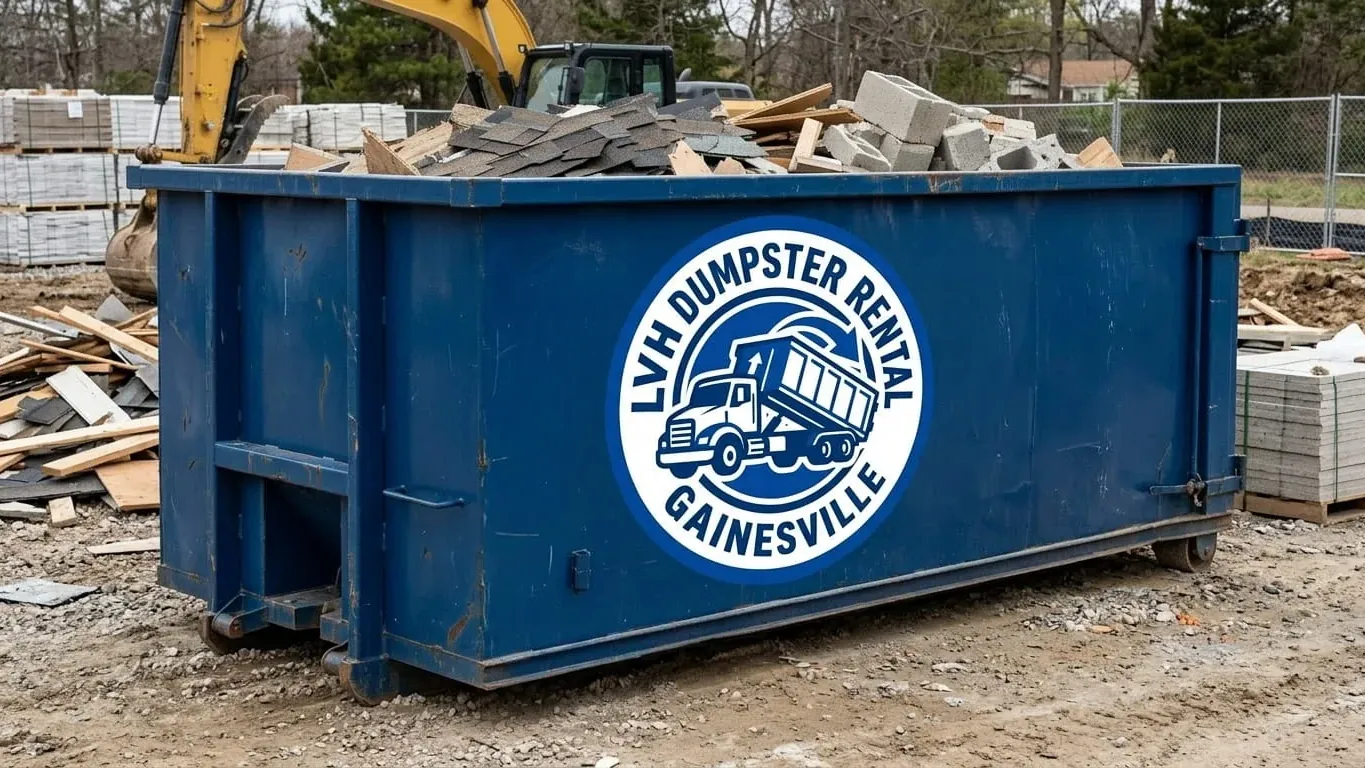
A roll-off is the container that arrives on the back of a truck, rolls off onto your ground and rolls back on when it is full. That is the whole mechanism, and everything that makes it work or not work in Hall County comes down to the ground it rolls onto and the run the truck needs to get there. We keep five sizes, from a 10 yard that fits a single-width driveway to a 40 yard that needs a commercial lot, and the size conversation is genuinely short once you tell us what the material is. The longer conversation is about placement, because north North Georgia has ground and geography that the flat southern half of the state simply does not, and the difference is worth ten minutes on the phone before delivery day rather than a problem in the driveway.
Start with the clay. The dominant soil across Hall County is the Cecil series — fine, kaolinitic, thermic Typic Kanhapludults, if you want the classification — with a red clay subsoil running 35 to 70 percent clay and better than sixty inches to bedrock. Two things follow. First, it is a low shrink-swell soil, so nothing here heaves the way clays do further west; do not let anyone sell you that story. Second, and much more practically, wet Cecil clay is slick and it ruts. A loaded roll-off can run well over ten tons gross, and on a saturated clay lawn or an unpaved pad in February it will sink and smear. Dry, the same ground carries it without a complaint. So the rule is simple: hard surface where there is one, plywood or timber mats under the rails on every placement, and no lawn sets after rain.
There is a code edge to the clay too, and it is one most haulers never mention. City Code Sec. 4-4-2(b) makes it a violation to allow dirt, silt, sediment or debris to be tracked or deposited into a city street from a parcel within the city, and Georgia runs a statewide erosion and sedimentation program through EPD at Ga. Comp. R. & Regs. Subject 391-3-7. Mud carried off a clay drive by a set of tires is exactly the thing both are aimed at. Mats, a firm approach and a clean pull-out are not fussiness on this ground. On the disposal side, Georgia’s permit by rule at 391-3-4-.06 sets conditions directly on collection containers — covered, substantially leakproof, durable and of easily cleanable construction, contents not to fall, leak or spill in transit, and everything deposited only at permitted facilities. Hall County Code Sec. 8.60.160 says the same thing about covering a load on a county road.
Then there is the lake, which is unlike anything else in this business. Lake Sidney Lanier is a Corps of Engineers reservoir — Buford Dam is an earth-fill dam 192 feet high and 1,630 feet long, the gates closed on 1 February 1956 and power came online in June 1957 — and it covers 39,038 acres at full pool with roughly 693 miles of shoreline. The part that matters to a container is ownership: the U.S. Army Corps of Engineers owns most of the land surrounding the lake in fee title, about 56,782 acres across roughly 760 miles of boundary line. On a Lake Lanier lot the property line is not the water. The Corps shoreline management plan requires authorization for things as ordinary as vegetation removal, land-formation modification, mowing and general lawn care, excavation and silt removal. We will not tell you whether your job needs Corps authorization — that is theirs to answer, on (770) 904-3262.
Practically, then, a roll-off delivery here is a short list of questions. Where is the firmest ground with a clear approach? Is the driveway long and sloping down to a basement walkout, as so many are in this county? Is there a hardwood limb, a service drop or a carport roof over the spot? Is any part of the container going to touch a public street, which under Sec. 4-4-2(a) needs permission from the governing body first? And on a lake lot, where does the federal boundary actually run? Send photographs of the approach when you book, or walk it with us on the phone on (470) 691-8287. Sizes and dimensions are on the container sizes page, and our driveway guide covers the surface question in detail.
What A Roll-Off Gets Used For Around Here
Basement And Attic Cleanouts
The everyday Hall County job. A stair carry sets the pace, so the container goes as close to the walkout or the garage-level door as the drive allows and the tailgate faces it.
Whole-House Remodels
Cabinets, flooring, drywall, trim and fixtures over weeks rather than days. A 20 or a 30 with a mid-job swap beats one oversized box standing open in the rain.
Roof Tear-Offs
Small container, loaded flat, set five feet clear of the eave line under the 2024 International Fire Code. Weight decides this one long before volume does.
Construction And New Builds
Framing offcuts, sheathing, siding, drywall and packaging on a scheduled swap cycle. Sec. 4-3-9 puts every one of those materials outside city collection.
Concrete, Block And Masonry
Broken slab, walk, block, brick and cured asphalt. A 10 loaded flat, kept clean, because the county landfill will not take bulk concrete and asphalt and a clean load has somewhere better to go.
Estate And Property Cleanouts
A house going out completely after a long tenure, usually with a full basement and a full attic. The 30 is the container for it, and the schedule is measured in days rather than hours.
Storm, Ice And Tree Debris
Limbs, split hardwoods, fencing and shingle after a spring storm or a February ice event. Yard debris rides as a separate clean load in Georgia, so tell us what the mix is.
Lake Lanier Property Work
Dock hardware, deck boards, seawall debris and boathouse material off a lake-side lot. Access lanes are narrow on the peninsulas and the federal boundary is a real line, so this one gets planned.
Picking A Size Without Guessing
The honest shortcut is to describe the material rather than the room. A 10 yard is the weight box: concrete, block, brick, mortar, tile in a bed and wet clay spoil, loaded flat. A 15 yard is one bounded job — a bathroom, a kitchen, a small tear-off, one basement bay. A 20 yard is the Gainesville default because the default job is a basement and attic cleared together or a multi-room remodel. A 30 yard is a whole house going out, a full estate cleanout or a large remodel. A 40 yard is commercial and construction bulk and it wants the most room on the site, which on a narrow lot or a lake-peninsula lane is often the reason to choose the 30 instead. Nothing gets loaded above the fill line, on any of them, because a container that cannot lawfully leave your driveway helps nobody. Dimensions are on the container sizes page, and our sizing guide walks the common jobs.
10 Yard Dumpster
Concrete, block, brick and soaked debris — the box that reaches payload before it looks full.
View this size →15yd³15 Yard Dumpster
A single room, a small tear-off, or a garage cleared to the walls.
View this size →20yd³20 Yard Dumpster
A whole-house declutter — the Gainesville default — or a multi-room remodel.
View this size →30yd³30 Yard Dumpster
A large remodel, a basement strip-out or a full estate cleanout.
View this size →Access, Surfaces And The Federal Property Line
The truck needs roughly 60 feet of straight run to line up and back, about ten and a half feet of working width and 20 feet of overhead clearance for the hoist to lift. In Hall County the overhead constraint is usually a mature hardwood limb or a service drop, and the horizontal one is a long curving driveway that drops to a basement walkout. Neither is a mountain-valley problem — this is rolling Piedmont at about 1,214 feet, not an escarpment — but a loaded container coming back up a wet clay slope is a genuinely different job from a flat set, and it is the reason we ask for photographs of the approach. Surfaces: hard ground beats grass every time, mats go under the rails on every placement, and we will not set a loaded heavy box on saturated clay. Public ground is a permission question under Sec. 4-4-2(a), with each day a separate offense under Sec. 4-4-2(d). And on the lake, the boundary matters: the Corps owns the shoreline in fee title, the Mobile District manages shoreline use while Section 404 and 408 regulatory permits go to the Savannah District, and the Lake Lanier Project Management Office takes those questions on (770) 904-3262. We place containers on your ground, not on the federal side of the line.
Not sure this is the right service? Describe the job on the phone and we will point you at the right container even if it is a different service page. Call (470) 691-8287.
Get a flat quote
Two minutes on the phone gets you a size, a price and a delivery slot. No forms.
(470) 691-8287Recommended sizes
How it works
Roll-Off Dumpster Rental in four steps
- 1
Call us
Tell us the project, your address and when you want it. Two minutes on the phone and you have a flat price.
- 2
We deliver
Our driver walks the drop, lays protection boards and sets the container exactly where you want it.
- 3
You load it
Take your time within your rental window. Keep it level with the top rail and we handle the rest.
- 4
We haul it
Call or text when you are done. We pull it, sort what can be recovered and dispose of the rest properly.
Roll-Off Dumpster Rental FAQs
How much room does the truck actually need?
About 60 feet of straight approach to line up and back the container off, roughly ten and a half feet of working width, and 20 feet of vertical clearance for the hoist. Those are working numbers rather than absolutes, and plenty of Hall County driveways that look impossible turn out to be fine once we see them. What we cannot do is lift under a low limb, a carport roof or a service drop, and what we would rather not do is drag a loaded box back up a soft clay slope in the wet season. Send two or three photographs of the driveway and the street approach when you book and we will tell you honestly whether it works.
Will it damage my driveway?
We take that seriously here because the ground gives us reason to. Plywood or timber mats go under the rails on every placement, which spreads the load and keeps the steel off the surface. On concrete and asphalt that is usually the end of it. On red clay it is the difference between a clean pull-out and a set of ruts, because Cecil clay carries weight well dry and gives way wet. We will not set a loaded container on a lawn after rain, and we would rather reschedule a delivery by a day than leave a mark that outlasts the job. Our driveway guide goes through the whole approach.
Do I have to call 811 before you deliver?
Not for the delivery itself. We set the container on the surface and dig nothing, so a locate request is not triggered by the drop. It is triggered by your project if that project involves excavation — footings, piers, stump removal, a pool, fence posts, septic or utility work. In Georgia that is Georgia 811, under the Georgia Underground Facility Protection Act at O.C.G.A. Title 25, Chapter 9. The notice window is not less than two and not more than eight business days, and the clock starts at 7 a.m. on the first business day after your request goes in. File it early; eight business days is a real ceiling on a tight schedule.
My lot is on Lake Lanier. Is there anything different?
Yes, and it is the one genuinely unusual thing about working here. The Corps of Engineers owns most of the land around the lake in fee title — roughly 56,782 acres over about 760 miles of boundary — so on a lakefront lot your property line is very often well above the water, and the ground between it and the lake is federal property. The Corps shoreline management plan requires authorization for vegetation removal, land-formation modification, mowing and general lawn care, chemical application, fires, and excavation or silt removal. We will not tell you whether your particular job needs a permit; call the Lake Lanier Project Management Office on (770) 904-3262. Note also that shoreline management is the Mobile District while Section 404 and 408 permits go to the Savannah District.
What can I not put in it?
No hazardous or chemical waste, no liquids, no septic pumpings, no pressurized tanks, no paint or fuel, and no tires — Georgia caps scrap tire storage at 25 tires statewide under O.C.G.A. § 12-8-40.1 and bars unprocessed tires from landfills, and the county landfill and compactor sites prohibit them separately. Yard trimmings are not banned from our containers, but Georgia bans them from lined municipal landfills under O.C.G.A. § 12-8-40.2, so they ride as their own clean load rather than mixed in with a remodel. Clean concrete and masonry is worth separating too. When in doubt, call the yard on (470) 691-8287 before it goes over the rim.
More services
Other things we haul
Residential Dumpster Rental
Driveway placement for the basement, attic and garage cleanouts a north Georgia house produces.
Learn more →Commercial Dumpster Rental
Containers for businesses and contractors — Hall County runs no curbside collection at all.
Learn more →Construction Dumpster Rental
Mixed C&D in one roll-off, with next-day swap-outs across Hall County.
Learn more →Roofing Dumpster Rental
Weight-rated cans sized by squares and layers, tarped between sessions.
Learn more →Same-Day Dumpster Rental
Call before the cut-off and we can usually get a container to you this afternoon.
Learn more →Junk Removal Dumpsters
Clear a basement, attic, garage or outbuilding on your own schedule.
Learn more →Estate Cleanout Dumpsters
Discreet, patient container service for families clearing a lifelong home.
Learn more →Demolition Debris Removal
Containers and fast swaps for porches, outbuildings, sheds, garages and interior gut-outs.
Learn more →Concrete & Heavy Debris
Dedicated heavy cans for concrete, block and brick — the county landfill rejects bulk concrete and asphalt.
Learn more →Yard Waste & Brush Removal
Clean separate loads — Georgia bans yard trimmings from lined municipal solid waste landfills.
Learn more →Where we deliver
Roll-Off Dumpster Rental across Hall County and North Georgia
Same service, same flat rates, every town below. Pick yours for local placement and permit notes.
Talk to a real person
Need roll-off dumpster rental in Gainesville?
Tell us what you are clearing out and we will tell you the right size and the flat price to put it in your driveway. No forms, no waiting on an email — just call and we will sort it out in a couple of minutes.
Serving Gainesville, Hall County and North Georgia · Mon–Fri 6:30am–5pm, Sat 7am–1pm