
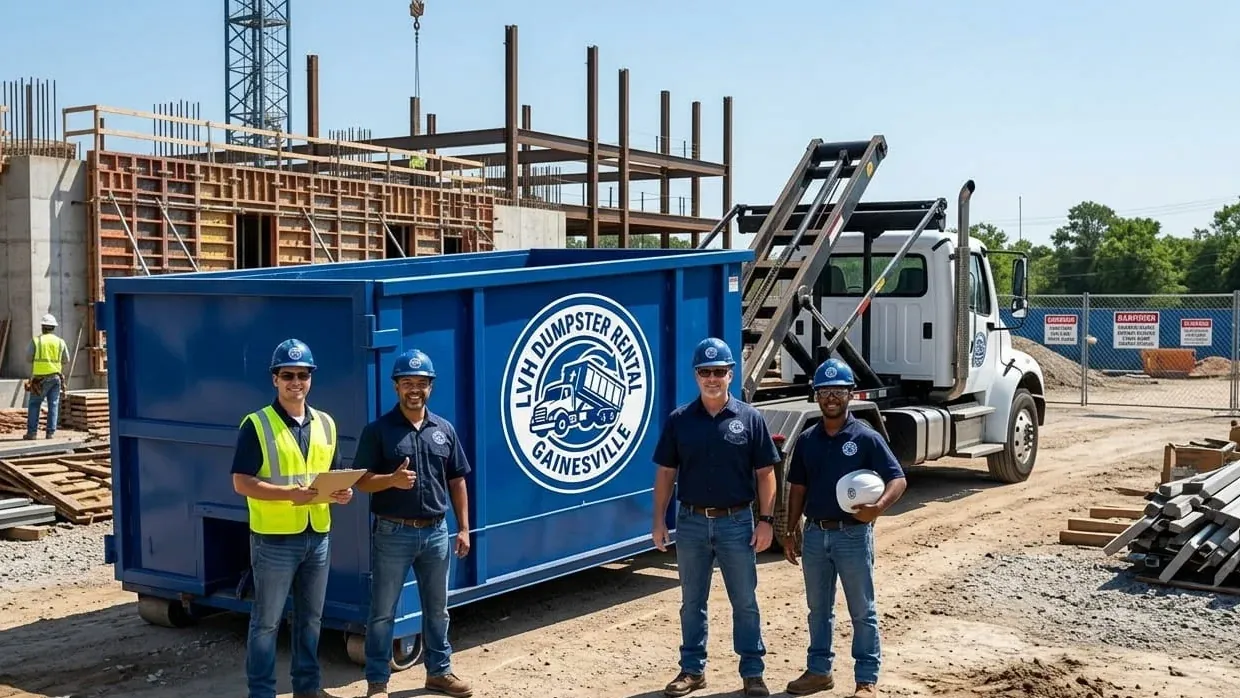
Wauka Mountain, GA · Hall County
Dumpster Rental in Wauka Mountain, GA
Roll-off containers delivered to Wauka Mountain from our Gainesville yard — north of our Northside Drive yard, up in the higher ground of north Hall County. Flat rates, driveway protection as standard, and same-day delivery when we can get a truck free.
Roll-off containers for Wauka Mountain homes and jobsites
Wauka Mountain is an area of north Hall County rather than a town. It takes its name from the mountain, and locally from the Hall County school of the same name, and there is no Wauka Mountain government of any kind. Hall County is the authority for permits, roads and disposal, and that means a completely different set of answers from anything inside a city limit.
Start with the one that matters most day to day. Hall County provides no residential curbside garbage collection at all. There is no county truck anywhere in unincorporated Hall. Households haul their own waste to one of twelve compactor sites or the county landfill, in bags of 39 gallons or less, and County Code Sec. 8.60.290 sets the terms: recyclables accepted, non-residents may bring recyclables only, no hazardous or liquid waste, no tires, no yard trimmings, no boats, no Styrofoam, no pressurized tanks, no scavenging, no fires, no out-of-county waste, businesses to the county recycling center, and commercial haulers who charge for disposal excluded outright. Nothing about a renovation or a barn clearance fits inside that.
Then there is the terrain, and it deserves accuracy rather than drama. This is the higher ground of Hall County, rolling Piedmont upland with ridges and side slopes, not a mountain valley. Gainesville itself sits at about 1,214 feet and the ground north of it rises from there. What that means practically is long driveways cut into slopes, houses set below or above the road, and daylight basements as a normal way of building rather than an unusual one. The soil is deep and well drained with better than sixty inches to bedrock, which is precisely why a basement works here. And basement stairs mean hand-carrying, which is why we would rather set a 20 close to a walkout than a 30 out at the road.
Winter is a real factor at this end of the county. Gainesville averages about 1.9 inches of snow a year on the NOAA 1991 to 2020 normals, and north Georgia gets ice. In February 2014 the National Weather Service recorded a quarter to over half an inch of ice near Atlanta and two to five inches of snow north of a Rome to Gainesville line. An ice event up here is a tree debris event and it is the reason our January and February look the way they do. The weather office for north Georgia is NWS Peachtree City on 770-486-1133.
Call (470) 691-8287 and tell us how the drive runs. That is the part that decides the delivery.
What we know about working in Wauka Mountain
Everything jurisdictional here is Hall County's. Permits come from Hall County Building Inspections at 2875 Browns Bridge Road, third floor, on 770-297-2650, and that office covers unincorporated Hall County only; it does not permit inside the city limits of Braselton, Buford, Clermont, Flowery Branch, Gainesville, Gillsville, Lula or Oakwood. Clermont's limits are not far east of here, so if your address is close to town, check. For anything in a county road right of way, call the county first. We could not find a county ordinance requiring a permit for a container in a county right of way and we are not going to claim there is none.
Burning is the north Hall conversation and it is worth having in full. Georgia EPD operates a summer open burn ban from 1 May to 30 September under Ga. Comp. R. and Regs. 391-3-1-.02(5), covering fifty-four counties including Hall, to hold down ground-level ozone. During those five months there is no outdoor burning. Between 1 October and 30 April the Hall County Fire Marshal's office issues burn permits and requires all requests through its online form. Even with a permit, the only thing you may burn is natural fallen vegetation, meaning leaves and small limbs that have fallen from the trees on your own property. The pile may be no larger than six feet by six feet. It must be at least fifty feet from structures and property lines. An adult must supervise it at all times. It may burn only between sunrise and sunset and must be completely out before dark. Not on a windy day of fifteen miles an hour or more, and not when smoke is trapped. And building materials, furniture, plastic, rubber, tires and garbage may not be burned in Hall County at any time of year. That last sentence is the one that ends the conversation about a demolition pile.
So the debris has to leave, and Georgia decides where it can go. Yard trimmings have been banned from lined municipal solid waste landfills since 1 September 1996 under O.C.G.A. Section 12-8-40.2, with the definition at Section 12-8-22(42). The county landfill at 1700 Oakbrook Drive, on 770-531-6851, rejects yard debris and bulk concrete and asphalt as well, at a published $20 minimum for up to 665 pounds and $60 a ton after, as published. Clean concrete, brick, rock and cured asphalt go to an inert facility under Rule 391-3-4-.07(4)(c). A mixed remodel load goes to a facility permitted for it. Sorting at the box is what makes the difference.
Placement is about the fire clearance and the ground. The fire clearance is the 2024 International Fire Code Section 304.3.4: five feet from combustible walls, openings and combustible roof eave lines for any container of 1.0 cubic yard or more. The ground is Cecil red clay, 35 to 70 percent clay in the subsoil, low shrink-swell, well drained, hard when dry and slick and rut-prone when wet. On a cut driveway on a slope after a wet week, that is the whole question. Mats under the rails, firmest flat ground we can reach, and an honest answer if we think the drive will not take it.
Radon is worth a line here because it comes up on every basement job in this county. Hall County is in EPA radon Zone 2, which is moderate potential, a predicted average indoor screening level between 2 and 4 picocuries per liter. That is not the high category, and EPA's own advice is that every home should be tested regardless of zone. If a test leads to a mitigation retrofit, the sub-slab work and the concrete cutting that go with it produce dense debris that belongs in a 10 rather than a big box.
- RegionHall County
- Distance from our yardNorth of our Northside Drive yard, up in the higher ground of north Hall County
- Main routesNorthside Dr north out of Gainesville and up the county
- Typical deliverySame or next day
Getting a truck to you
We run north out of Gainesville on SR 11 or US 129 and come across the county roads, or drop over on SR 60 when we have been working the lake side. It is a longer run than the mileage suggests, because the last stretch is two-lane county road climbing and falling through wooded country with drives cut into the bank on both sides. We schedule the north end of the county in blocks for that reason, and a same-day set this far up is a genuine maybe rather than a promise. On site the constraints are grade, surface and turning room. A 20 yard container wants roughly sixty feet of straight approach, about eleven feet of working width and better than twenty feet of clear overhead so the hoist can stand the box up as it comes off the rails, and on a wooded cut driveway the overhead can be the thing that stops us. Tell us how steep the drive is, whether it turns, what it is made of and what hangs over it. If the top of the drive is the only firm flat ground, we will set there and you carry the extra distance, and that is usually the right trade.
Routes we run: Northside Dr north out of Gainesville and up the county, SR 11 north for the direct run into the north Hall high ground, US 129 north through the north county crossroads, SR 60 north when we are coming across from the lake side, the north Hall county roads for the last stretch.
Landmarks and neighborhoods we work around
Local landmarks
- the Wauka Mountain area of north Hall
- the north Hall ridges and woodland
- Clermont a short run east
- Murrayville to the west
- the north arm of Lake Lanier down to the southwest
- Gainesville about twenty minutes south
Neighborhoods & communities
- the properties on the higher ground
- the acreage and woodland lots
- the roads running east toward Clermont
- the roads running west toward Murrayville
- the newer building on cut lots
- the corridor south back to Gainesville
Permits, streets and placement in Wauka Mountain
Start with the question that decides everything else: which government are you standing in. Hall County has nine municipalities and Wauka Mountain is not one of them. Wauka Mountain is unincorporated Hall County: no city hall, no city council and no city permit counter, because there is no city. The county is the building department, the zoning counter and the road authority for every address out here, and Hall County Building Inspections at 2875 Browns Bridge Road, third floor, on 770-297-2650 is the office — it handles permits for unincorporated Hall County only. If an address near you turns out to sit inside a municipal limit, and in this county those lines wander, that address gets the city’s answers instead. We check rather than assume.
Then comes the fact that reshapes everything else out here, and people who have moved in from somewhere with a weekly truck rarely believe it the first time: Hall County provides no residential curbside garbage collection at all. None. There is no county truck to compare us with. What exists instead is twelve compactor sites and the county landfill, and households haul their own. There is a quicker test than reading a map, and it sits at the end of your driveway: if nothing comes for your household garbage, you are on county ground. Then work out who owns the pavement. I-985 is an interstate and SR 365 with US 23, SR 369, SR 13, SR 11, SR 53, SR 60 and US 129 are GDOT’s. The rest — the two-lane county roads and the gravel aprons off them — is Hall County’s, under Chapter 12.20 of the county code. Give us the address and we will tell you which owner you are dealing with before we load a truck.
Now the part most of our competitors skip. On your own driveway or your own property in Wauka Mountain, we know of no Hall County permit requirement for a container, and the driveway is where we would rather put it anyway. If any part of the box will sit in a county road or the ditch line, that is county right-of-way and it is a question for the county before the truck comes. There is no City of Wauka Mountain permit desk, because there is no city. What we will not do is tell you flatly that a county road either does or does not need a permit for a container, because we did not find a published county provision that names dumpsters or roll-off containers at all — and “we could not find one” is not the same sentence as “there is none.” Call the county first. Chapter 12.40 of the county code covers driveway construction and is the right chapter for apron and culvert questions where a private drive meets a county road.
Contrast that with the city limits down the road, where it is written down and unambiguous: permission from the governing body under Sec. 4-4-2(a), each day of an unpermitted blockage a separate offense under Sec. 4-4-2(d), and Sec. 4-4-7 letting the public works director remove an intrusion at the owner’s expense. Different government, different paperwork, same truck. Either way, call Georgia 811 before anything is dug, trenched, driven or pulled.
The driveway carries one rule of its own and it is a fire rule. Georgia works from the International Fire Code, adopted by the Safety Fire Commissioner at Ga. Comp. R. & Regs. 120-3-3-.04 under O.C.G.A. §§ 25-2-13 and 25-2-14, and the state is on the 2024 edition. The edition matters, because the threshold moved. 2024 IFC § 304.3.4: a dumpster with an individual capacity of 1.0 cubic yard — 200 gallons — or more shall not be stored in buildings or placed within five feet of combustible walls, openings or combustible roof eave lines. An earlier edition set that trigger higher, and plenty of national blogs are still quoting the older figure alongside a “ten feet from the building” rule of thumb that is nobody’s code at all. In Georgia the numbers are 1.0 cubic yard and five feet, and every roll-off we run is well over the threshold. On a Wauka Mountain lot with a frame house, a deep eave and a narrow side yard, five feet is a real measurement and we take it before the rails come off the truck.
Last, the approach. To swing a box off the rails we want about 60 feet of straight, roughly 11 feet of working width and 20-plus feet of clear overhead. What fails that test in Wauka Mountain is rarely the highway; it is almost always the last hundred feet. This is rolling Piedmont upland — Gainesville sits at about 1,214 feet — so the drives run long, curve out of sight and often fall away toward a daylight basement; the surface under them is red clay that carries a loaded truck well in August and will not in February; and the overhead is a mature hardwood with an older service drop running underneath it. A spot that looks wide open at eye level can be closed at twenty feet. Walk out, look up, and tell us what you see.
Two more layers reach every job we run, and neither of them starts at a local counter. The first is what may legally go in the box, which in Georgia is a real question rather than housekeeping. Georgia EPD, a division of Georgia DNR, runs solid waste under Ga. Comp. R. & Regs. Chapter 391-3-4, and the state recognizes three separate landfill classes: municipal solid waste, construction and demolition under Rule 391-3-4-.07(4)(b), and inert under Rule 391-3-4-.07(4)(c), which is the class defined around earth and earth-like products, concrete, cured asphalt, rock, brick, yard trimmings, stumps, limbs and leaves. Which class a load belongs to decides where it may legally go, so sorting at the container changes the route and the bill rather than merely tidying the pile. Two statewide bans sit on top of that. Yard trimmings have been banned from lined municipal solid waste landfills since 1 September 1996 under O.C.G.A. § 12-8-40.2, with the definition at § 12-8-22(42). And O.C.G.A. § 12-8-40.1 caps scrap tire storage at twenty-five tires anywhere in Georgia and keeps unprocessed tires out of landfills, which is why tires never go in our containers.
The container itself is regulated too, and that is worth knowing when you are comparing quotes. EPD’s permit-by-rule at 391-3-4-.06 requires collection vehicles and containers to be covered, substantially leakproof, durable and of easily cleanable construction, with contents that must not fall, leak or spill, and all waste deposited only at permitted facilities. Hall County Code Sec. 8.60.160 says the same thing in its own words, and Sec. 8.60.150 requires haulers to number their trucks and list each truck’s weight. The tarp is a legal condition here, not a courtesy. Paint, solvents, fuel, automotive fluids, batteries and pool chemicals stay out of our containers as well: chemical, hazardous and liquid waste are prohibited at both the county landfill and the compactor sites, and we could not verify a standing year-round household hazardous waste program in Hall County, so call the landfill on 770-531-6851 before you move anything chemical anywhere.
Asbestos is the hard stop. We do not accept asbestos in our containers. In Georgia one agency does the whole job rather than two: Georgia EPD, under Chapter 391-3-14. It wants ten working days’ notice ahead of a regulated renovation or a demolition, it requires a survey for regulated asbestos containing material by an agent of a Georgia licensed abatement contractor beforehand, and the fee is ten cents per square foot plus ten cents per linear foot, minimum $25, capped at $50 for residential and small projects and $1,000 otherwise, as published. Demolition notification is required for all projects except residential structures of four or fewer dwelling units that are not part of a larger project, so a commercial building is not in the exception. The EPD duty officer is (404) 363-7026. None of that is our filing to make, but all of it sits ahead of the container and we would rather book around it than deliver into a stop-work order. The other date is 1 January 1978, which puts a job under the Renovation, Repair and Painting rule — and here Georgia is different from most of the South. Georgia runs RRP itself: EPA-authorized as the twelfth state, effective 5 July 2011, under Chapter 391-3-24, so your contractor certifies with EPD rather than with EPA, and Georgia’s version is stricter than the federal rule in places, including cleaning window troughs. In a market with this much pre-1978 housing, RRP is the default condition of a renovation rather than an edge case.
Then, before anything is dug, trenched, driven or pulled — and before anything is knocked down — call Georgia 811 on 811. That is the state’s one-call center under the Georgia Underground Facility Protection Act, O.C.G.A. Title 25, Chapter 9, and the notice period is not less than two and not more than eight business days, with the clock starting at 7 a.m. on the first business day after you file. Setting a box on a driveway does not trigger it; your project does — footings, stumps, fence posts, a septic repair. Plan the call into the week before rather than the morning of. Our permit and placement guide walks the whole sequence in order.
The ground under Wauka Mountain decides most of the rest, and it is the reverse of what a sizing chart written for a coastal market assumes. This is Cecil red clay — fine, kaolinitic, thermic Typic Kanhapludults, the dominant soil of the north Georgia Piedmont — 35 to 70 percent clay in the subsoil, well drained, with better than sixty inches to bedrock. One thing about it gets written wrong constantly. Cecil is kaolinitic rather than smectitic, and its shrink-swell potential is low. It does not heave, and the swelling-clay framing you will read in copy written for Texas or the Gulf coast does not apply here. What it does instead is simpler and more expensive. Dry, it is hard and it bears well. Wet, it is slick and it ruts — and north Georgia takes about 53 inches of rain a year spread right through the calendar, so the ground here is frequently just wet enough to matter. A loaded 20 yard box weighs several tons and puts all of it on four small contact points, which is why the driveway is the surface and the lawn is not, why plywood or timber mats go under every wheel and under both rails on every placement, all year round, and why after a wet stretch we would rather move a date than tear up two hundred feet of drive. On city ground there is a rule attached to it as well: Sec. 4-4-2(b) makes allowing dirt, silt, sediment or debris to be tracked or deposited into a city street a violation in its own right. We mat the rails and we sweep the apron.
The houses match the ground, and here is the biggest thing to unlearn if you have moved up from the coast: basements and crawlspaces are normal in north Georgia. Deep, well-drained residual soil on rolling Piedmont upland, a city sitting at about 1,214 feet, and side slopes in every direction is precisely the setting that makes a daylight basement practical, and this county builds that way. So a cleanout here is a basement and an attic before it is anything else, and that changes the container rather than just the price: stairs mean hand-carrying, and a smaller box parked close to the walkout is worth more than a bigger one parked out of the way. North Georgia also has a real winter, which the lower half of the state does not. IRC R403.1.4 puts footings at least twelve inches below undisturbed grade and below the frost depth the local building official establishes — and we will not print an inch figure for Hall County, because we could not find a published one. One adjacent question comes up often enough while a house is open to answer here: Hall County is EPA radon Zone 2, moderate, a predicted average indoor screening level between 2 and 4 pCi/L. That is moderate potential rather than high, and EPA recommends testing every home regardless of zone.
The vintage is the part that surprises people who only know this county from the interstate. Green Street was built out from about 1880; the mill villages at New Holland and Chicopee — Chicopee designed in 1925 and built from 1927 — are older than most of what surrounds them; and a good deal of downtown is 1936 to 1938 reconstruction. All of that sits a long way the wrong side of the 1978 lead paint line, which is why RRP is the normal condition of a renovation here. Around that older core, the Census Bureau puts Hall County’s growth at roughly 23,400 more people between the 2020 census and the July 2025 estimate, with new subdivisions going up to match. And one more number worth carrying: Hall County is 68.6 percent owner-occupied while the City of Gainesville is only 39.2 percent. Those are two different customer sets on two sides of one line — homeowners clearing a basement on one side, landlords and property managers turning a unit on the other — and the container that suits one street often will not suit the next one over.
There is a third landowner in this service area, and it is the federal government. Lake Sidney Lanier is not a natural lake. It is a US Army Corps of Engineers reservoir: Buford Dam is an earth-fill dam 192 feet high and 1,630 feet long, the sluice gates closed on 1 February 1956 and the powerhouse came online in June 1957. At full pool, elevation 1,071 feet, the lake covers 39,038 acres with roughly 693 miles of shoreline — and the Corps owns most of the land around it outright, in fee title: about 56,782 acres across something like 760 miles of boundary line. On a great many lots sold as lakefront, the private property line stops well above the water. The Lake Lanier Shoreline Management Plan requires Corps authorization for a list broader than people expect — vegetation removal, land formation modification, mowing and general lawn care, chemical application, fires, and excavation or silt removal — under the 2004 plan, 36 C.F.R. Part 327 and Division Regulation 1130-15-1. Shoreline allocations run Limited Development 47 percent, Protected Shoreline 31.9 percent, Public Recreation 20.8 percent and Prohibited Access 0.2 percent. We will not tell you whether your particular job needs authorization, because that is not ours to say. The Lake Lanier Project Management Office help desk is (770) 904-3262, and it is worth knowing that shoreline management is the Corps’ Mobile District while Section 404 and Section 408 regulatory permits go to the Savannah District. Two districts, one lake. What we will commit to is where a container goes: on your own ground, up the drive, well clear of the boundary, and never on Corps property.
Weather here is nothing like the Georgia coast, and it is worth being precise about. Hall County is better than 250 miles from the Georgia coast and has no coastline of its own, so water pushed inland off the ocean is not a hazard at a Wauka Mountain address and never has been. What we get instead is severe weather and ice. Gainesville, Georgia appears twice on NOAA’s list of the twenty-five deadliest tornadoes in United States history — 6 April 1936, 203 deaths, the fifth deadliest in the country, and 1 June 1903, 98 deaths, ranked seventeenth, both per the NOAA Storm Prediction Center. We state that plainly because it explains the building stock downtown and because it is part of what this town is, and then we leave it there. Day to day the drivers are smaller. Gainesville averages about 1.9 inches of snow a year on the NOAA normals, and north Georgia gets genuine ice: in February 2014 the weather service recorded a quarter to over half an inch of ice near Atlanta and two to five inches of snow north of a Rome to Gainesville line. Then there is the rain field of a decayed tropical system, which is what put seven to eight inches of rain over Hall County from Helene in September 2024 according to the National Weather Service office at Peachtree City, (770) 486-1133. An ice event is a tree debris event, a wet week is a rutted driveway, and an open container left uncovered through a heavy afternoon fills with water, which is weight you pay us to haul. Tarp it, or ask us for one.
Where all of it ends up is the local detail we like best, because in Hall County four separate rules close every route except the one we sell, and every one of them is written down. Georgia EPD runs a summer open burn ban from 1 May to 30 September under Ga. Comp. R. & Regs. 391-3-1-.02(5), covering fifty-four counties including Hall — no outdoor burning at all for those five months. In the open season, 1 October to 30 April, the Hall County Fire Marshal issues permits through the county’s online form, and even then only natural fallen leaves and small limbs from your own property qualify, in a pile no bigger than six feet by six feet, at least fifty feet from structures and property lines, adult present, sunrise to sunset, completely out before dark, not on a windy day. And building materials, furniture, plastic, rubber, tires and garbage may not be burned in Hall County at any time of year. Add the rest and the squeeze is complete: Georgia bans yard trimmings from lined municipal landfills under O.C.G.A. § 12-8-40.2, the compactor sites exclude commercial haulers who charge for disposal under County Code Sec. 8.60.290, and inside the city Sec. 4-3-9 says the city will not collect it. You cannot burn it, you cannot bury green waste in a municipal landfill, you cannot take job debris to a compactor site, and the city will not pick it up. That is the whole argument for a container, and it is not our argument. It is theirs.
Collection in Wauka Mountain is Hall County’s, and the shortest true description of it is that there is none. The county provides no residential curbside garbage collection at all. Its solid waste division moves roughly 350 tons a day through the landfill and twelve compactor sites, and households haul their own waste to them. County Code Sec. 8.60.290 sets the terms at those sites, and they are worth reading before you plan anything: household garbage in sturdy paper or plastic bags of 39 gallon maximum capacity, securely closed, plus recyclables; non-residents may bring recyclables only; hazardous waste, liquid waste, septic tank pumpings, tires, yard trimmings, boats, Styrofoam, pressurized tanks and mobile homes are prohibited; no scavenging, no fires and no out-of-county waste; businesses must use the county recycling center; and commercial haulers who charge for garbage disposal are excluded from the sites outright. The annual compactor fee for unincorporated residences is assessed on the ad valorem tax bill. A bathroom, a roof tear-off, a basement or a barn does not fit in a 39 gallon bag, and we are not allowed through the gate with it either. That, in one paragraph, is why a container exists out here.
The landfill is the other half of the system and it has exclusions of its own. 1700 Oakbrook Drive, on 770-531-6851, Monday to Friday 8 a.m. to 4 p.m. and Saturday 8 a.m. to 2 p.m., closed Sunday and major holidays, with published tipping at a $20 minimum covering up to 665 pounds and $60 a ton beyond, as published, plus published specialty fees on items such as tires, paint and mattresses. It will not take yard debris including trees, stumps, leaves and grass clippings, bulk Styrofoam, bulk concrete and asphalt, pressurized tanks, chemical, hazardous or liquid waste, mobile homes or boats. Set that list beside a demolition scope and you can see why the sorting happens at the container rather than at the gate. The Hall County Recycling Center at 1008 Chestnut Street SE, on 770-535-8284, is staffed weekdays 7:30 to 4 with the drop-off area available around the clock, and County Code Sec. 8.60.190 requires recovery of recyclable corrugated cardboard, which for a business out here is an ordinance obligation rather than a courtesy.
Sizes we deliver to Wauka Mountain
10 Yard Dumpster
Concrete, block, brick and soaked debris — the box that reaches payload before it looks full.
View this size → 15yd³15 Yard Dumpster
A single room, a small tear-off, or a garage cleared to the walls.
View this size → 20yd³20 Yard Dumpster
A whole-house declutter — the Gainesville default — or a multi-room remodel.
View this size → 30yd³30 Yard Dumpster
A large remodel, a basement strip-out or a full estate cleanout.
View this size → 40yd³40 Yard Dumpster
Commercial gut jobs and construction — it needs the most room to set down.
View this size →Delivering to Wauka Mountain today
Call before nine and we can usually get a container to Wauka Mountain the same afternoon. On the far end of the county we will tell you honestly if tomorrow morning is the better booking.
(470) 691-8287Popular in Wauka Mountain
Services in Wauka Mountain
What we haul in and out of Wauka Mountain
Junk Removal Dumpsters
Clear a basement, attic, garage or outbuilding on your own schedule.
Learn more →Estate Cleanout Dumpsters
Discreet, patient container service for families clearing a lifelong home.
Learn more →Residential Dumpster Rental
Driveway placement for the basement, attic and garage cleanouts a north Georgia house produces.
Learn more →Yard Waste & Brush Removal
Clean separate loads — Georgia bans yard trimmings from lined municipal solid waste landfills.
Learn more →Roofing Dumpster Rental
Weight-rated cans sized by squares and layers, tarped between sessions.
Learn more →Roll-Off Dumpster Rental
10, 15, 20, 30 and 40 yard roll-offs across Gainesville and Hall County.
Learn more →How it works
Delivering to Wauka Mountain in four steps
- 1
Call us
Tell us the project, your address and when you want it. Two minutes on the phone and you have a flat price.
- 2
We deliver
Our driver walks the drop, lays protection boards and sets the container exactly where you want it.
- 3
You load it
Take your time within your rental window. Keep it level with the top rail and we handle the rest.
- 4
We haul it
Call or text when you are done. We pull it, sort what can be recovered and dispose of the rest properly.
Dumpster Rental in Wauka Mountain — FAQs
Is Wauka Mountain its own town?
No. It is an area of north Hall County named for the mountain, and locally for the Hall County school, rather than an incorporated place. There is no Wauka Mountain government and no municipal permit desk. Hall County is the authority: Building Inspections on 770-297-2650 for permits, the county solid waste division for disposal, and the county for anything touching a county road. Clermont's town limits are not far east, so if you are close to town tell us the street and we will check which side you are on.
Can I burn a demolition pile up here?
No, and not at any time of year. Hall County prohibits burning building materials, furniture, plastic, rubber, tires and garbage year round. On top of that, Georgia EPD's summer open burn ban stops all outdoor burning in Hall County from 1 May to 30 September. In the open season, a Hall County Fire Marshal permit through the county's online form covers only natural fallen leaves and small limbs from your own property, in a pile no bigger than six by six, fifty feet from structures, adult present, out before dark. For a demolition the container is the legal route.
We are finishing a basement. What size and what should I know?
A 20 usually, parked as close to the walkout as the fire clearance allows, because the carry is the work rather than the volume. If you are taking out a slab or block, add a 10 for the heavy fraction. Hall County is in EPA radon Zone 2, moderate potential, and EPA recommends testing every home regardless of zone, which is worth doing before you finish the space rather than after. The basement guide runs through the sequence.
What happens up here after an ice storm?
Downed limbs, split hardwoods and damaged fencing, usually spread over a lot of ground. Gainesville averages about 1.9 inches of snow a year, and in February 2014 the National Weather Service recorded a quarter to over half an inch of ice near Atlanta and two to five inches of snow north of a Rome to Gainesville line. Woody storm debris is a clean load, because Georgia's yard trimmings ban keeps it out of a lined municipal landfill. Keep it separate from anything else and it has somewhere legal to go. NWS Peachtree City is on 770-486-1133.
How steep is too steep for a delivery?
It depends on the surface as much as the angle. A dry, well-compacted drive on a moderate grade is fine. The same drive on wet Cecil clay is not, because a loaded roll-off truck is heavy and clay gets slick rather than swelling. We mat under the rails, we set on the firmest flat ground we can reach, and we would rather put the box at the top of the drive than damage two hundred feet of it. Send a photo of the approach when you book on (470) 691-8287 and we will tell you before the truck leaves.
How quickly can you deliver a dumpster to Wauka Mountain?
Wauka Mountain is north of our Northside Drive yard, up in the higher ground of north Hall County, so it is a run we make regularly. Same-day delivery is usually possible if you call before nine, and next morning otherwise. The far end of Hall County is a longer trip and we schedule it in blocks, so out there a same-day set is an honest maybe rather than a promise. An ice or snow morning in January can take a route out for a day, and so can the week after a spring severe weather outbreak, when half the county opens a wet basement at the same time. We will tell you the truth about the day when you call.
Do you charge extra to deliver to Wauka Mountain?
No. Wauka Mountain sits inside our standard service area and the flat rate is the same as it is in Gainesville. Delivery, pickup, your rental window and disposal up to the agreed tonnage are all included in the number we quote you.
What size dumpster do most Wauka Mountain customers take?
A 20 yard is the most common by a wide margin — it suits a basement-and-attic clear-out, a multi-room remodel or a straightforward roof, which is where most of the volume in this market actually lives. But if you are stripping a roof with two layers on it, breaking out a front walk or a set of steps, or hauling out soaked debris after a storm, size DOWN to a 10 yard heavy container and take two hauls — that material reaches the weight limit long before it fills the box. Keep clean woody debris in a load of its own as well, because Georgia’s yard trimmings ban means a mixed load loses you the cheaper legal route.
Nearby
Towns we serve around Wauka Mountain
Talk to a real person
Need a dumpster in Wauka Mountain?
Tell us the job and the address and we will size it, price it flat and get a truck out. We run to Wauka Mountain most days, so a same-day slot is often available.
Wauka Mountain, GA · Hall County · delivered from 344 Northside Dr, Gainesville, GA 30501