Permits
Dumpster Permits and Placement Rules in Gainesville, GA
Private property placement is usually just a delivery. The street is not. Here is what Gainesville Sec. 4-4-2, the 2024 fire code and Georgia 811 require before a container is set.
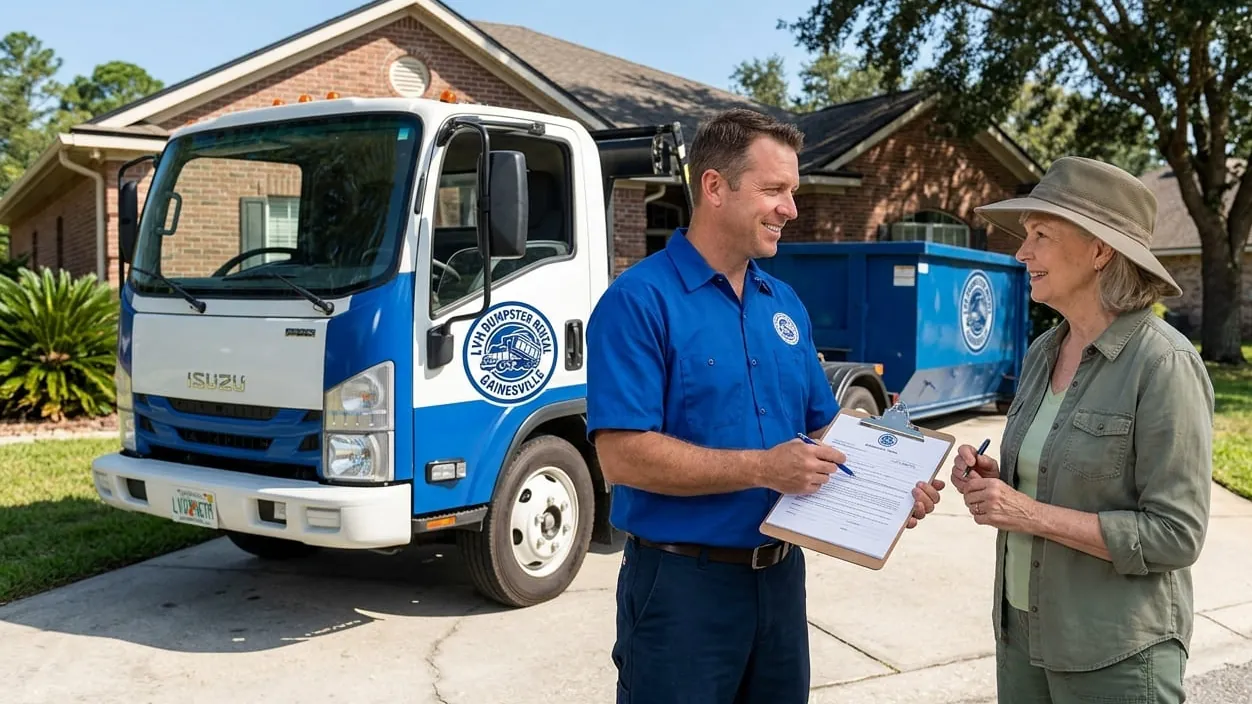
The question comes in almost every week. Do I need a permit for a dumpster in Gainesville? The short answer is that it depends entirely on where the box sits, and the line that matters is the edge of your property, not the edge of your driveway.
Below is what the city code, the state fire code and the state dig law actually say, with the section numbers, so you can check any of it yourself.
On private property, the code assumes you are fine
We found no City of Gainesville or Hall County ordinance requiring a permit to place a roll-off container entirely on private property. The city's own solid waste ordinance points the same direction from the other side. Sec. 4-3-4 provides that commercial containers must remain on private property unless the governing body grants permission to place them in public alleys, streets or sidewalks.
An ordinance written that way presumes private placement is the normal case. So a container on your own driveway, on your own parking lot, or on a job site behind the property line is ordinarily just a delivery.
Two caveats. If you are in a historic overlay district, a homeowners association, or a leased commercial property, there may be private restrictions that have nothing to do with the city. And on a multifamily, condominium or commercial project there is a separate step described further down.
The historic district point deserves a sentence of its own, because Gainesville has real ones. Inside a city historic preservation overlay, a certificate of appropriateness comes before exterior work, and that process covers demolition and relocation as well as additions and new construction. That is a project approval rather than a container approval, but the sequence matters: the certificate clears, then the building permit, then the demolition, then the box. Homeowners who reverse that order end up paying for a container to sit idle in a driveway.
In the street, you need permission from the governing body
City of Gainesville Code Sec. 4-4-2(a) is direct about it. No person shall block, flood or otherwise interfere with or impair the use of any public street, road or thoroughfare in the city without first having secured permission from the governing body.
A roll-off container sitting in a travel lane, in a parking lane, or across a sidewalk is an obstruction of a public way. That is permission from the governing body, sought in advance, not a form you fill out afterward.
Sec. 4-4-2(c) adds a wrinkle that is worth knowing before you point a driver at the curb. Anyone who gives or transmits an order or instruction to block or impair a street without permission is themselves guilty of a violation. That reaches the person directing the placement, not only the person driving the truck.
An old citation you will still find online
Search engines still surface a Gainesville code node labeled as an obstruction section under Chapter 4-4. In the current code that section is reserved. Cite Sec. 4-4-2 for blocking a street. If you are relying on a code link you saved a few years ago, pull it again, because the node identifiers changed between supplements and old bookmarks fail.
Each day is a separate offense
Sec. 4-4-2(d) is the part that turns a small oversight into a real problem. Each day that any such street, road or thoroughfare is blocked is a separate and distinct offense, punishable under the general penalty provision at Sec. 1-1-8.
A container left in a Gainesville street without permission does not accrue one violation that you settle at the end. It accrues a fresh violation every day it sits there. On a two week renovation, that arithmetic gets uncomfortable quickly.
Which is why, on a tight downtown lot or a narrow Green Street frontage, the conversation about placement needs to happen before the truck is dispatched rather than while it idles at the curb. If the only workable spot is in the public way, the permission comes first.
Mud on a city street is its own violation
This one is specific to red clay country and it catches contractors from flatter, sandier places. Sec. 4-4-2(b) provides that no person shall interfere with or impair the use of a public street by allowing dirt, silt, sediment or debris to be tracked or deposited into that street from a parcel within the city.
Cecil clay is the dominant soil across Hall County, running 35 to 70 percent clay through the subsoil. It has low shrink-swell, so it is not the kind of clay that moves a foundation, but it is slick when wet and it ruts under load, and it rides out to the road on tires in a way sand never does. North Georgia gets about 53 inches of rain a year spread across the calendar, so the ground is often just wet enough to make a mess.
- Set the container on the driveway, on plywood or timber mats under the rails.
- Keep truck traffic off a saturated lawn, especially in February.
- Put down a stone or gravel approach on a job site with any real traffic.
- Sweep or scrape the apron before the mud dries into the pavement.
Erosion is the regulated concern in the Piedmont, not swelling. More on setting a box without damage is in our guide to driveway protection on delivery day.
Five feet from the building, and the number is real
Georgia adopts the International Fire Code, 2024 edition, through the Safety Fire Commissioner at Ga. Comp. R. & Regs. 120-3-3-.04, under the authority of O.C.G.A. §§ 25-2-13 and 25-2-14.
Section 304.3.4 of that code is the one that governs a container on your driveway. Dumpsters with an individual capacity of 1.0 cubic yard, which is 200 gallons, or more are not to be stored in buildings or placed within five feet of combustible walls, openings or combustible roof eave lines, unless they are of noncombustible or low heat release construction. There are exceptions for areas protected by an approved automatic sprinkler system and for certain construction types set well away from other buildings.
Every roll-off container is far past 1.0 cubic yard. So the practical rule on a residential job is five feet of clearance from siding, from a door or window, and from the eave line above. On a narrow driveway running alongside a house, that clearance sometimes decides which size container can be delivered at all. Say so when you call and we will bring a box that fits the gap.
Georgia 811 before anybody digs
Setting a container is not excavation. But most of the projects that need a container involve some digging, and Georgia's dig law is not the one you may have used in another state.
The one-call center here is Georgia 811. The governing statute is the Georgia Underground Facility Protection Act, at O.C.G.A. Title 25, Chapter 9.
- The notice window is not less than two and not more than eight business days before excavation.
- The clock starts at 7:00 a.m. on the first business day following your locate request.
- Weekends and holidays do not count toward business days.
- The ticket has a life. Plan the work inside the window rather than at the far edge of it.
Call it early. On a demolition, a footing, a fence line, a French drain around a basement wall or a septic repair, the locate is the thing that sets the schedule, and a container booked for Monday does no good if the marks are not down until Thursday.
Two jurisdictions, two different instruments
This part is about the companies, not about you, but it explains why the answer to a simple question changes across a city line.
Inside the city, Gainesville Code Sec. 4-3-4 provides that no individual, partnership, corporation or commercial hauler may collect and dispose of solid waste for a fee within the city without obtaining a franchise from the city's governing authority. Franchises granted by the city are nontransferable, and violations can bring suspension or revocation.
In unincorporated Hall County the instrument is different. County Code Sec. 8.60.140 requires that all sanitary contractors obtain business licenses from the county.
Two jurisdictions, two separate mechanisms, one activity. A franchise is not a license and a license is not a franchise. If you are engaging a hauler for a project inside the city limits and you want to satisfy yourself about their standing, the City of Gainesville public works department is the office that maintains that information, and the county is the office for unincorporated addresses.
Commercial and multifamily projects have a permit gate
Sec. 4-3-10 is short and it has teeth. The city shall not issue a building permit for a multifamily dwelling, condominium or commercial establishment until the public works director or a designee gives approval to the proposed plans for the storage and disposal of solid waste.
That means the waste plan is a predecessor to the building permit, not a detail to sort out during construction. Container locations, screening, access for a truck and the service pattern all belong in the drawings. Bring it up early with your design team and it is routine.
Lake Lanier lots and the federal property line
On a lakefront property there is a fourth jurisdiction, and it is the one people forget. The US Army Corps of Engineers owns the Lake Lanier shoreline in fee title, roughly 56,782 acres over about 760 miles of boundary. Your deed does not run to the water.
The Lake Lanier Shoreline Management Plan, adopted in 2004, together with 36 C.F.R. Part 327 and Division Regulation 1130-15-1, requires Corps authorization for activities including vegetation removal, land formation modification, mowing and general lawn care, chemical application, fires, and excavation or silt removal. Those are ordinary yard activities on an ordinary Saturday, and on Corps land they are regulated.
We will not tell you whether your particular job needs an authorization, because that is the Corps' call and not ours. What we will tell you is who to ask. The Lake Lanier Project Management Office help desk is (770) 904-3262. Shoreline management for Lanier runs through the Mobile District, while Section 404 and Section 408 regulatory permits are handled by the Savannah District. Before a container goes anywhere near the back of a lakefront lot, somebody needs to know where the federal boundary runs. There is more in our guide to Lake Lanier property cleanouts.
The short version
- Private property, entirely on your own ground: ordinarily no city permit.
- Any part of the container in a street, alley or sidewalk: permission from the governing body first, under Sec. 4-4-2(a), and every day without it is a separate offense.
- Keep the clay off the pavement. Sec. 4-4-2(b) makes tracked sediment a violation on its own.
- Five feet from combustible walls, openings and eave lines, under 2024 IFC Section 304.3.4.
- If anyone is digging, Georgia 811 first, two to eight business days out.
- Multifamily, condominium or commercial: the solid waste plan clears before the building permit issues.
- On the lake, the shoreline is federal. Call the Corps office, not us.
Tell us the address and what the site looks like and we will tell you which of those apply. Call (470) 691-8287, look over our roll-off dumpster rental service, or find the yard through our contact page.
Questions this guide did not answer? Call (470) 691-8287. We would rather spend two minutes on the phone than have you order the wrong container.