
Residential
Residential Dumpster Rental in Gainesville, GA
Houses here have basements, crawlspaces and attics, so the job is usually below the floor or above the ceiling rather than out in the garage. Hall County is 68.6 percent owner-occupied and the City of Gainesville is 39.2 percent, which means two different jobs on two sides of the same city limit line.
Start with the thing that decides most house jobs in Hall County: these houses have a downstairs. Gainesville sits at about 1,214 feet on rolling Piedmont upland, and the dominant soil across the county is the Cecil series — deep, well drained residuum running more than sixty inches to bedrock. Deep soil on a side slope is exactly the ground that produces a daylight basement, and north Georgia has been building them for a century. Where there is no basement there is usually a crawlspace. Georgia’s residential code carries full provisions for basement walls, basement wall drainage and crawlspace ventilation, and the footing rule at IRC R403.1.4 puts exterior footings at least twelve inches below undisturbed grade and below whatever frost depth the local building official has established. So the clear-out that matters here is not the garage. It is the basement, the crawlspace and the attic, and all three of them mean carrying material up or down a stair before it ever reaches the container.
The second thing that decides the job is which side of the city limit line you are on, because the two markets are genuinely different. Hall County is 68.6 percent owner-occupied. The City of Gainesville is 39.2 percent, with a median gross rent of $1,299 as published by the Census Bureau. That single pair of numbers explains most of what we see. County work is owner work: a homeowner finally emptying a basement that has been filling since the eighties, a kitchen going out, a deck coming off the back of a lake-side house. City work skews toward landlords, property managers and turnover — a unit stripped between tenants, carpet and blinds and a range out in an afternoon. Both are residential jobs. They want different sizes, different schedules and different answers about who is responsible for the debris, and the City ordinance actually settles that last question in writing.
Inside the city limits you do get collection, and it is worth knowing precisely where it stops. City Code Sec. 4-3-5 provides once-weekly collection of garbage, refuse, recyclables and yard trimmings. The practical limit is one city-supplied 96-gallon rolling cart, out by 7 a.m., at the curb or the end of the drive or within ten feet of the house, and crews do not enter a residence. A second cart runs $25 a month as published, and Solid Waste takes calls on (770) 532-0493. Then comes Sec. 4-3-9, which lists what the city will not collect: discarded building materials, dirt, broken concrete, bricks, rock or debris; sinks, tubs, shower stalls and toilets; cabinets, doors, windows, roofing debris, lumber and siding; landscape timbers, crossties, carpet and floor coverings. The City wrote our job description into its own ordinance — everything on that list is what goes in our containers. Crossties and landscape timbers are on it too, and we take them — tell us when treated timber is in the load, because it has to go to a facility permitted to receive it rather than to an inert site. Read the City of Gainesville solid waste pages and you will find the same line.
Outside the city limits the answer is blunter still. Hall County provides no residential curbside garbage collection at all. What exists instead is twelve compactor sites and the county landfill, and residents haul their own household waste to them. The compactor sites take bagged household garbage in bags of 39 gallons or less, securely closed, plus recyclables; they prohibit yard trimmings, tires, liquids, hazardous waste and pressurized tanks; and commercial haulers who charge for disposal are excluded from them outright. The landfill at 1700 Oakbrook Drive is open Monday to Friday 8 a.m. to 4 p.m. and Saturday 8 a.m. to 2 p.m., closed Sunday, on a $20 minimum covering up to 665 pounds and $60 a ton over that, as published. It will not take yard debris or bulk concrete and asphalt. If you live in unincorporated Hall and you are clearing a basement, there is no version of this where a rolling cart is the answer. The Hall County solid waste pages set all of it out.
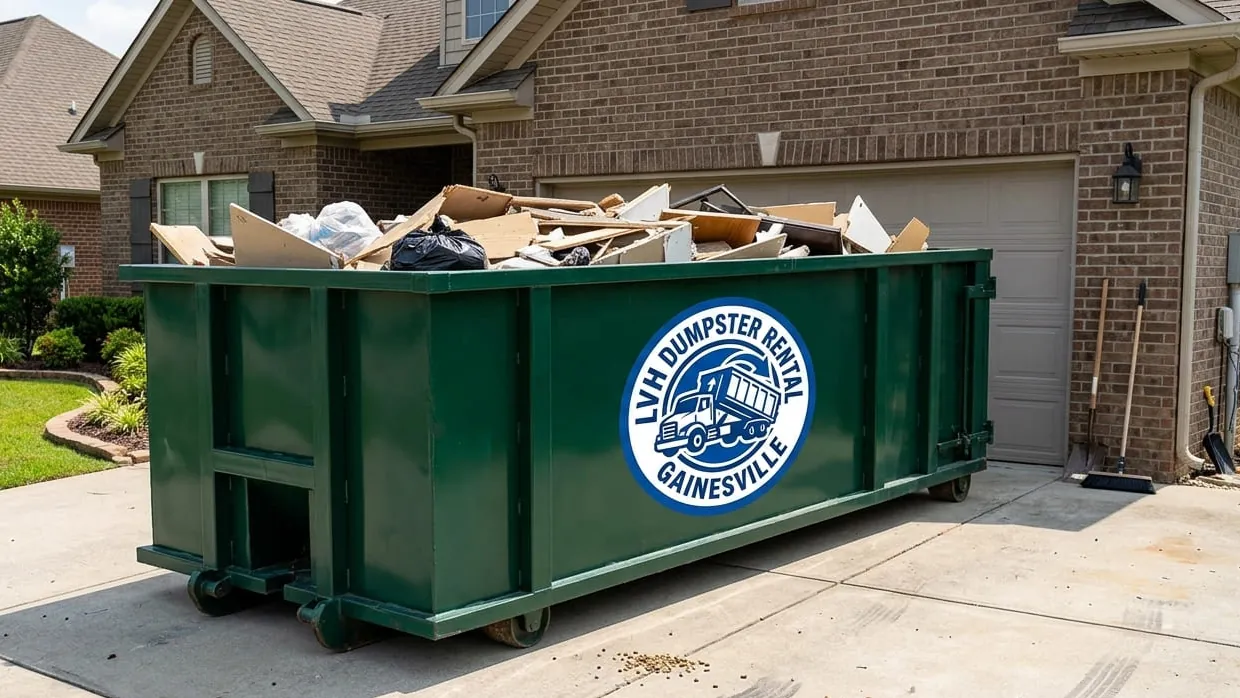
Sizing follows the material and the stair, not the square footage of the house. The 20 yard is the Gainesville default because the default job here is a basement and attic cleared together or a multi-room remodel, and that debris builds volume long before it builds weight. A 15 yard covers one bounded room or a single basement bay. The 10 yard is the weight box — block, brick, broken concrete, mortar, tile set in a bed, and wet clay spoil. A 30 yard is for a house going out completely. Where it sits is the other half of the decision. Wholly on your own driveway is ordinary; the City’s own code presumes private-property placement. In the street is different, and under Sec. 4-4-2 that needs permission from the governing body first. Our Gainesville permit guide works through both.
What Gainesville Households Actually Clear Out
Basement And Daylight-Basement Clear-Out
The big one in this market. Thirty years of storage, a dead chest freezer, shelving, paneling off the walls and the carpet that went down over the slab in 1994. Set the box near the walkout and the carry stops being a stair carry.
Crawlspace Cleanout
Old batt insulation, vapor barrier, ductwork, abandoned pipe and whatever got pushed under there decades ago. Awkward, filthy, light per piece and slow to move, which usually means a smaller container and a longer rental.
Attic And Upper-Floor Cleanout
Boxes, blown-in insulation bags, an old window unit and the furniture that went up when somebody moved out. Everything comes down a pull-down ladder one armful at a time, so plan the container for the pace of the carry.
Kitchen Rip-Out
Cabinets, counters, a wall oven, sheet vinyl and the soffit above the wall run. In a house built before 1978 this is lead-safe work under Georgia’s own RRP rule, so the container schedule follows the contractor’s containment schedule.
Bathroom Strip-Out
Vanity, tub, toilet, surround and floor tile. Sec. 4-3-9 names tubs and toilets as items the city will not collect, which is exactly why a bathroom ends up in a container. The tile bed is the weight.
Flooring And Carpet Replacement
Carpet and pad, laminate, glued-down vinyl and tack strip. Carpet rolls eat far more room than anyone expects, so count rooms, roll tight and load them flat rather than standing them on end.
Deck, Porch And Outbuilding Tear-Off
Pressure-treated decking, joists, railing, lattice and the storage building at the back of the lot. Landscape timbers and crossties are on the city’s exclusion list too, so they ride with the rest of it.
Rental Turnover And Between-Tenant Cleanup
The city is a majority-renter market. Sec. 4-3-9 puts between-tenant cleanup waste on the landlord and requires post-eviction items to be removed within 24 hours or the city removes them at the owner’s cost. A container on site beats a deadline.
Sizing A Container For A Gainesville House
Work from the material first. A 10 yard is the weight box: block, brick, broken concrete, mortar, tile set in a bed, and wet red clay spoil out of a basement dig-out. It reaches a lawful payload while the sides are still plainly visible, and that is the container working correctly rather than the container being too small. A 15 yard covers one bounded job — a bathroom, a kitchen, one basement bay emptied properly. A 20 yard is the Gainesville default, because the default job here is a basement and an attic cleared in the same week or a multi-room remodel. A 30 yard is a whole house going out, which in the older city stock is often an estate cleanout after a long tenure. A 40 yard is airy bulk only and it wants the most room on the lot. Dimensions are on the container sizes page, and our sizing guide walks the common Hall County jobs. Or describe the pile on the phone and we will tell you which box it wants.
10 Yard Dumpster
Concrete, block, brick and soaked debris — the box that reaches payload before it looks full.
View this size →15yd³15 Yard Dumpster
A single room, a small tear-off, or a garage cleared to the walls.
View this size →20yd³20 Yard Dumpster
A whole-house declutter — the Gainesville default — or a multi-room remodel.
View this size →Red Clay, Driveways And Where The Box Goes
The ground here is Cecil red clay, 35 to 70 percent clay through the subsoil, and it behaves in two completely different ways depending on the week. Dry, it is hard and it carries a loaded container without complaint. Wet, it is slick and it ruts, and a loaded box on a saturated lawn will sink, smear and leave marks that outlast the remodel. Cecil is a low shrink-swell soil, so this is not a heaving problem — it is a bearing and traction problem, and it is worst from December through March. So: plywood or timber mats under the rails on every placement, hard surface rather than grass, and no lawn sets after rain. There is a code edge to it as well. City Code Sec. 4-4-2(b) makes it a violation to allow dirt, silt, sediment or debris to be tracked or deposited into a city street from a parcel, which is the same mud a truck picks up backing off a clay drive. The truck itself wants roughly 60 feet of straight approach, about ten and a half feet of working width and 20 feet of overhead clearance for the hoist, and on these long sloping driveways down to a basement walkout the pinch is usually a hardwood limb or a service drop. One more number: under the 2024 International Fire Code § 304.3.4, which Georgia adopts, a container of 1.0 cubic yard or more must not sit within five feet of combustible walls, openings or combustible roof eave lines. Every roll-off we run is over that threshold. We keep the five feet.
Not sure this is the right service? Describe the job on the phone and we will point you at the right container even if it is a different service page. Call (470) 691-8287.
Get a flat quote
Two minutes on the phone gets you a size, a price and a delivery slot. No forms.
(470) 691-8287Recommended sizes
How it works
Residential Dumpster Rental in four steps
- 1
Call us
Tell us the project, your address and when you want it. Two minutes on the phone and you have a flat price.
- 2
We deliver
Our driver walks the drop, lays protection boards and sets the container exactly where you want it.
- 3
You load it
Take your time within your rental window. Keep it level with the top rail and we handle the rest.
- 4
We haul it
Call or text when you are done. We pull it, sort what can be recovered and dispose of the rest properly.
Residential Dumpster Rental FAQs
Do I need a permit to put one on my driveway?
Nothing we have found in the City of Gainesville code or the Hall County code requires a permit for a container placed wholly on private property, and the city’s own Sec. 4-3-4 presumes private placement when it says commercial containers must remain on private property unless the governing body grants permission for a public alley, street or sidewalk. That is not a blanket yes: a subdivision covenant, a lakefront community’s rules or a landlord’s consent can still apply, and those are not public records. If any part of the container will sit in the street, Sec. 4-4-2(a) requires permission from the governing body first, and under Sec. 4-4-2(d) each day it sits there without permission is a separate offense. Our permit guide lays out the whole picture.
Everything is in the basement. Does that change the container?
It changes where we set it more than what size you take. A stair carry sets the pace of the job, so the useful move is to put the container as close to the walkout, the bulkhead or the garage-level door as the driveway allows, and to face the tailgate at it. That turns a stair carry into a short flat carry for the second half of every load. It also argues for the 15 or the 20 over the 30, because a container you fill in four days at the speed of a basement stair is better than a bigger one standing open for two weeks. Tell us which opening the pile is coming out of when you book and we will set it to face that door.
Will the city just pick up my remodel debris?
No, and the ordinance is unusually specific about it. Sec. 4-3-9 excludes discarded building materials, dirt, broken concrete, bricks, rock or debris, plus sinks, tubs, shower stalls, toilets, cabinets, doors, windows, roofing debris, lumber, siding, landscape timbers, crossties, carpet and floor coverings — and says those are the responsibility of contractors, tenants or property owners. Appliances and oversized refuse are collectable only as special pickups subject to a service charge under Sec. 4-3-8. And if you are outside the city limits, Hall County has no residential curbside collection at all, so there is nothing to leave at the road in the first place.
My house is from the 1950s. Is there anything I should know before the work starts?
Two things, and both are Georgia programs rather than federal ones. If the house was built before 1978 and the work will disturb painted surfaces, the Renovation, Repair and Painting rule applies, and in Georgia that rule is run by the Environmental Protection Division under Ga. Comp. R. & Regs. Chapter 391-3-24. Georgia has been authorized to run it since 5 July 2011 — the twelfth state — so your contractor certifies with Georgia EPD, not with EPA, and Georgia’s version is stricter than the federal one. Second, if the job disturbs asbestos-containing material, EPD wants ten working days’ notice and a RACM survey first. The EPD duty officer is (404) 363-7026. Neither is our department, but both change your schedule.
How long can I keep the container?
As long as the job honestly needs it on private ground. Call the yard on (470) 691-8287 when you want it collected and we will fit it into the route rather than hold you to a fixed day. Two things are worth watching in north Georgia. Keep it covered: the county averages about 53 inches of rain a year spread right through the calendar, and water is weight you pay to haul. And watch the calendar in winter — an ice event can take a delivery route out for a day or two here, which is not something south Georgia has to plan around. If the container is in the street rather than on your own property, that permission is a separate matter under Sec. 4-4-2.
More services
Other things we haul
Commercial Dumpster Rental
Containers for businesses and contractors — Hall County runs no curbside collection at all.
Learn more →Construction Dumpster Rental
Mixed C&D in one roll-off, with next-day swap-outs across Hall County.
Learn more →Roofing Dumpster Rental
Weight-rated cans sized by squares and layers, tarped between sessions.
Learn more →Roll-Off Dumpster Rental
10, 15, 20, 30 and 40 yard roll-offs across Gainesville and Hall County.
Learn more →Same-Day Dumpster Rental
Call before the cut-off and we can usually get a container to you this afternoon.
Learn more →Junk Removal Dumpsters
Clear a basement, attic, garage or outbuilding on your own schedule.
Learn more →Estate Cleanout Dumpsters
Discreet, patient container service for families clearing a lifelong home.
Learn more →Demolition Debris Removal
Containers and fast swaps for porches, outbuildings, sheds, garages and interior gut-outs.
Learn more →Concrete & Heavy Debris
Dedicated heavy cans for concrete, block and brick — the county landfill rejects bulk concrete and asphalt.
Learn more →Yard Waste & Brush Removal
Clean separate loads — Georgia bans yard trimmings from lined municipal solid waste landfills.
Learn more →Where we deliver
Residential Dumpster Rental across Hall County and North Georgia
Same service, same flat rates, every town below. Pick yours for local placement and permit notes.
Talk to a real person
Need residential dumpster rental in Gainesville?
Tell us what you are clearing out and we will tell you the right size and the flat price to put it in your driveway. No forms, no waiting on an email — just call and we will sort it out in a couple of minutes.
Serving Gainesville, Hall County and North Georgia · Mon–Fri 6:30am–5pm, Sat 7am–1pm