
One bounded job
15 Yard Dumpster Rental in Gainesville, GA
The container for a single room, a small tear-off or one basement bay emptied properly. Bigger than the weight box, smaller than the default, and the right answer whenever the job has a clear edge to it — one bathroom, one kitchen, one roof, one bay of a basement rather than the whole downstairs.
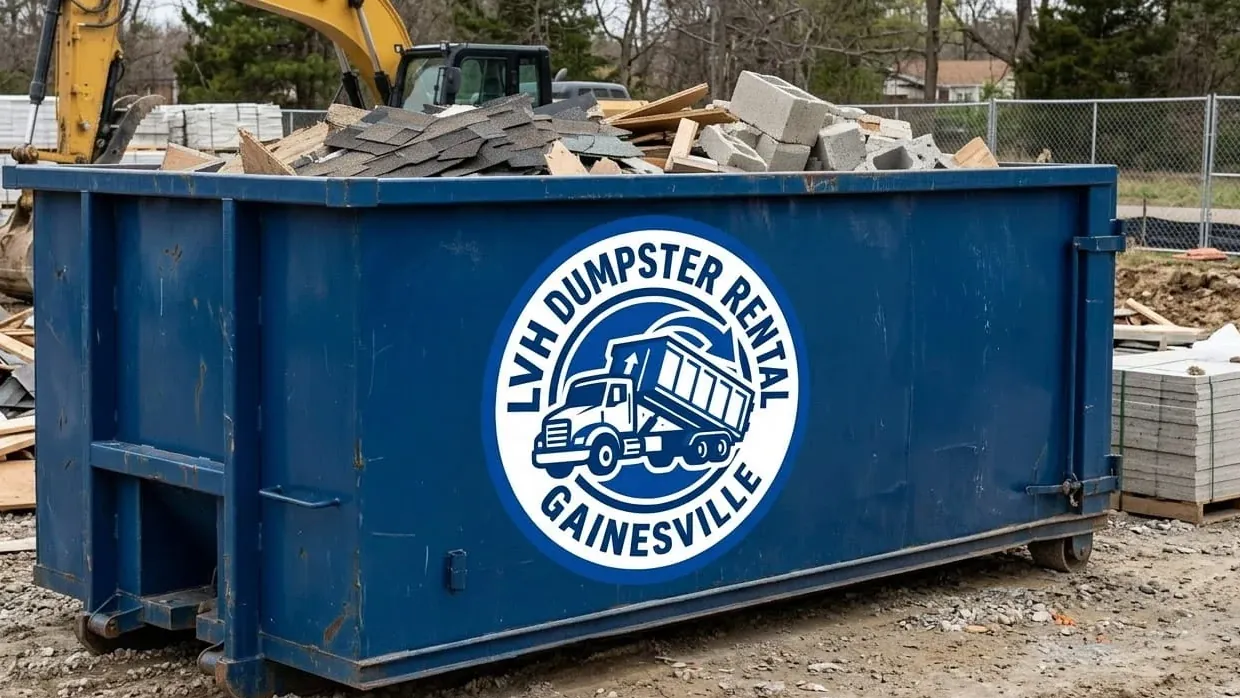
A 15 yard roll-off runs about sixteen feet long, eight feet wide and roughly four feet tall — five or six pickup loads, with sides still low enough to load over rather than climb. It is the size that suits a job with a boundary around it: one room stripped, one roof torn off, one bay of a basement cleared. It also takes a heavy load better than most people expect, which makes it the sensible step up from a 10 when the debris is dense but not purely masonry.
- Capacity15 cubic yards
- Footprint16 ft x 8 ft x 4 ft
- Weight allowance2 – 3 tons
- Holds about~4 – 5 pickup truck loads
Why people choose the 15 yard
The 15 exists for the job that is genuinely finished when it is finished. One bathroom out to the studs. One kitchen with cabinets, counters and flooring. One bedroom taken back to bare walls. One bay of a basement cleared properly rather than shuffled. Those jobs have a known volume, and a 15 absorbs them without leaving half a container standing empty on your driveway for a week. It is also the size that most often gets chosen correctly by phone, because a bounded job is easy to describe: tell us the room and what is coming out of it and we can size it in a sentence. Where people go wrong is treating a bounded job as the first stage of an unbounded one — if the bathroom is step one of a whole-floor remodel, take the 20 at the start rather than paying for a second haul in week three. The 15 also suits the job where one or two people are doing all the carrying, because its sides stay low enough to load over rather than climb, and over a weekend that matters far more than any figure on a specification sheet.
It is also the roofing container in Hall County. An ordinary single-layer asphalt tear-off on a house here fits a 15 comfortably, and the reason it is not a bigger box is payload rather than room. Roof covering is dense material and a tear-off delivers all of it in one afternoon: shingle does not compress, felt and flashing come with it, and any wet decking makes it worse. A 15 loaded flat and low goes out at a lawful weight, and a container that looks half full is very often already there. Two layers, a large roof, or decking coming off with the shingle usually means a 20 or a planned swap instead. Note also where the box can sit: Georgia is on the 2024 International Fire Code, and § 304.3.4 keeps any container of 1.0 cubic yard or more five feet clear of combustible roof eave lines, so it will not be tucked under the eave.
In this county there is a third job that lands squarely on the 15, and it is one the coastal plain simply does not have: the basement bay. Houses in Hall County have basements and crawlspaces — deep, well-drained Cecil soils running better than sixty inches to bedrock on sloping Piedmont upland, with a hundred years of daylight basements built into hillsides. Clearing a basement is rarely one continuous effort; it is usually a section at a time, over several weekends, at the pace of a stair carry. A 15 matches that pace. It also matches the geometry: park it near the walkout or the basement-level garage door, face the tailgate at the opening, and the second half of every load becomes a flat carry rather than a stair carry. If the whole basement plus the attic is coming out in one push, that is a 20 or a 30 instead. Crawlspaces are the same story in miniature: old batt insulation, vapor barrier, abandoned duct and pipe come out slowly, awkwardly and in small pieces, and a 15 matches that pace better than a bigger container standing open for a fortnight.
The last consideration is what the container has to be kept out of, and in Georgia the rules are specific enough to matter. Yard trimmings are banned from lined municipal solid waste landfills under O.C.G.A. § 12-8-40.2, so brush and limbs are a separate clean load rather than filler for the gaps around a bathroom rip-out. Clean concrete, block and brick are worth separating for the opposite reason — Georgia’s inert waste class gives them a route a mixed load does not have, and the Hall County landfill will not take bulk concrete or asphalt at all. Tires, liquids, chemicals, fuel and pressurized tanks never go in, and both the county landfill and the compactor sites prohibit them independently. Everything else — drywall, cabinetry, flooring, fixtures, trim, roofing — is ordinary content for this container.
Good fit for
- One bathroom stripped to the studs
- One kitchen: cabinets, counters, flooring and appliances
- A single-layer asphalt roof tear-off
- One bay of a basement cleared properly
- A bedroom or living room taken back to bare walls
- Carpet and flooring out of two or three rooms
- A deck, porch or small outbuilding coming off
- Heavy loads that are dense but not purely masonry
Not the right size for
- A whole house going out after a long tenure
- A basement and an attic cleared in the same week
- Multi-room remodels running over several weeks
- Large commercial build-outs and warehouse clear-downs
- Clean masonry, which belongs in a 10 loaded flat
- Lot clearing and large-scale brush removal
Will it fit?
At about sixteen feet long the 15 still behaves like a small container on a Hall County lot. It fits an ordinary driveway with room to get past, and its sides are low enough that most material goes in over the rim rather than up a ladder, which matters on a job where one or two people are doing all the carrying. The truck wants roughly 60 feet of straight approach, about ten and a half feet of working width and 20 feet of overhead clearance for the hoist. On the long, curving, sloping driveways that come with daylight basements around here, the thing we check first is the overhead — a mature hardwood limb or a service drop is the usual obstacle rather than the slope itself. Surfaces matter on the wet half of the year: Cecil red clay is slick and rut-prone when saturated, so mats go under the rails on every placement and loaded containers stay off lawns. And the container sits five feet clear of combustible walls, openings and roof eave lines, as the 2024 International Fire Code § 304.3.4 requires.
Before delivery, move cars and bins, mark the septic lid, the drain field and the well head if the house is on its own system, and tell us about fresh concrete, made or filled ground, a low spot in the drive that holds water for a day after rain, or a mature hardwood limb or service drop hanging over the only flat spot. A loaded box is several tons carried on four small contact points, and Cecil red clay carries that well when it is dry and ruts badly when it is wet — so the driveway is the surface, not the lawn, and plywood or timber mats go under every wheel and under both rails as standard. Keep the container five feet clear of combustible walls, openings and roof eave lines, which is what the 2024 International Fire Code § 304.3.4 requires of any container of 1.0 cubic yard or more in Georgia. If any part of it will sit in a city street, sidewalk or verge, that is permission from the governing body under City of Gainesville Code Sec. 4-4-2(a), and each day it sits there without permission is a separate offense under Sec. 4-4-2(d). If your own project involves digging — footings, stumps, fence posts, a septic repair — call Georgia 811 first; notice runs two to eight business days and the clock starts at 7 a.m. the next business day. Our delivery and driveway protection guide and our Gainesville placement and permit guide cover the rest.
Compare all five sizes
| Size | Footprint | Weight allowance | Holds about | Best for |
|---|---|---|---|---|
| 10 Yard Dumpster | 12 ft x 8 ft x 3.5 ft | 2 – 3 tons | ~3 pickup truck loads | Concrete, block, brick and soaked debris — the box that reaches payload before it looks full. |
| 15 Yard Dumpster | 16 ft x 8 ft x 4 ft | 2 – 3 tons | ~4 – 5 pickup truck loads | A single room, a small tear-off, or a garage cleared to the walls. |
| 20 Yard Dumpster | 22 ft x 8 ft x 4.5 ft | 3 – 4 tons | ~6 – 8 pickup truck loads | A whole-house declutter — the Gainesville default — or a multi-room remodel. |
| 30 Yard Dumpster | 22 ft x 8 ft x 6 ft | 4 – 5 tons | ~9 – 12 pickup truck loads | A large remodel, a basement strip-out or a full estate cleanout. |
| 40 Yard Dumpster | 22 ft x 8 ft x 8 ft | 5 – 6 tons | ~12 – 16 pickup truck loads | Commercial gut jobs and construction — it needs the most room to set down. |
Still not sure? Describe what you are throwing away and we will size it on the phone in two minutes. Getting it wrong costs us more than it costs you, so we have every reason to get it right. Call (470) 691-8287.
Book a 15 yard
Flat rate including delivery, pickup, rental period and disposal. Same-day where we can.
(470) 691-8287Other sizes
Popular services
All sizes
Compare our five roll-off containers
10 Yard Dumpster
Concrete, block, brick and soaked debris — the box that reaches payload before it looks full.
View this size → 15yd³15 Yard Dumpster
A single room, a small tear-off, or a garage cleared to the walls.
View this size → 20yd³20 Yard Dumpster
A whole-house declutter — the Gainesville default — or a multi-room remodel.
View this size → 30yd³30 Yard Dumpster
A large remodel, a basement strip-out or a full estate cleanout.
View this size → 40yd³40 Yard Dumpster
Commercial gut jobs and construction — it needs the most room to set down.
View this size →15 Yard Dumpster FAQs
Is a 15 big enough for a kitchen?
For a standard kitchen rip-out, yes, comfortably in most cases. Cabinets, counters, a wall oven or range, sheet flooring or tile, backer board and the soffit above the wall run will fit a 15 with room to spare unless the floor is tile set in a thick mortar bed, in which case the weight arrives before the volume does. The question we ask is whether the kitchen is the whole job or the first part of one. If the flooring is being replaced through the rest of the house afterward, or walls are coming out, take a 20 at the start rather than paying for a second haul later.
What size do I need for a roof?
For an ordinary single-layer asphalt tear-off on a Hall County house, a 15 is the usual answer. A porch, carport or detached garage roof fits a 10. A large roof, a two-layer tear-off, or a job with decking coming off with the shingle usually wants a 20 or a planned swap. We do not put roofing in a 30, because torn shingle reaches a lawful payload long before it fills the box. Call with the square footage, the number of layers and whether the decking is coming off, and be aware that the container will sit five feet off the eave line under the 2024 International Fire Code rather than directly beneath it.
Can I use it for a basement cleanout?
For a section of a basement, yes, and it is a good match for the pace. Clearing a basement in this county is usually a stair carry done over several weekends rather than one continuous push, and a 15 fills at about that rate. Set it near the walkout or the basement-level garage door with the tailgate facing the opening and the second half of every load becomes a flat carry. If the whole basement plus the attic is going out in one push — which is the common Gainesville job — step up to a 20, or a 30 if the house is being emptied completely.
Can I mix a bit of concrete in with it?
A small amount will not stop us taking the load, but it changes where the load can go, so tell us. Georgia treats a clean load of concrete, block, brick, rock and cured asphalt as inert material with its own route under 391-3-4-.07(4)(c), and the Hall County landfill will not accept bulk concrete or asphalt at all. Mixed into drywall, cabinetry and flooring, masonry loses that route and the whole load costs more to place. On a job producing both, one 10 for the masonry loaded flat and one 15 for everything else is normally cheaper than a single container carrying the lot.
How long do I get it for?
As long as the job needs on private ground — call (470) 691-8287 when you want it collected and we will route it rather than hold you to a fixed day. On a bounded job the useful pattern is to book the delivery for the day before work starts and the collection for the day after it finishes, which keeps the container off your driveway for the fortnight either side. Keep it covered between sessions if rain is in the forecast: this county takes about 53 inches a year and soaked drywall, carpet and decking are weight you end up paying to haul.
Services
What people put in a 15 yard
Residential Dumpster Rental
Driveway placement for the basement, attic and garage cleanouts a north Georgia house produces.
Learn more →Commercial Dumpster Rental
Containers for businesses and contractors — Hall County runs no curbside collection at all.
Learn more →Construction Dumpster Rental
Mixed C&D in one roll-off, with next-day swap-outs across Hall County.
Learn more →Roofing Dumpster Rental
Weight-rated cans sized by squares and layers, tarped between sessions.
Learn more →Roll-Off Dumpster Rental
10, 15, 20, 30 and 40 yard roll-offs across Gainesville and Hall County.
Learn more →Same-Day Dumpster Rental
Call before the cut-off and we can usually get a container to you this afternoon.
Learn more →Talk to a real person
Need a 15 yard in Gainesville?
Tell us what you are clearing out and we will tell you the right size and the flat price to put it in your driveway. No forms, no waiting on an email — just call and we will sort it out in a couple of minutes.
Serving Gainesville, Hall County and North Georgia · Mon–Fri 6:30am–5pm, Sat 7am–1pm