
Commercial and construction
40 Yard Dumpster Rental in Gainesville, GA
The largest container we run, and the one that needs the most room. Racking, ceiling grid, crating, insulation, framing and packaging — airy bulk at scale. It is a commercial and construction box rather than a household one, and access decides whether it can go on a site at all.
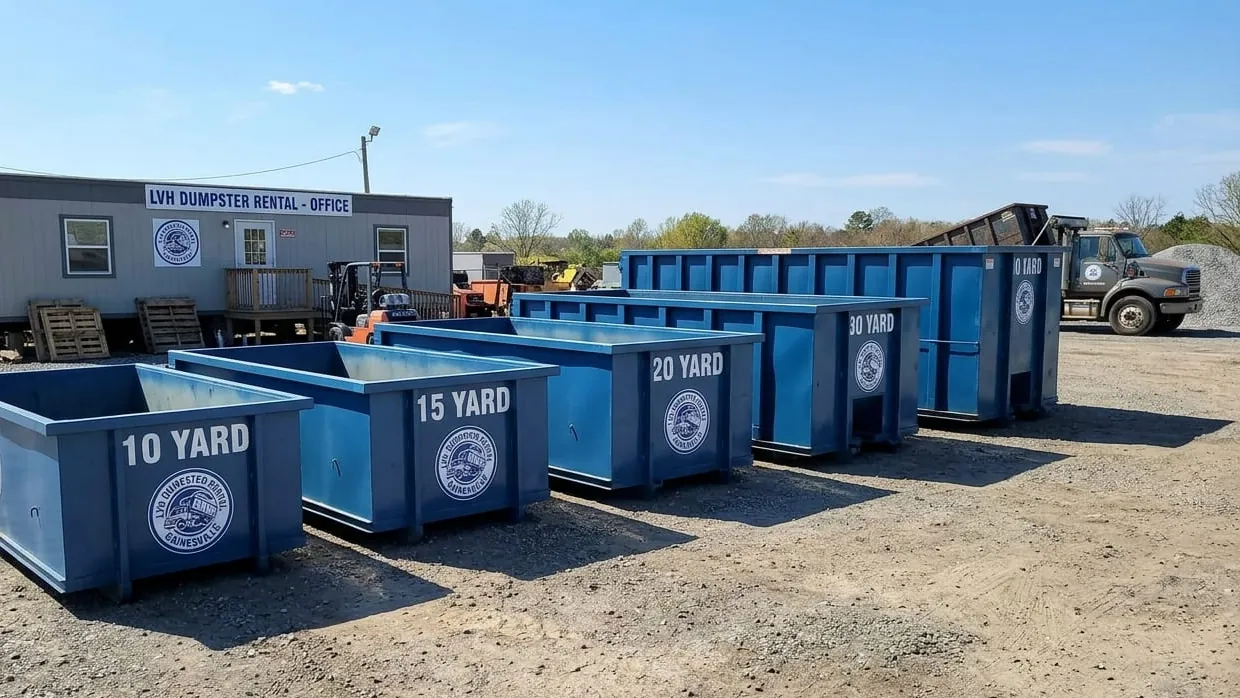
A 40 yard roll-off is about twenty-two feet long, eight feet wide and roughly eight feet tall — the same footprint as a 20 or a 30 with substantially more height. That height is the whole point and also the whole limitation: it takes airy bulk beautifully, it reaches a lawful payload quickly on anything dense, and it needs more straight approach and more overhead clearance than any other container in the fleet.
- Capacity40 cubic yards
- Footprint22 ft x 8 ft x 8 ft
- Weight allowance5 – 6 tons
- Holds about~12 – 16 pickup truck loads
Why people choose the 40 yard
The 40 is a volume container, and it earns its place on jobs where the debris is genuinely light for its size. Pallet racking, wire decking, damaged pallets, crating, banding, shrink film, ceiling grid and tile, insulation, ductwork, office partitions, workstations and packaging are all material that fills space far faster than it gains weight. On a warehouse clear-down or a full tenant build-out in a Gainesville commercial unit, a 40 does in one haul what two 20s would do in two, and that is where the saving is. New construction sits in the same category once a build is producing framing offcuts, sheathing, housewrap, siding cutoffs and window and door packaging at a steady rate. What we would not do is put a 40 on a residential job just because the house is large; household debris is bulky, but it is rarely bulky enough to justify a container that struggles to get onto the lot. The honest test is whether one person can carry most individual pieces without help. If the answer is yes across the whole job, the 40 is probably earning its keep; if it is no, you want smaller containers on a swap cycle instead.
Weight is the discipline that goes with the height. Because the sides are tall, a 40 will keep taking material long after a shorter container would have looked full, which makes it the easiest size to overload without noticing. Anything dense — broken concrete, block, brick, mortar, tile in a mortar bed, wet clay spoil, roof covering, plaster, dense hardwood — reaches a lawful payload while a 40 still looks half used, and a container that cannot lawfully be lifted is worse than one that is slightly small. In Hall County there is a second consideration for the masonry side of that list: the county landfill will not accept bulk concrete or asphalt, and clean inert material has its own route under Ga. Comp. R. & Regs. 391-3-4-.07(4)(c). Heavy goes in a 10 or a 15, loaded flat. Airy goes in the 40.
Access is what actually decides whether a 40 is possible. The footprint is the same as a 20 and a 30, but the truck needs more room to place and retrieve a container of this height safely, and the hoist needs more vertical clearance to lift it. On a commercial lot in Gainesville — an industrial parcel off I-985, a plant yard, a distribution building, a retail rear service area — that is usually straightforward. On a narrow older city street, a tight infill lot, or one of the lake-peninsula lanes that serve properties around Lake Lanier, it very often is not, and the honest answer there is a 30 or two smaller containers on a swap cycle. Photographs of the approach are worth more than any description on a 40, and we would rather look at them before delivery day than send a truck that has to leave with the container still on it.
The last piece is the rule set that comes with commercial work here, and it is worth a paragraph because it is unusually specific. Inside the city limits, City Code Sec. 4-3-10 provides that no building permit issues for a multifamily dwelling, condominium or commercial establishment until the public works director approves the plans for storage and disposal of solid waste — so on a new project, container access is a permit-stage question rather than a punch-list one. Containers stay on private property unless the governing body grants permission for a street or alley, under Sec. 4-3-4, and blocking a street without permission is an offense that recurs daily under Sec. 4-4-2(d). In unincorporated Hall County, Sec. 8.60.190 requires recovery of recyclable corrugated cardboard, which on a warehouse job is both an obligation and the cheapest volume you will ever remove from a load. And Georgia’s permit by rule at Ga. Comp. R. & Regs. 391-3-4-.06 sits behind all of it: containers covered, substantially leakproof, durable and easily cleanable, nothing falling, leaking or spilling in transit, and every load deposited only at a permitted facility.
Good fit for
- Warehouse and distribution clear-downs
- Pallet racking, wire decking and damaged pallets
- Full commercial tenant build-outs and fit-outs
- Ceiling grid, tile, insulation and ductwork
- Office strip-outs with workstations and partitions
- New construction framing offcuts and sheathing
- Crating, banding, shrink film and packaging at volume
- Large-scale interior demolition producing light debris
Not the right size for
- Anything dense: concrete, block, brick or mortar
- Roof tear-offs of any size
- Clay spoil, soil, fill or rock
- Tight residential driveways and narrow older streets
- Lake-peninsula lanes and constrained infill lots
- Sites without about 60 feet of straight approach
Will it fit?
The 40 is the container that most often fails on access rather than on price, so this is the section to read first. The footprint is about twenty-two feet by eight, the same as a 20 or a 30, but the height changes what the truck needs: roughly 60 feet of straight approach as an absolute minimum and more where the run is not straight, about ten and a half feet of working width, and generous overhead clearance for the hoist — more than the 20 feet that suits the smaller sizes, and far more than a mature hardwood limb or a dock canopy will usually allow. On a commercial lot off I-985 or GA-365 that is rarely a problem. On a narrow street in the older city grid, a tight infill lot or a lake-peninsula lane, it frequently is, and a 30 or two smaller containers on a swap cycle is the better answer. Surface still matters: mats under the rails, hard standing rather than clay in the wet months. And the five-foot clearance from combustible walls, openings and roof eave lines under the 2024 International Fire Code § 304.3.4 applies here as everywhere.
Before delivery, move cars and bins, mark the septic lid, the drain field and the well head if the house is on its own system, and tell us about fresh concrete, made or filled ground, a low spot in the drive that holds water for a day after rain, or a mature hardwood limb or service drop hanging over the only flat spot. A loaded box is several tons carried on four small contact points, and Cecil red clay carries that well when it is dry and ruts badly when it is wet — so the driveway is the surface, not the lawn, and plywood or timber mats go under every wheel and under both rails as standard. Keep the container five feet clear of combustible walls, openings and roof eave lines, which is what the 2024 International Fire Code § 304.3.4 requires of any container of 1.0 cubic yard or more in Georgia. If any part of it will sit in a city street, sidewalk or verge, that is permission from the governing body under City of Gainesville Code Sec. 4-4-2(a), and each day it sits there without permission is a separate offense under Sec. 4-4-2(d). If your own project involves digging — footings, stumps, fence posts, a septic repair — call Georgia 811 first; notice runs two to eight business days and the clock starts at 7 a.m. the next business day. Our delivery and driveway protection guide and our Gainesville placement and permit guide cover the rest.
Compare all five sizes
| Size | Footprint | Weight allowance | Holds about | Best for |
|---|---|---|---|---|
| 10 Yard Dumpster | 12 ft x 8 ft x 3.5 ft | 2 – 3 tons | ~3 pickup truck loads | Concrete, block, brick and soaked debris — the box that reaches payload before it looks full. |
| 15 Yard Dumpster | 16 ft x 8 ft x 4 ft | 2 – 3 tons | ~4 – 5 pickup truck loads | A single room, a small tear-off, or a garage cleared to the walls. |
| 20 Yard Dumpster | 22 ft x 8 ft x 4.5 ft | 3 – 4 tons | ~6 – 8 pickup truck loads | A whole-house declutter — the Gainesville default — or a multi-room remodel. |
| 30 Yard Dumpster | 22 ft x 8 ft x 6 ft | 4 – 5 tons | ~9 – 12 pickup truck loads | A large remodel, a basement strip-out or a full estate cleanout. |
| 40 Yard Dumpster | 22 ft x 8 ft x 8 ft | 5 – 6 tons | ~12 – 16 pickup truck loads | Commercial gut jobs and construction — it needs the most room to set down. |
Still not sure? Describe what you are throwing away and we will size it on the phone in two minutes. Getting it wrong costs us more than it costs you, so we have every reason to get it right. Call (470) 691-8287.
Book a 40 yard
Flat rate including delivery, pickup, rental period and disposal. Same-day where we can.
(470) 691-8287Other sizes
Popular services
All sizes
Compare our five roll-off containers
10 Yard Dumpster
Concrete, block, brick and soaked debris — the box that reaches payload before it looks full.
View this size → 15yd³15 Yard Dumpster
A single room, a small tear-off, or a garage cleared to the walls.
View this size → 20yd³20 Yard Dumpster
A whole-house declutter — the Gainesville default — or a multi-room remodel.
View this size → 30yd³30 Yard Dumpster
A large remodel, a basement strip-out or a full estate cleanout.
View this size → 40yd³40 Yard Dumpster
Commercial gut jobs and construction — it needs the most room to set down.
View this size →40 Yard Dumpster FAQs
Will a 40 fit at my property?
On a commercial lot, usually. On a residential driveway, often not, and we would rather say so before delivery day. The footprint is the same twenty-two by eight feet as a 20 and a 30, but the extra height means the truck needs more room to place and retrieve it and the hoist needs more vertical clearance to lift it. Around Gainesville the things that stop a 40 are mature hardwood limbs over a driveway, narrow older streets, tight infill lots and the lake-peninsula lanes. Send photographs of the approach and the placement spot when you enquire and we will give you a straight answer, including which size to take instead.
Is a 40 better value than two 20s?
When the debris is genuinely airy, yes, because you are paying for one haul rather than two. Racking, grid, crating, insulation, packaging and framing offcuts are exactly that kind of material. When the debris has any density to it, the arithmetic reverses fast: a 40 reaches its lawful payload while it still looks half used, so you end up with a container that cannot be lifted and a delay while it is unloaded. The practical test is whether one person can carry most individual pieces easily. If yes, the 40 is probably the cheaper route. If not, take smaller containers on a swap cycle.
Can I put concrete or roofing in it?
No, and this is the most common expensive mistake on this size. Masonry, block, brick, mortar, tile in a bed and roof covering are dense enough to reach a lawful payload in a small fraction of a 40’s volume, so the container becomes unliftable long before it is full. There is a Hall County angle too: the county landfill will not accept bulk concrete or asphalt, and Georgia gives clean inert material its own facility class under 391-3-4-.07(4)(c), which a mixed load loses access to. Put masonry and roofing in a 10 or a 15 loaded flat and keep the 40 for the airy material.
What do we need to sort out of the load?
Cardboard first, especially on a warehouse or retail job — in unincorporated Hall County, Sec. 8.60.190 requires recovery of recyclable corrugated cardboard, and flattened OCC is pure volume you would otherwise pay to haul. Then the usual exclusions: no hazardous or chemical waste, no liquids, no pressurized tanks, no tires, since Georgia caps scrap tire storage at 25 tires statewide under O.C.G.A. § 12-8-40.1 and bars unprocessed tires from landfills. Yard trimmings and clean masonry are separate loads rather than refusals. Under Georgia’s permit by rule at 391-3-4-.06, everything we take goes to a permitted facility, covered on the road.
Where can the container sit on a commercial site?
On your own ground, in a spot the truck can reach and the hoist can work, and five feet clear of combustible walls, openings and combustible roof eave lines under the 2024 International Fire Code § 304.3.4 — which on a tight rear service yard is frequently the constraint that decides the placement. Inside the city limits, containers stay on private property unless the governing body grants permission for a public alley, street or sidewalk under Sec. 4-3-4, and Sec. 4-4-2 makes blocking a street without permission an offense that recurs each day, reaching the person who gave the instruction as well as the driver. Settle the placement before the truck is booked.
Services
What people put in a 40 yard
Residential Dumpster Rental
Driveway placement for the basement, attic and garage cleanouts a north Georgia house produces.
Learn more →Commercial Dumpster Rental
Containers for businesses and contractors — Hall County runs no curbside collection at all.
Learn more →Construction Dumpster Rental
Mixed C&D in one roll-off, with next-day swap-outs across Hall County.
Learn more →Roofing Dumpster Rental
Weight-rated cans sized by squares and layers, tarped between sessions.
Learn more →Roll-Off Dumpster Rental
10, 15, 20, 30 and 40 yard roll-offs across Gainesville and Hall County.
Learn more →Same-Day Dumpster Rental
Call before the cut-off and we can usually get a container to you this afternoon.
Learn more →Talk to a real person
Need a 40 yard in Gainesville?
Tell us what you are clearing out and we will tell you the right size and the flat price to put it in your driveway. No forms, no waiting on an email — just call and we will sort it out in a couple of minutes.
Serving Gainesville, Hall County and North Georgia · Mon–Fri 6:30am–5pm, Sat 7am–1pm