
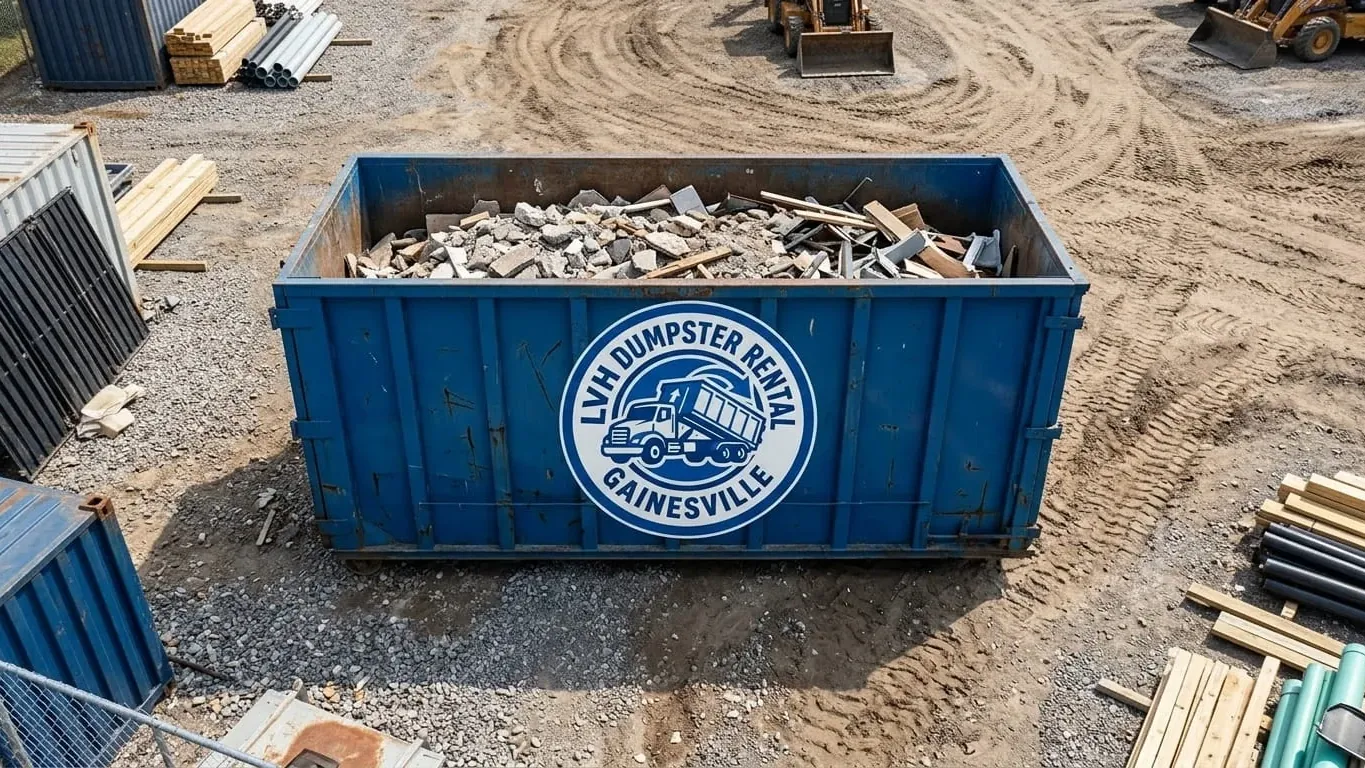
Concrete and heavy debris
Concrete And Heavy Debris Dumpster Rental in Gainesville, GA
Broken slab, block, brick, mortar, cured asphalt and wet red clay spoil. The Hall County landfill will not take bulk concrete or asphalt at all, so a clean load is worth keeping clean — it changes where it can legally go.
Heavy debris is the one category where the container that looks too small is the correct one, and in Hall County there is a second reason for that beyond weight. The Hall County landfill publishes a list of what it will not accept, and large construction debris — concrete and asphalt — is on it, alongside yard debris, bulk Styrofoam, pressurized tanks, chemical and hazardous and liquid waste, mobile homes and boats. So the county’s municipal landfill is simply not a destination for a broken driveway apron or a torn-out patio. That is not a problem, but it is a fact that has to be planned around, and it is the reason we ask what the material is before the container leaves the yard rather than after it is full.
What Georgia provides instead is a separate class of facility. The state rules recognize three landfill classes, and the inert waste landfill at Ga. Comp. R. & Regs. 391-3-4-.07(4)(c) is defined around exactly this material: earth and earth-like products, concrete, cured asphalt, rock, bricks, yard trimmings and land-clearing debris. Those facilities carry their own conditions — hundred-foot buffers from property lines, no siting in wetlands or floodplains, quarterly methane monitoring, monthly earth cover of at least a foot, two feet of final cover with vegetation and thirty years of post-closure care. The practical consequence for you is simple and worth money: a clean load of masonry has a route that a mixed load does not. Put one wheelbarrow of drywall and carpet into a container of broken slab and it stops being an inert load.
The weight arithmetic is the other half of it. Masonry rubble runs several times denser than the mixed household debris people picture when they imagine a roll-off. Broken slab, driveway apron, sidewalk, block from a wall or a planter, mortar, brick, pavers and the compacted base under them all reach a lawful payload while the sides of the container are still plainly visible. A 10 yard loaded flat with rubble is the right tool. The same rubble in a 30 gives you a container that cannot lawfully leave your property, which costs everybody a morning and solves nothing. As a benchmark for how the disposal side is counted, the Hall County landfill publishes a $20 minimum covering up to 665 pounds and $60 a ton over that, as published — weight, not volume, is the unit that matters.
Red clay spoil is the local variation on the theme, and it catches people out. Cecil clay is 35 to 70 percent clay through the subsoil, and a cubic yard of it wet is a genuinely heavy thing. Footing spoil, basement dig-out, a stump hole, a trench — all of it wants a small container loaded flat, and all of it gains weight in the rain, because north Georgia takes about 53 inches of rainfall a year spread right through the calendar rather than in one season. Tell us at booking roughly how much of the load is soil and how much is masonry, because the two are handled differently and mixing them limits where the load can go. And keep it covered between sessions; water is weight you pay to haul.
One more thing that belongs on this page. If your project involves breaking ground rather than just breaking concrete — footings, piers, a pool, stump removal, fence posts, a septic line — that is a Georgia 811 locate request under the Georgia Underground Facility Protection Act, O.C.G.A. Title 25, Chapter 9. Notice is not less than two and not more than eight business days before you dig, and the clock starts at 7 a.m. on the first business day after your request. It is not triggered by the container drop, which sits on the surface. It is triggered by the digging, and eight business days is long enough to matter to a schedule. Call the yard on (470) 691-8287 and describe the material.
Heavy Loads We Handle Around Hall County
Driveway And Apron Removal
Broken concrete out of a driveway, apron or turn-around. Dense, uniform and the classic 10 yard load — keep it clean and it stays an inert load with somewhere to go.
Sidewalks, Walks And Steps
Poured walks, steps and stoops, usually with mesh or rebar in them. Cut the steel back below the rim before we arrive so the lid line and the tarp still work.
Patios And Pool Decks
Slab, coping and the compacted base underneath. Pool work usually means ground disturbance too, so file the Georgia 811 locate request before anything comes out.
Block, Brick And Mortar
Retaining wall block, planters, chimney brick, foundation block and mortar rubble. Dirty, dense and best loaded in pieces two people can place rather than pieces one person can drop.
Cured Asphalt
Broken asphalt off a drive or a parking area. Georgia’s inert waste class names cured asphalt directly, and the county landfill names asphalt on its list of what it will not take.
Footing And Basement Spoil
Excavated red clay and rock from footings, piers or a basement dig-out. Heavier wet than dry, so it goes in a small container, loaded flat, and it gets collected rather than left standing open.
Tile, Terrazzo And Mortar Beds
Floor tile set in a mortar bed, thin-set, backer and the bed itself. The mortar is the weight and it is always more than people expect from one bathroom floor.
Stone, Rock And Rip-Rap
Landscape rock, boulders, gravel and stacked stone coming out of a yard. Straightforward as long as it stays clean and stays low in the container.
Which Container For Heavy Material
The 10 yard is the container for anything genuinely dense: broken slab, block, brick, mortar, tile in a bed, cured asphalt and wet clay spoil. It is roughly twelve feet long, it fits a single-width Hall County driveway, its low sides mean material goes in over the rim rather than up a ladder, and it reaches a lawful payload while the sides are still visible. That is the box working correctly, not the box being too small. A 15 yard is the right step up when the load is heavy but mixed with something bulkier — a patio slab plus the framing of the deck that sat on it, say — and it still loads flat. We do not put clean masonry in a 30 or a 40. Load across the whole floor rather than heaping at the tailgate, cut rebar and mesh back below the rim, and stop at the marked fill line even when it looks early. Dimensions are on the container sizes page.
10 Yard Dumpster
Concrete, block, brick and soaked debris — the box that reaches payload before it looks full.
View this size →15yd³15 Yard Dumpster
A single room, a small tear-off, or a garage cleared to the walls.
View this size →Clean Loads, Clay And Getting The Truck In
Two habits make a heavy job cheap and one makes it expensive. The cheap habits are keeping the load clean and loading it flat. Clean means masonry, concrete, brick, rock and cured asphalt with nothing else in it — no wood, no drywall, no carpet, no bagged trash — because that is what Georgia’s inert waste class at 391-3-4-.07(4)(c) is written around, and because the Hall County landfill will not take bulk concrete and asphalt anyway. Flat means spread across the whole container floor rather than piled at the tailgate end, which keeps the weight where the truck can lift it. The expensive habit is loading past the fill line on the theory that it looks empty. Placement is the other half. A loaded masonry container is the heaviest thing we set, so it goes on hard ground with mats under the rails, never on a lawn and never on saturated red clay — wet Cecil clay is slick and it ruts under load. We want about 60 feet of straight approach, ten and a half feet of working width and 20 feet of overhead clearance, and the container stays five feet clear of combustible walls, openings and roof eave lines under the 2024 International Fire Code § 304.3.4.
Not sure this is the right service? Describe the job on the phone and we will point you at the right container even if it is a different service page. Call (470) 691-8287.
Get a flat quote
Two minutes on the phone gets you a size, a price and a delivery slot. No forms.
(470) 691-8287Recommended sizes
How it works
Concrete & Heavy Debris in four steps
- 1
Call us
Tell us the project, your address and when you want it. Two minutes on the phone and you have a flat price.
- 2
We deliver
Our driver walks the drop, lays protection boards and sets the container exactly where you want it.
- 3
You load it
Take your time within your rental window. Keep it level with the top rail and we handle the rest.
- 4
We haul it
Call or text when you are done. We pull it, sort what can be recovered and dispose of the rest properly.
Concrete & Heavy Debris FAQs
Why do I need a small container for a big pile of concrete?
Because the limit is weight, not volume. Broken concrete, block, brick, mortar, pavers and tile in a mortar bed are several times denser than mixed household debris, so a container hits its lawful payload long before the sides fill. A 10 yard loaded flat and low goes out legally; the same rubble in a 30 gives you a box that cannot move. Load in pieces two people can place rather than pieces one person can drop, spread the material across the whole floor instead of heaping it at the tailgate, cut any rebar or mesh back below the rim, and stop at the marked fill line even when it feels early.
Can I take concrete to the Hall County landfill myself?
Not in bulk. The county landfill publishes a list of what it will not accept and large construction debris — concrete and asphalt — is on it, along with yard debris, bulk Styrofoam, pressurized tanks, chemical, hazardous and liquid waste, mobile homes and boats. The compactor sites are no help either: they take bagged household garbage in bags of 39 gallons or less plus recyclables, and they exclude commercial haulers charging for disposal. Georgia’s answer for this material is the inert waste landfill class at 391-3-4-.07(4)(c), which is exactly where a clean load of concrete, brick, rock and cured asphalt belongs.
Does it matter if a bit of wood or drywall gets in there?
It does, more than most people expect. A clean load of concrete, block, brick, rock and cured asphalt is inert material with its own route under Georgia’s rules. Add framing scrap, drywall, carpet or bagged trash and it becomes a mixed construction and demolition load, which has fewer destinations and costs more to place. Practically that means two containers on a job that produces both, and the small one fills up fast so it is usually the one that gets swapped. If a little contamination happens, tell us rather than hoping we do not notice — it changes where the load can be taken, not whether we will take it.
Can I put dirt and clay spoil in it?
Yes, and tell us before you book rather than after. Excavated red clay is dense, it is heavier wet than dry, and it is handled differently from masonry rubble — mixing the two limits where a load can go, so we want to know roughly what the split is beforehand. Cecil clay runs 35 to 70 percent clay through the subsoil, which is why a cubic yard of it weighs what it does. Keep it covered between sessions; the county takes about 53 inches of rain a year and spoil that has stood open through a wet week has moved up a weight class. If the job involves digging, file the Georgia 811 locate request first.
Will a loaded heavy container damage my driveway?
It is the heaviest thing we set, so we treat it that way. Plywood or timber mats go under the rails on every placement, which spreads the load rather than concentrating it on four points. On concrete and asphalt that is generally the end of the discussion. On red clay it is the difference between a clean pull-out and a set of ruts, because Cecil clay carries load well when it is dry and gives way when it is wet, and December through March is the worst of it. We will not set a loaded masonry container on a lawn or on saturated clay, and we would rather move a delivery by a day than leave a mark that outlasts the job.
More services
Other things we haul
Residential Dumpster Rental
Driveway placement for the basement, attic and garage cleanouts a north Georgia house produces.
Learn more →Commercial Dumpster Rental
Containers for businesses and contractors — Hall County runs no curbside collection at all.
Learn more →Construction Dumpster Rental
Mixed C&D in one roll-off, with next-day swap-outs across Hall County.
Learn more →Roofing Dumpster Rental
Weight-rated cans sized by squares and layers, tarped between sessions.
Learn more →Roll-Off Dumpster Rental
10, 15, 20, 30 and 40 yard roll-offs across Gainesville and Hall County.
Learn more →Same-Day Dumpster Rental
Call before the cut-off and we can usually get a container to you this afternoon.
Learn more →Junk Removal Dumpsters
Clear a basement, attic, garage or outbuilding on your own schedule.
Learn more →Estate Cleanout Dumpsters
Discreet, patient container service for families clearing a lifelong home.
Learn more →Demolition Debris Removal
Containers and fast swaps for porches, outbuildings, sheds, garages and interior gut-outs.
Learn more →Yard Waste & Brush Removal
Clean separate loads — Georgia bans yard trimmings from lined municipal solid waste landfills.
Learn more →Where we deliver
Concrete & Heavy Debris across Hall County and North Georgia
Same service, same flat rates, every town below. Pick yours for local placement and permit notes.
Talk to a real person
Need concrete & heavy debris in Gainesville?
Tell us what you are clearing out and we will tell you the right size and the flat price to put it in your driveway. No forms, no waiting on an email — just call and we will sort it out in a couple of minutes.
Serving Gainesville, Hall County and North Georgia · Mon–Fri 6:30am–5pm, Sat 7am–1pm