
The Gainesville default
20 Yard Dumpster Rental in Gainesville, GA
The container we deliver more of than any other, because the default job in Hall County is a basement and an attic cleared in the same week or a multi-room remodel. Bulky household and renovation debris builds volume long before it builds weight, and the 20 is sized for exactly that.
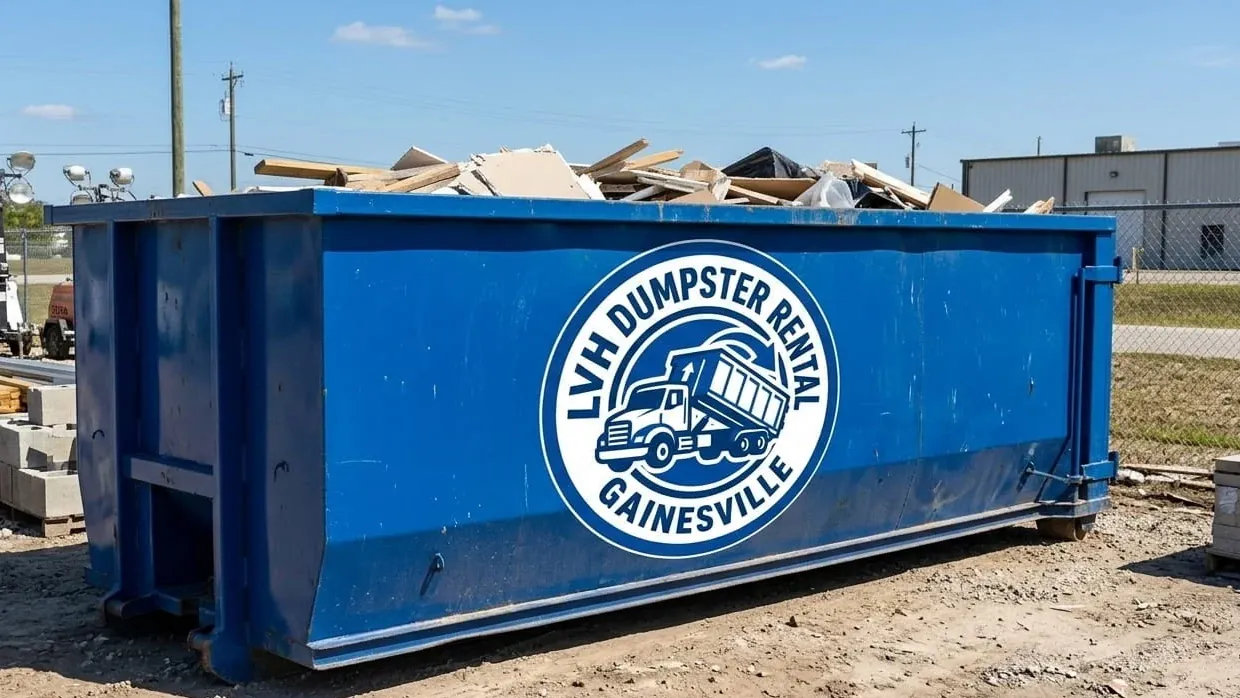
A 20 yard roll-off is about twenty-two feet long, eight feet wide and roughly four and a half feet tall — six to eight pickup loads. The sides are still low enough to load over on most of it, and the footprint fits an ordinary Hall County driveway with the tailgate facing whichever door the pile is coming out of. If you are not sure which size you want and the job is a house rather than a slab, this is the one to start from.
- Capacity20 cubic yards
- Footprint22 ft x 8 ft x 4.5 ft
- Weight allowance3 – 4 tons
- Holds about~6 – 8 pickup truck loads
Why people choose the 20 yard
The reason the 20 is the default here is structural rather than commercial. Houses in Hall County have a downstairs and an upstairs that nobody lives in. The dominant soil is the Cecil series, deep and well drained with better than sixty inches to bedrock, on rolling Piedmont upland with the city sitting at about 1,214 feet — which is exactly the ground that produces daylight basements, and north Georgia has been building them for a century. Where there is no basement there is usually a crawlspace, and above it there is nearly always an attic. So the ordinary residential job here is not one room; it is a basement and an attic emptied over a week or two, plus whatever the rooms give up. That is a volume job, not a weight job, and the 20 is the container sized for it.
The second job that lands on the 20 is the multi-room remodel, and it lands there for the same reason. Cabinets, counters, carpet and pad, laminate, drywall, trim, closet shelving, light fixtures and a couple of plumbing fixtures make a load that is bulky and comparatively light. Carpet rolls in particular take far more room than anyone expects — count rooms, roll tight and load flat rather than standing them on end. What pushes a remodel above a 20 is not usually the number of rooms; it is whether the house is being emptied of furniture at the same time. If the remodel is also a clear-out, look at the 30. And if the job has masonry in it — a tile floor set in a bed, a hearth, an old patio — that goes in a separate 10 loaded flat rather than into this one, because clean masonry has a disposal route that mixed debris does not. The other thing worth counting properly is beds and sofas. Two or three mattresses will take a surprising share of a 20 on their own, so if a house is being turned over rather than remodeled, count furniture before you count rooms.
Placement is where a 20 earns its keep on a north Georgia lot, and it is worth thinking about before delivery day. With a daylight basement the useful spot is almost never the front of the house: it is the driveway apron by the walkout, or the basement-level garage door, with the tailgate facing the opening. That turns the back half of every load from a stair carry into a flat carry, and on a job that runs a week it is the difference between finishing and not. The trade-off is the driveway itself. Hall County drives tend to be long, curving and sloping, and the surface underneath is red clay, which carries a loaded container well when dry and ruts when wet. Mats go under the rails on every placement. And under the 2024 International Fire Code § 304.3.4, which Georgia adopts, the box sits five feet clear of combustible walls, openings and roof eave lines. On a house with a daylight basement that usually means keeping the container off the wall rather than tight against it, and it is far easier to arrange before the truck arrives than after it has been set.
Finally, know what the container is for and what the local rules keep out of it, because in this county there is genuinely nowhere else for most of this material to go. Inside the city limits, Sec. 4-3-9 excludes building materials, cabinets, doors, windows, roofing debris, lumber, siding, landscape timbers, crossties, carpet and floor coverings, sinks, tubs, shower stalls and toilets from city collection, and Sec. 4-3-8 makes appliances and oversized refuse special pickups with a service charge. Outside the city, Hall County provides no residential curbside collection at all — twelve compactor sites taking bagged household garbage in bags of 39 gallons or less, and a landfill that rejects yard debris and bulk concrete and asphalt. What stays out of the 20: tires, liquids, chemicals, fuel, pressurized tanks, and brush, which goes as its own clean load under Georgia’s yard trimmings ban.
Good fit for
- A basement and an attic cleared in the same week
- Multi-room remodels and whole-floor refreshes
- Whole-house declutters with furniture in them
- Carpet and flooring out of a whole house
- Large roof tear-offs and two-layer tear-offs
- Deck, porch and outbuilding removal
- Rental turnovers and between-tenant clear-outs
- Crawlspace cleanouts with insulation and duct in them
Not the right size for
- Clean concrete, block, brick or cured asphalt
- Wet red clay spoil from a footing or basement dig
- Tile set in a thick mortar bed on its own
- A whole estate going out of an older house
- Large commercial build-outs and warehouse clear-downs
- Brush and limbs mixed in with household debris
Will it fit?
At about twenty-two feet long and eight feet wide the 20 takes the same ground as a 30 or a 40 — the extra yardage above it comes from taller sides rather than a longer box — and at four and a half feet of side wall it is the tallest container most people can still load over the rail on an ordinary Hall County residential driveway. The truck wants roughly 60 feet of straight approach to line up and back, about ten and a half feet of working width and 20 feet of overhead clearance for the hoist to lift, and on the long sloping drives that come with daylight basements the constraint is usually a mature hardwood limb or a service drop rather than the grade. Surface is the other half of it: Cecil red clay is low shrink-swell so nothing is heaving, but wet clay is slick and rut-prone under a loaded container, so it goes on the firmest surface available with plywood or timber mats under the rails, and never on a saturated lawn. Keep the five feet from combustible walls, openings and roof eave lines that the 2024 International Fire Code § 304.3.4 requires. If any part of it needs to sit in a city street, that is permission from the governing body under City Code Sec. 4-4-2(a), with each day a separate offense.
Before delivery, move cars and bins, mark the septic lid, the drain field and the well head if the house is on its own system, and tell us about fresh concrete, made or filled ground, a low spot in the drive that holds water for a day after rain, or a mature hardwood limb or service drop hanging over the only flat spot. A loaded box is several tons carried on four small contact points, and Cecil red clay carries that well when it is dry and ruts badly when it is wet — so the driveway is the surface, not the lawn, and plywood or timber mats go under every wheel and under both rails as standard. Keep the container five feet clear of combustible walls, openings and roof eave lines, which is what the 2024 International Fire Code § 304.3.4 requires of any container of 1.0 cubic yard or more in Georgia. If any part of it will sit in a city street, sidewalk or verge, that is permission from the governing body under City of Gainesville Code Sec. 4-4-2(a), and each day it sits there without permission is a separate offense under Sec. 4-4-2(d). If your own project involves digging — footings, stumps, fence posts, a septic repair — call Georgia 811 first; notice runs two to eight business days and the clock starts at 7 a.m. the next business day. Our delivery and driveway protection guide and our Gainesville placement and permit guide cover the rest.
Compare all five sizes
| Size | Footprint | Weight allowance | Holds about | Best for |
|---|---|---|---|---|
| 10 Yard Dumpster | 12 ft x 8 ft x 3.5 ft | 2 – 3 tons | ~3 pickup truck loads | Concrete, block, brick and soaked debris — the box that reaches payload before it looks full. |
| 15 Yard Dumpster | 16 ft x 8 ft x 4 ft | 2 – 3 tons | ~4 – 5 pickup truck loads | A single room, a small tear-off, or a garage cleared to the walls. |
| 20 Yard Dumpster | 22 ft x 8 ft x 4.5 ft | 3 – 4 tons | ~6 – 8 pickup truck loads | A whole-house declutter — the Gainesville default — or a multi-room remodel. |
| 30 Yard Dumpster | 22 ft x 8 ft x 6 ft | 4 – 5 tons | ~9 – 12 pickup truck loads | A large remodel, a basement strip-out or a full estate cleanout. |
| 40 Yard Dumpster | 22 ft x 8 ft x 8 ft | 5 – 6 tons | ~12 – 16 pickup truck loads | Commercial gut jobs and construction — it needs the most room to set down. |
Still not sure? Describe what you are throwing away and we will size it on the phone in two minutes. Getting it wrong costs us more than it costs you, so we have every reason to get it right. Call (470) 691-8287.
Book a 20 yard
Flat rate including delivery, pickup, rental period and disposal. Same-day where we can.
(470) 691-8287Other sizes
Popular services
All sizes
Compare our five roll-off containers
10 Yard Dumpster
Concrete, block, brick and soaked debris — the box that reaches payload before it looks full.
View this size → 15yd³15 Yard Dumpster
A single room, a small tear-off, or a garage cleared to the walls.
View this size → 20yd³20 Yard Dumpster
A whole-house declutter — the Gainesville default — or a multi-room remodel.
View this size → 30yd³30 Yard Dumpster
A large remodel, a basement strip-out or a full estate cleanout.
View this size → 40yd³40 Yard Dumpster
Commercial gut jobs and construction — it needs the most room to set down.
View this size →20 Yard Dumpster FAQs
Why is the 20 the default around here?
Because the default job is a house with a basement and an attic in it. Deep, well-drained Cecil soils on sloping Piedmont upland made daylight basements normal in Hall County, and where there is no basement there is generally a crawlspace, with an attic above. So the ordinary residential clear-out is not one room, it is the whole vertical stack, and that debris is bulky rather than dense. A 20 absorbs it without a second haul and still fits a normal driveway. If you are guessing between sizes on a house job, the 20 is the safest guess; if the house is being emptied completely, look at the 30.
Where should it go on the property?
As close to the door the material is actually coming out of as the approach allows, which on a house with a daylight basement is usually the walkout or the basement-level garage door rather than the front. Facing the tailgate at that opening turns the second half of every load into a flat carry, and on a job that runs a week that matters more than any other single decision. Tell us which opening when you book. We will need about 60 feet of straight approach, ten and a half feet of width and 20 feet of overhead, and we will put mats under the rails wherever it lands.
Can I put the old tile floor and the patio in it too?
You can, but it will cost you more than splitting it. Clean concrete, block, brick, rock and cured asphalt are inert material in Georgia with their own route under Ga. Comp. R. & Regs. 391-3-4-.07(4)(c) — and they need it, because the Hall County landfill will not accept bulk concrete or asphalt. Once that material is mixed into drywall, carpet and cabinetry it is a mixed construction and demolition load with fewer destinations. On a job that produces both, a 10 for the masonry loaded flat alongside the 20 for everything else is normally the cheaper arrangement.
What about the brush from the yard?
Separate load, and this is a Georgia rule rather than a preference. Yard trimmings have been banned from lined municipal solid waste landfills since 1 September 1996 under O.C.G.A. § 12-8-40.2, the Hall County landfill rejects yard debris outright, and the compactor sites prohibit yard trimmings. A clean woody load can be routed to a facility that takes it; brush stuffed into the gaps around a household clear-out takes the whole container somewhere more expensive. And you cannot burn it instead between 1 May and 30 September, when Georgia EPD’s summer open burn ban covers Hall County.
How long can I keep it?
As long as the job honestly needs on private ground, and a basement-and-attic job usually needs a week or two. Call the yard on (470) 691-8287 when you want it collected and we will fit it into the route rather than hold you to a fixed day. Keep it covered between sessions, because Hall County takes about 53 inches of rain a year spread right through the calendar and soaked carpet and cardboard are weight you pay to haul. In winter, allow for the possibility of an ice event taking a route out for a day or two — that is a real north Georgia scheduling factor.
Services
What people put in a 20 yard
Residential Dumpster Rental
Driveway placement for the basement, attic and garage cleanouts a north Georgia house produces.
Learn more →Commercial Dumpster Rental
Containers for businesses and contractors — Hall County runs no curbside collection at all.
Learn more →Construction Dumpster Rental
Mixed C&D in one roll-off, with next-day swap-outs across Hall County.
Learn more →Roofing Dumpster Rental
Weight-rated cans sized by squares and layers, tarped between sessions.
Learn more →Roll-Off Dumpster Rental
10, 15, 20, 30 and 40 yard roll-offs across Gainesville and Hall County.
Learn more →Same-Day Dumpster Rental
Call before the cut-off and we can usually get a container to you this afternoon.
Learn more →Talk to a real person
Need a 20 yard in Gainesville?
Tell us what you are clearing out and we will tell you the right size and the flat price to put it in your driveway. No forms, no waiting on an email — just call and we will sort it out in a couple of minutes.
Serving Gainesville, Hall County and North Georgia · Mon–Fri 6:30am–5pm, Sat 7am–1pm