
Roofing
Roofing Dumpster Rental in Gainesville, GA
Tear-off containers set close to the drip line and clear of the eave. Georgia is on the 2024 International Fire Code, which puts any container of 1.0 cubic yard or more five feet away from combustible roof eave lines — and that rule decides where a roofing box can actually sit.
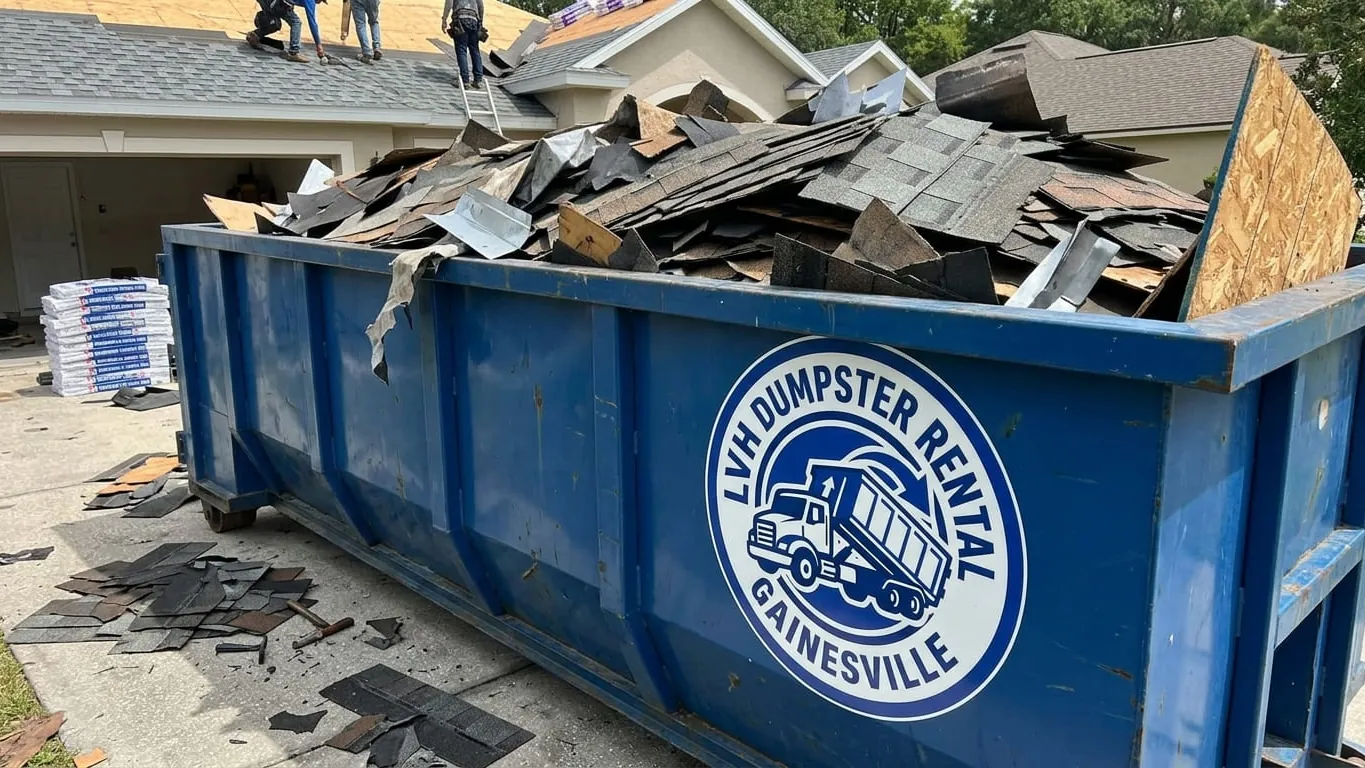
A tear-off is the one job where the container placement is governed by a published number rather than by preference, and in Georgia that number is five feet. Georgia adopts the International Fire Code, 2024 edition, through the Safety Fire Commissioner at Ga. Comp. R. & Regs. 120-3-3-.04, and § 304.3.4 of that code provides that dumpsters with an individual capacity of 1.0 cubic yard, which is 200 gallons, or more shall not be stored in buildings or placed within five feet of combustible walls, openings or combustible roof eave lines. Every roll-off we run — the 10, the 15, the 20, the 30, the 40 — is well over that one cubic yard threshold. So on a shingle job, where the natural instinct is to tuck the box directly under the eave so the debris falls straight in, the code answer is that it does not go there. It goes near, at an angle, five feet off the eave line, with tarps or a slide taking up the difference.
The second thing about a tear-off is weight, and it is the thing customers underestimate every single time. A roof covering is dense material and a tear-off delivers all of it in one afternoon. Torn shingles do not compress, they do not stack politely, and once felt, flashing, nails and any wet decking come off with them, a container that looks half full is often already at its payload. That is why we put roofing in the smaller boxes. A 10 or a 15 loaded flat and low goes out at a lawful weight. The same shingle in a 30 gives you a container that cannot lawfully leave the driveway, which costs a morning and solves nothing. If the tear-off is a second layer, or if the roof has been open through a rain, move it up a weight class in your head before you book.
There is no free route for it either, which is why so many Hall County roofers keep a container on standing order. City Code Sec. 4-3-9 names roofing debris explicitly, alongside lumber, siding, cabinets, doors and windows, as material the city will not collect and as the responsibility of contractors, tenants or property owners. Outside the city, Hall County has no residential curbside collection to leave it at, the twelve compactor sites take bagged household garbage in bags of 39 gallons or less and are closed to commercial haulers who charge for disposal, and the landfill runs Monday to Friday 8 a.m. to 4 p.m. and Saturday until 2 p.m. on a $20 minimum covering up to 665 pounds and $60 a ton thereafter, as published. A tear-off is not a pickup-truck job in this county, and the arithmetic says so before the ordinance does.
North Georgia gives roofs a specific kind of beating, and it is worth knowing what actually drives replacement work here. Spring severe weather runs March through May and it is a normal annual feature rather than an event. Winter brings ice: in February 2014 the National Weather Service office at Peachtree City recorded a quarter to more than half an inch of ice near Atlanta and two to five inches of snow north of a Rome-to-Gainesville line, and the county averages about 1.9 inches of snow a year on the 1991 to 2020 normals. And decayed tropical systems still reach this far inland — Helene put seven to eight inches of rain across Hall County in September 2024 and put trees down at Wiley Road, Price Road and Highway 323. Hall County is more than 250 miles from the coast, so nothing arrives here off the water. It is wind, ice, hail and limbs. The forecast office is NWS Peachtree City on (770) 486-1133.
For the crew, the useful things are boring and they matter. We can set the container so the tailgate faces the working slope while still keeping the five feet off the eave. We will put mats under the rails on a clay drive, because a loaded roofing box on soft red clay in February leaves a mark. We will come back for a mid-job swap on a big roof rather than have anyone load above the fill line. And we will keep the delivery early so the tear-off starts on a clear morning. Call the yard on (470) 691-8287 with the square footage, the number of layers and whether there is decking coming off, and we will tell you which box and how many. Our tear-off sizing guide runs the same arithmetic in writing.
Roofing Jobs We Set Containers For
Single-Layer Asphalt Tear-Off
The standard Hall County job. Shingles, felt, drip edge, ridge and nails, all arriving in one day. It is a weight load rather than a volume load, so it goes in a small box loaded flat and low.
Two-Layer And Multi-Layer Tear-Off
Two layers is roughly double the weight off the same square footage, and it is the most common reason a container comes up short. Say so at booking and we size it up or plan a swap.
Decking Replacement
Rotten sheathing, old plank decking and the framing repairs underneath. Bulkier than shingle and lighter per piece, so it changes the mix in the container more than people expect.
Storm And Hail Damage Replacement
Spring severe weather runs March through May in north Georgia and it drives a season of replacements. Shingle, ridge vent, flashing, gutter and the fascia that came with it.
Ice And Limb Damage
Ice loading and hardwood limbs take out sections of roof here in a way south Georgia never sees. Shingle, decking, gutter and often soffit, mixed with the limb that did it.
Commercial Low-Slope Roofs
Membrane, ballast, insulation board, fasteners and flashing off a flat commercial roof. Dense, heavy per square foot and best staged with swaps rather than one oversized container.
Porch, Carport And Outbuilding Roofs
Small, bounded roofs that still make a real pile. A 10 yard usually covers a porch or a detached garage in one go, and it fits where the bigger boxes will not.
Gutter, Fascia And Soffit Replacement
Aluminum gutter, downspout, wood fascia, vented soffit and the ladder-height debris that comes with them. Light, awkward and easy to combine with a tear-off already in progress.
Which Size For A Tear-Off
Roofing sizes down, not up. A 10 yard suits a porch, a carport, a detached garage or a small single-layer roof, and it is the container we reach for whenever the material is nothing but covering. A 15 yard is the workhorse for an ordinary single-layer house tear-off in Hall County. A 20 yard covers a larger roof, a two-layer tear-off or a job with decking coming off with the shingle, and beyond that we would rather stage two containers or plan a mid-job swap than put a roof in a 30. The reason is payload, not room: torn shingle reaches a lawful weight long before it reaches the top rail, and a container that cannot lawfully leave is worse than one that is slightly small. Load flat and across the whole floor rather than heaping at the tailgate, and stop at the marked fill line even when it looks early. Dimensions are on the container sizes page; the tear-off guide has the details.
10 Yard Dumpster
Concrete, block, brick and soaked debris — the box that reaches payload before it looks full.
View this size →15yd³15 Yard Dumpster
A single room, a small tear-off, or a garage cleared to the walls.
View this size →20yd³20 Yard Dumpster
A whole-house declutter — the Gainesville default — or a multi-room remodel.
View this size →The Five-Foot Rule And Where The Box Actually Goes
On most jobs a fire clearance is a footnote. On a tear-off it is the whole placement decision, because the natural spot for the container is exactly the spot the code takes away. Georgia is on the 2024 International Fire Code, and § 304.3.4 provides that a container of 1.0 cubic yard or more shall not be stored in buildings or placed within five feet of combustible walls, openings or combustible roof eave lines, with exceptions only for containers of noncombustible or low-heat-release construction, areas protected by an approved automatic sprinkler system, and Type I or Type IIA structures standing ten feet or more from other buildings. A wood-framed Hall County house with an asphalt roof is none of those. So we set the container five feet or more off the eave, angled to the working slope, and let the crew close the gap with tarps, a chute or a slide. Everything else is the usual: mats under the rails so a loaded box does not rut a wet clay drive, about 60 feet of straight approach for the truck, ten and a half feet of working width, 20 feet of overhead clearance for the hoist, and an eye on gutters, service drops and hardwood limbs. If the driveway will not take it, tell us before delivery day and we will look at the approach photographs first.
Not sure this is the right service? Describe the job on the phone and we will point you at the right container even if it is a different service page. Call (470) 691-8287.
Get a flat quote
Two minutes on the phone gets you a size, a price and a delivery slot. No forms.
(470) 691-8287Recommended sizes
How it works
Roofing Dumpster Rental in four steps
- 1
Call us
Tell us the project, your address and when you want it. Two minutes on the phone and you have a flat price.
- 2
We deliver
Our driver walks the drop, lays protection boards and sets the container exactly where you want it.
- 3
You load it
Take your time within your rental window. Keep it level with the top rail and we handle the rest.
- 4
We haul it
Call or text when you are done. We pull it, sort what can be recovered and dispose of the rest properly.
Roofing Dumpster Rental FAQs
Can you put the container right under the eave so we can throw straight in?
No, and it is not our rule. Georgia adopts the 2024 International Fire Code, and § 304.3.4 keeps any container of 1.0 cubic yard or more at least five feet away from combustible walls, openings and combustible roof eave lines. Every roll-off size we run is above that threshold, so the five feet applies to all of them, on a private driveway just as much as anywhere else. What we can do is set the box close to that line, angle the tailgate toward the working slope and give you the longest possible side to aim at. Most crews close the gap with tarps or a slide and lose very little time doing it.
What size do I need for a tear-off?
Work from squares and layers rather than from the size of the house. For an ordinary single-layer asphalt roof on a Hall County house, a 15 yard is the usual answer. A porch, carport or detached garage roof fits a 10. A large roof, a two-layer tear-off, or a job that includes decking coming off usually wants a 20 or a planned swap. We do not put roofing in a 30, because torn shingle hits its lawful payload long before it fills the box. Call with the square footage, the number of layers and whether the decking is coming off, and we will tell you which container and whether you need two.
Why does a half-full container get picked up?
Because the limit is weight and not volume. Roof covering is dense, it does not compress, and a tear-off puts the entire weight of the roof into the box in a single afternoon. When a roofing container looks half full it is very often already at its payload, and loading it higher would make it unlawful to haul rather than better value. Loading flat across the whole floor instead of heaping at the tailgate end helps, and so does stopping at the marked fill line. If the roof is bigger than the box, the right answer is a swap, and swaps are cheap compared with a container that cannot move.
Will the city or county take shingles at the curb?
No. City Code Sec. 4-3-9 names roofing debris directly on its list of items the city will not collect, along with lumber, siding, cabinets, doors and windows, and says those are the responsibility of contractors, tenants or property owners. Outside the city limits Hall County runs no residential curbside collection at all, its twelve compactor sites take bagged household garbage in bags of 39 gallons or less and exclude commercial haulers who charge for disposal, and the landfill charges a $20 minimum covering up to 665 pounds and $60 a ton over that, as published, on limited hours. A container is the only sensible route for a tear-off here.
Can the container stay over the weekend?
Yes. On private ground you keep it as long as the job needs, and the sensible pattern on a roof is delivery the evening before, tear-off in the morning and collection when the crew is off the roof. Two north Georgia notes. Keep it covered if rain is forecast between sessions — the county gets about 53 inches a year and wet felt and wet decking are weight you pay to haul. And in January and February an ice event can genuinely take a route out for a day or two here, so if a winter job is on a tight schedule, tell us and we will build some slack into the collection date rather than promise you a morning we cannot control.
More services
Other things we haul
Residential Dumpster Rental
Driveway placement for the basement, attic and garage cleanouts a north Georgia house produces.
Learn more →Commercial Dumpster Rental
Containers for businesses and contractors — Hall County runs no curbside collection at all.
Learn more →Construction Dumpster Rental
Mixed C&D in one roll-off, with next-day swap-outs across Hall County.
Learn more →Roll-Off Dumpster Rental
10, 15, 20, 30 and 40 yard roll-offs across Gainesville and Hall County.
Learn more →Same-Day Dumpster Rental
Call before the cut-off and we can usually get a container to you this afternoon.
Learn more →Junk Removal Dumpsters
Clear a basement, attic, garage or outbuilding on your own schedule.
Learn more →Estate Cleanout Dumpsters
Discreet, patient container service for families clearing a lifelong home.
Learn more →Demolition Debris Removal
Containers and fast swaps for porches, outbuildings, sheds, garages and interior gut-outs.
Learn more →Concrete & Heavy Debris
Dedicated heavy cans for concrete, block and brick — the county landfill rejects bulk concrete and asphalt.
Learn more →Yard Waste & Brush Removal
Clean separate loads — Georgia bans yard trimmings from lined municipal solid waste landfills.
Learn more →Where we deliver
Roofing Dumpster Rental across Hall County and North Georgia
Same service, same flat rates, every town below. Pick yours for local placement and permit notes.
Talk to a real person
Need roofing dumpster rental in Gainesville?
Tell us what you are clearing out and we will tell you the right size and the flat price to put it in your driveway. No forms, no waiting on an email — just call and we will sort it out in a couple of minutes.
Serving Gainesville, Hall County and North Georgia · Mon–Fri 6:30am–5pm, Sat 7am–1pm