
Storm
Storm and Tornado Debris Cleanup in Gainesville, Georgia
Ice, wind and saturated ground drive most cleanup work in Hall County. Here is how to sort a storm pile into loads a facility will accept, and why the yard trimmings ban still applies.
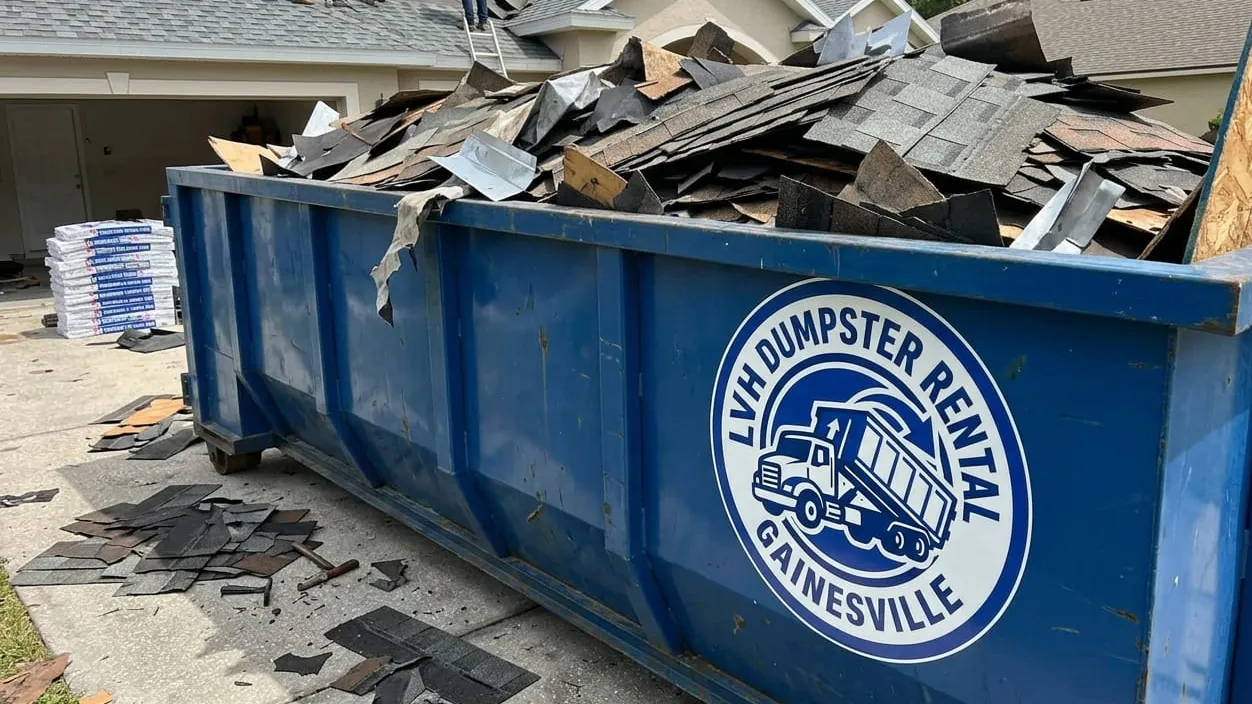
Storm cleanup in Hall County is mostly trees. Limbs across a driveway, a hardwood split down the middle, a fence flattened, and a roof that needs a tarp before it needs a contractor. The work is straightforward. What is not straightforward is where the debris is allowed to go, because Georgia's disposal rules do not relax after a storm.
This page covers what this county's weather record actually is, and then the practical question of sorting a storm pile into loads that a facility will accept.
What the record says about this county
Gainesville, Georgia appears twice on NOAA's list of the 25 deadliest tornadoes in United States history. No other city name does.
On 6 April 1936, two F4 tornadoes merged over downtown Gainesville. The National Weather Service records it plainly: the 203 listed fatalities make the Gainesville tornado the fifth deadliest in United States history. Roughly 1,600 people were injured. The first tornado struck the Brenau campus at about 8:27 a.m., and downtown clocks stopped between 8:28 and 8:37. At the Cooper Pants Factory, of about 125 workers, at least 60 were killed when the building collapsed and burned, the deadliest single-building tornado incident in American history. Damage was around 13 million dollars in 1936 money. President Roosevelt arrived within three days and returned in 1938 for the rededication of the rebuilt courthouse and city hall.
The earlier event was 1 June 1903, with 98 deaths, tied for seventeenth on the same NOAA list.
We mention this because it is part of why downtown Gainesville looks the way it does, and because the record belongs to the people who live here. It is not a selling point and we will not treat it as one. The honest operational takeaway is narrower: severe spring weather is a normal annual feature of north Georgia, and March through May is the season when this county generates debris.
Ice storms are the other half of the record
The event most likely to fill a container here is not a tornado. It is ice.
In February 2014, the Peachtree City weather office recorded ice accumulations near Atlanta of a quarter inch to more than half an inch, with two to five inches of snow north of a line from Rome to Gainesville. The office described ice accumulations further east as not seen in decades. Snow averages about 1.9 inches a year in Gainesville, which is not much, but the ice is the part that does the damage.
An ice storm in the Piedmont is a large tree debris event. Water freezes on limbs, the load builds, and hardwoods split. What you get afterward is downed limbs across an entire neighborhood at once, split trunks that have to be sectioned, broken fencing and torn gutters. That is exactly what a 20 or 30 yard container is for, with one large caveat covered below.
It is also a delivery problem. An ice event can stop a route in north Georgia for a day or two. If a storm is forecast, book early rather than after.
Frozen pipes and the indoor half of an ice storm
The other thing a hard freeze produces here is water damage inside the house. A burst supply line in an unconditioned crawlspace or an unheated basement will soak carpet, pad, drywall, insulation and whatever was stored on the floor. In a county where basements and crawlspaces are normal construction, that is a common January call, and it is a different container job from the tree work outside. The material is wet, it is heavy, and it usually needs to leave quickly for the sake of the rest of the house.
Decayed tropical systems reach this far inland
Hall County is more than 250 miles from the Georgia coast. What arrives here from the tropics is the rain and wind field of a system that has already come apart over land, and it is a rainfall and tree event rather than a coastal one.
The clearest recent example is September 2024, when the Peachtree City office recorded, on average, seven to eight inches of rain across Hall County and logged trees down at Wiley Road and Clarks Bridge Road, at Price Road and Old Wilkie Road, and on Highway 323 between East Hall Road and Lebanon Church Road. Neighboring counties took more. That is the shape of the risk here: saturated ground, downed hardwoods, water in basements and crawlspaces.
The basement point is worth its own sentence, because it is a north Georgia problem that does not exist in flatter country. Houses here have basements and crawlspaces, so a heavy rain event produces soaked carpet, ruined drywall, wet insulation and water damaged storage. That is a container job on its own, and wet material is dramatically heavier than dry.
The yard trimmings ban does not pause for a storm
This is the rule that catches people during cleanup, and it is a statute rather than a policy.
Georgia bans yard trimmings from lined municipal solid waste landfills under O.C.G.A. § 12-8-40.2, effective 1 September 1996, with the definition at § 12-8-22(42): leaves, brush, grass clippings, shrub and tree prunings, discarded Christmas trees and similar landscaping material. The material has to be sorted and stockpiled, chipped, composted, mulched or otherwise beneficially reused instead. Land clearing debris such as whole trees and stumps is handled separately, and inert waste facilities under Ga. Comp. R. & Regs. 391-3-4-.07(4)(c) can take that class of material.
Locally the ban shows up three ways. The Hall County landfill rejects yard debris, meaning trees, stumps, leaves and grass clippings. The county compactor sites prohibit yard trimmings. And the City of Gainesville runs yard trimmings as a separate collection stream rather than mixing them with garbage.
Burning is not the alternative. Georgia EPD's summer open burn ban runs 1 May through 30 September under Ga. Comp. R. & Regs. 391-3-1-.02(5) and covers Hall County. Hall County separately prohibits burning building materials, furniture, plastic, rubber, tires and garbage year round. Between 1 October and 30 April you may burn only fallen leaves and small limbs from your own property, in a pile no larger than six feet by six feet, fifty feet from any structure, with an adult present and a permit from the county Fire Marshal.
So after a storm you cannot burn the pile in summer, cannot burn the building material at all, cannot put the woody debris in a municipal landfill, and cannot take any of it to a compactor site. The route that remains is a sorted load to a facility permitted for it. Our yard waste removal service exists because of that squeeze, and the detail is in our guide to yard waste and brush removal.
Sorting a storm pile into lawful loads
After a real storm the pile in the front yard is usually four different waste streams stacked on top of each other. Separating them at the curb is the single most useful hour of the cleanup.
| Stream | What is in it | Where it goes |
|---|---|---|
| Woody debris | Limbs, brush, prunings, leaves | Separate clean load, banned from MSW landfills |
| Land clearing debris | Whole trees, stumps, root balls | Handled separately from yard trimmings |
| Construction debris | Fencing, decking, siding, shingles, drywall | Construction and demolition facility |
| Water damaged household goods | Carpet, pad, furniture, boxed storage | Mixed load, and heavier than it looks |
| Masonry | Broken block, brick, chimney rubble | Inert facility; county landfill rejects bulk concrete |
Two containers sorted almost always beat one container mixed. Mixing pushes the whole load to the most restricted destination available, and after a storm that is the slowest and most expensive route.
Sort while you are already handling it
The practical trick is to sort as you drag, not afterward. Limbs go in one heap, fence and decking in a second, household goods in a third. Every piece of storm debris gets handled at least twice anyway, once to move it out of the way and once to load it, so making the first handling a sorting pass costs nothing. Re-sorting a mixed pile at the container costs an afternoon, and re-sorting a mixed load at a scale house is not an option at all.
What a container cannot take after a storm
Some of what a storm produces never belongs in a roll-off.
- Tires. Georgia handles scrap tires under O.C.G.A. § 12-8-40.1, and the city and the county each have their own tire provisions.
- Fuel, chemicals and pressurized tanks. Banned at the county landfill and the compactor sites, and prohibited in a collection container under state permit-by-rule conditions.
- Generator fuel cans, propane cylinders and pool chemicals. Common after an outage, and all of them are their own problem.
- Anything from a damaged older building identified as containing asbestos. That routes through Georgia EPD, not a container.
- Downed utility conductors or anything near them. That is the utility's job and nobody else's.
The state's permit-by-rule at 391-3-4-.06 also requires that collection containers be covered, substantially leakproof, durable and easily cleanable, and that contents not fall, leak or spill in transit. After a storm, when loads are wet and full of light debris, keeping the material below the rails is what makes a container haulable.
Access after a storm
Storm work happens on saturated ground, which in this county means red clay. Cecil clay runs 35 to 70 percent clay through the subsoil, has low shrink-swell so it will not move a foundation, and turns slick and rut-prone the moment it is wet under load.
- Driveway placement, on plywood or timber mats. Not the lawn, not the week after a seven inch rain.
- Check the overhead before you pick a spot. Damaged limbs and sagging service drops are the usual obstruction.
- Keep the apron clean. Tracking mud into a city street is a violation under City Code Sec. 4-4-2(b).
- Any part of the container in the street needs permission from the governing body under Sec. 4-4-2(a), and each day without it is a separate offense.
- If a stump is coming out or a fence line is being reset, call Georgia 811 first. The notice window is two to eight business days, and the clock starts at 7:00 a.m. the next business day.
Lakefront properties and the federal boundary
On a Lake Lanier lot there is one more party involved. The US Army Corps of Engineers owns the shoreline in fee title, roughly 56,782 acres over about 760 miles of boundary, so the deed does not run to the water. The Lake Lanier Shoreline Management Plan, with 36 C.F.R. Part 327 and Division Regulation 1130-15-1, requires Corps authorization for activities including vegetation removal, land formation modification, mowing and general lawn care, chemical application, fires, and excavation or silt removal.
After a storm, clearing downed trees near the water is exactly the sort of ordinary work that runs into that. We will not tell you whether your particular job needs an authorization, because that is the Corps' call. The Lake Lanier Project Management Office help desk is (770) 904-3262. Ask them before the saw starts.
Working through a cleanup
Make the yard safe first, then sort, then call for a container sized to the largest single stream. Tell us which streams you have and we will tell you whether it is one box or two. If the job is mostly household contents out of a wet basement, our junk removal service may be the simpler route.
Forecasts and local storm summaries come from NWS Peachtree City at (770) 486-1133, the historical tornado record is published by the NOAA Storm Prediction Center, and the disposal bans are published by Georgia EPD. To check what applies at your address, see our service areas or call (470) 691-8287.
Questions this guide did not answer? Call (470) 691-8287. We would rather spend two minutes on the phone than have you order the wrong container.