
Cleanouts
Basement and Crawlspace Cleanouts in Gainesville, GA
In Hall County the household does not pile up in the garage. It piles up under the house, and it comes back out up a stairwell or through a hatch. That sets the size and the placement.
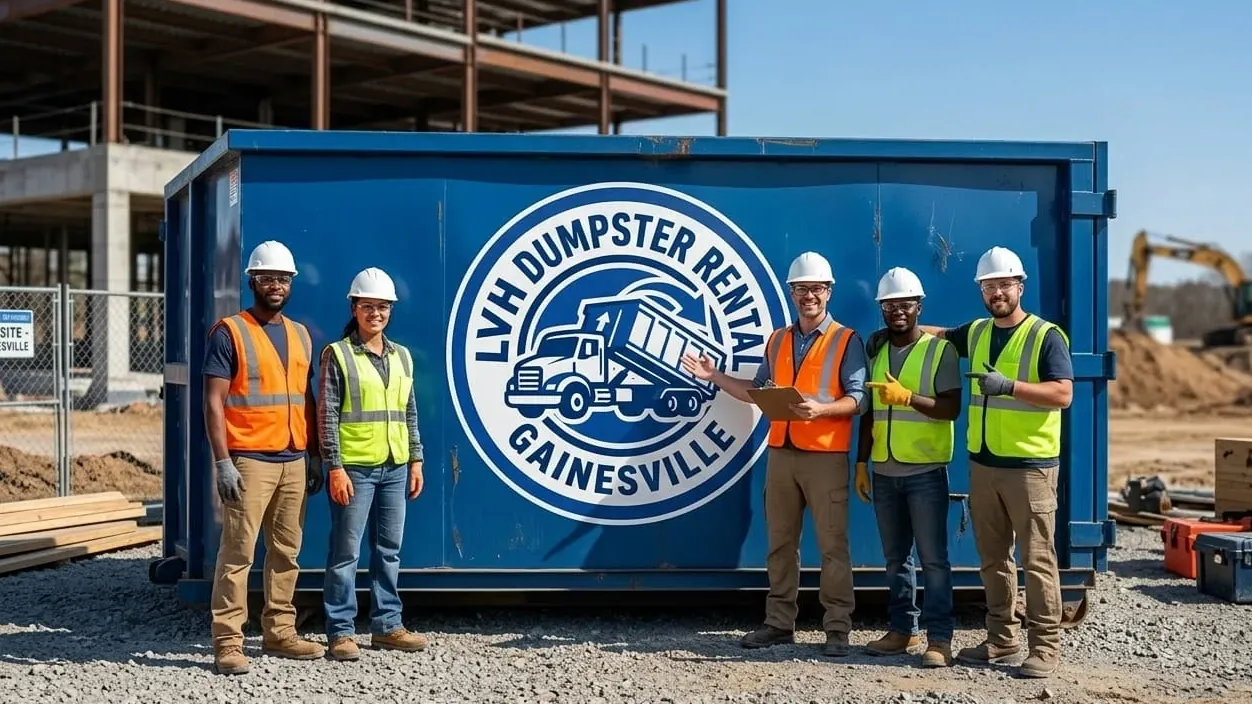
Call a dumpster company in a lot of the country and the residential job is a garage, a spare bedroom and a shed. Here it is a basement. Or a crawlspace. Usually both, plus an attic, and the container has to be sized and parked around that fact rather than around the square footage of the house.
Hall County builds with something underneath the floor. That is not a preference. It is what the ground allows, and it is the single biggest difference between a cleanout here and a cleanout in a flat southern market.
Why Hall County houses have something underneath them
The dominant soil across this part of the Georgia Piedmont is the Cecil series, a fine kaolinitic thermic Typic Kanhapludult with a red clay subsoil running 35 to 70 percent clay. What matters for foundations is what sits below it: more than 60 inches to bedrock, well drained, on rolling uplands, ridges and side slopes. Gainesville itself sits at roughly 1,214 feet.
Deep, well drained residuum on sloping ground is exactly the setting that makes a full basement and a daylight walkout practical, and builders in north Georgia have used it for a century. Georgia's residential code carries whole chapters on basement walls, basement wall drainage and crawlspace ventilation, because those are ordinary assemblies in this state. Footings go below grade, too. The residential code sets a floor at 12 inches below undisturbed grade under IRC R403.1.4, and then the local building official sets the frost depth on top of that. We do not publish an inch figure for Hall County, because we have not found one published by the City or the County. Ask the building department before you dig footings.
A daylight walkout changes everything
The practical version is simpler. A daylight basement means a door at grade on the downhill side of the house. That door is worth more to a cleanout than any container feature we could sell you, because it converts a stair carry into a walk. If your house has one, tell us on the phone. It moves the container, it usually moves the size down, and it can take a day off the job.
The carry is the job, not the container
Thirty years of a household does not accumulate in the living room. It accumulates where nobody has to look at it, which in this county means the basement, the crawlspace and the attic. Then it has to come back out the way it went in.
Up a stairwell. Through a bulkhead. Out a hatch that a 1968 builder framed for a plumber, not for a chest freezer. Every one of those routes has a maximum piece size, a turn radius and a number of trips, and those three things set the pace of the whole project.
So we size off the carry, not off the pile. A 20 yard container thirty feet from a walkout beats a 30 yard container parked at the top of the drive where the last forty feet is uphill with a box in your arms. Two people can throw material over the side of a 20. On a 30 you are usually working the rear door or standing on the load.
Sizing off the stair, not the square footage
Most full basement and attic clear-outs in Hall County land on the 20 yard. Step to the 30 when the basement is finished and coming apart: paneling, ceiling tile, framed partitions, carpet and pad, cabinets. Drop to the 15 when the carry is long, the drive is narrow, or you are working one bay of the basement rather than all of it. Drop to the 10 when the load turns heavy, which on a basement job usually means a demolished block wall, a poured slab section, or wet clay spoil from a drain tile trench. There is more on the trade-offs in our guide to what size dumpster you need for a Gainesville project, and the full lineup sits on the dumpster sizes page.
Where the box goes on a basement lot
Sloping lots are the norm here, and a container wants a reasonably level set. Rails on a cross slope will walk, and a loaded box on a grade is not something to be casual about. We look for the flattest usable run of driveway with the shortest path to the walkout or the stair.
Clay is the other constraint. Cecil clay is slick when it is wet and it ruts under a loaded truck, then it dries as hard as anything you have poured. We put boards under the rails on a driveway and we do not set a box on a lawn after rain. That is not fussiness. City Code Sec. 4-4-2(b) makes it a violation to allow dirt, silt, sediment or debris to be tracked or deposited into a city street from a parcel inside the city, and red clay tracks better than almost anything else on earth.
Five feet, and the code means it
Georgia is on the 2024 International Fire Code, adopted at Ga. Comp. R. & Regs. 120-3-3-.04. Section 304.3.4 says a dumpster of 1.0 cubic yard or more may not be stored in buildings or placed within five feet of combustible walls, openings or combustible roof eave lines. Every roll-off we own is over that threshold. On a basement job the temptation is to tuck the box right against the walkout wall to shorten the carry by eight feet. Five feet off the wall is where it goes instead.
Damp is the reason half of it is going out
North Georgia gets about 53 inches of rain a year, spread through the year, and a below-grade room in that climate is a humidity problem waiting for cardboard. Most basement cleanouts we run are triggered by the same discovery. The boxes on the floor have gone soft. The bottom two inches of everything stacked against the block wall are ruined. There is a smell.
Two rules make that easier to work through. First, wet material is heavy, and weight is what fills a container's legal capacity long before its volume runs out. Waterlogged carpet, soaked cardboard and swollen particle board weigh several times what the same volume of dry material does. Second, if there is visible mold on a large area, stop and get somebody who does remediation to look at it before you start moving it around the house.
Since this comes up on almost every basement job in a county like this one: Hall County is EPA radon Zone 2, moderate potential, with a predicted average indoor screening level between 2 and 4 picocuries per liter. That is not high. It is also not zero, and EPA's position is that every home should be tested regardless of zone. If you are about to finish a basement you just emptied, test it first. The US EPA publishes the zone maps and the testing guidance.
What rides in the container and what does not
A basement is where the household's chemistry set ends up. Half-used paint from three owners ago. A gallon of something with a faded label. A propane cylinder for a grill that rusted out in 1994. Those items are exactly what a container cannot take, and they are not a gray area.
| Goes in the container | Does not go in the container |
|---|---|
| Furniture, mattresses, box springs, rugs | Liquid paint, solvents, thinners, pesticides |
| Boxes, papers, books, clothing, toys | Motor oil, antifreeze, fuel, any liquid waste |
| Carpet, pad, paneling, ceiling tile, trim | Propane cylinders and any pressurized tank |
| Shelving, cabinets, doors, non-load framing | Tires and wheels |
| Water heaters, dead exercise equipment | Sealed refrigerant appliances until evacuated |
| Scrap metal, ductwork, old pipe | Brush, limbs, leaves and grass clippings |
| Dry, bagged demolition debris | Asbestos material, chemical or biomedical waste |
The bottom right corner surprises people, so it is worth saying plainly. Yard trimmings cannot ride in a mixed load in Georgia. The state banned them from lined municipal solid waste landfills under O.C.G.A. Section 12-8-40.2, effective 1 September 1996, with the definition at Section 12-8-22(42). If you have been storing brush beside the basement door, that is a separate clean load.
The rest of the right-hand column is enforced further down the chain. The Hall County landfill will not take chemical waste, liquid waste, hazardous waste or pressurized tanks, and the county's compactor sites prohibit the same categories. There is nowhere for those items to go inside a mixed load, which is why we ask about them before delivery rather than after.
Old tanks, old paint and the pre-1978 question
Three things turn up in older Hall County basements often enough to plan for.
A disused fuel oil tank. Some houses of a certain age still have one in the basement or buried near it. It is not container material and it is not a Saturday project. Get a contractor who handles tanks, and if there is any sign of a release into soil, Georgia EPD is the agency that answers that question.
The paint shelf. Hall County does not run a standing household hazardous waste drop-off that we were able to confirm. What we can tell you is that the county landfill handles paint and refrigerant for a fee, as published, and that periodic county recycling events take a wider list. Call the landfill at 770-531-6851 before you load anything chemical into a car.
Pre-1978 construction. If the house was built before 1978 and your cleanout turns into a renovation that disturbs painted surfaces, Georgia's lead Renovation, Repair and Painting rule applies. Georgia is one of the states EPA authorized to run its own program. It became the twelfth, effective 5 July 2011, under Ga. Comp. R. & Regs. Chapter 391-3-24. Certification comes from EPD, not from EPA, and Georgia's program is stricter than the federal baseline. Emptying a room is not RRP work. Sanding, scraping and cutting into old paint is.
Crawlspaces are their own problem
A crawlspace cleanout is not a small basement cleanout. It is a different job with a different bottleneck: the access hatch.
Everything that comes out has to fit through it, which means old fiberglass batts that fell off the joists, torn vapor barrier, a rusted duct trunk, buried scrap lumber left by the original crew, and whatever the previous owner decided to store down there in 1985. It comes out in pieces sized to the hatch and it comes out dirty. Bag the insulation as it is pulled, because loose fiberglass in an open container is a nuisance for everyone downwind.
Two practical notes. Wet crawlspace debris is heavier than it looks, so the 15 is often the right box even though the volume seems small. And if you are pulling a vapor barrier because of standing water, the water is a grading and drainage problem outside the house, which is worth solving before you pay somebody to put a new barrier over the same puddle.
How a basement cleanout actually runs
- Walk the basement and the crawlspace before you call. Note the exit route, the hatch size and whether there is a walkout.
- Pull the chemicals, the cylinders and the tires out first and set them aside. They are a separate errand, not a container item.
- Sort brush and yard debris into its own pile. It cannot ride with the household load.
- Stage material near the exit before delivery day so the container fills fast instead of sitting for a week.
- Tell us where the box should sit and what the driveway is made of. We bring boards.
- Load heavy and flat first, bulky and light on top. A container loaded that way holds more and travels legally.
- Call for the swap before you need it, not the morning you run out of room.
We have been running these out of the yard on Northside Drive since 2013, and the ones that go smoothly all look the same: somebody figured out the carry route first. If you want a hand deciding between a 15, a 20 and a 30 for a house you already know is full, call the office at (470) 691-8287 and describe the stair. That is usually enough. Our residential dumpster rental page covers the rest of what we bring.
Questions this guide did not answer? Call (470) 691-8287. We would rather spend two minutes on the phone than have you order the wrong container.