
Roofing
Roofing Tear-Off Dumpster Sizing for North Georgia Roofs
Shingles fill a container by weight, not volume. Here is how to size a tear-off by squares and layers, and why the 2024 fire code keeps the box five feet off your eave line.
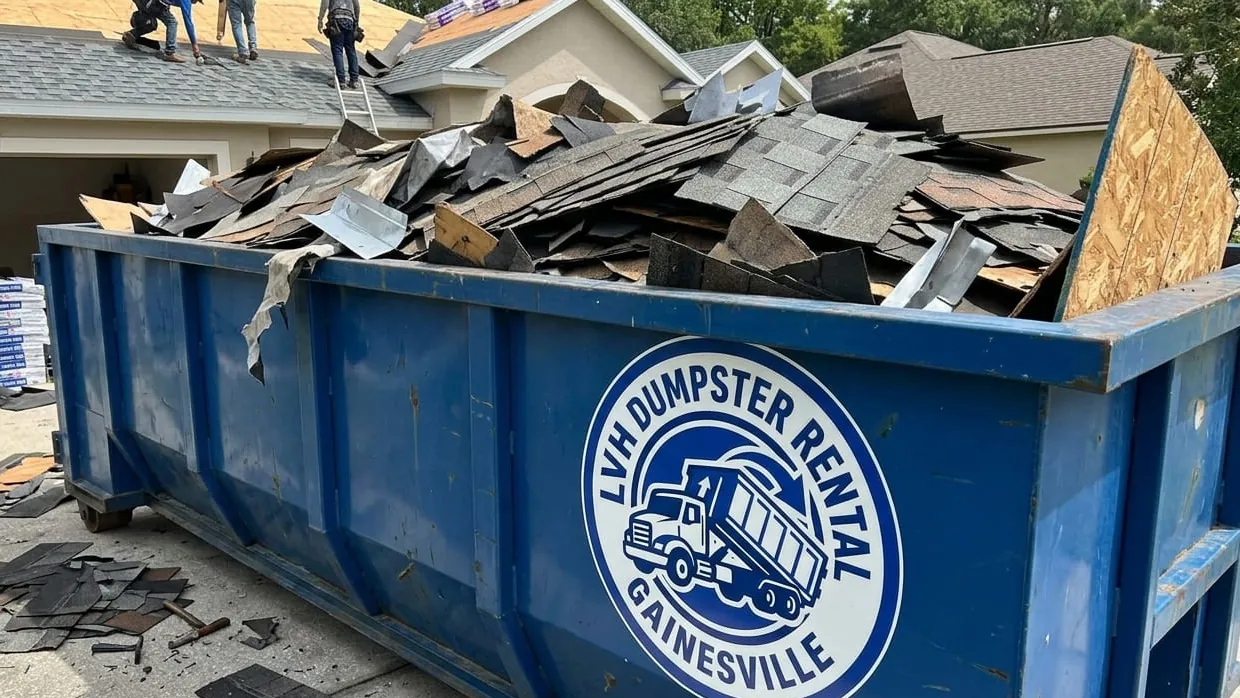
A roof tear-off is the most predictable container job there is. You know the area, you know the material, and you know how many layers are coming off. Which means you can size it right the first time, and the only reason people get it wrong is that they size by volume when shingles are a weight problem.
Here is how we size a tear-off in Hall County, and the two local rules that shape where the box actually sits.
Shingles are heavy for their bulk
Roofers measure in squares. One square is 100 square feet of roof surface. Weight per square varies with the product and its age, but the working ranges most crews use are these.
| Material | Approximate weight per square | Notes |
|---|---|---|
| Three tab asphalt shingle | Roughly 225 to 250 pounds | The older, lighter product |
| Architectural or laminated shingle | Roughly 350 to 450 pounds | Standard on newer north Georgia roofs |
| Second layer over the first | Add the full weight again | Layovers are common on 1970s and 1980s houses |
| Felt, ice barrier, drip edge, nails | Small but not zero | Adds up across a large roof |
| Rotten decking | Wet plywood is far heavier than dry | Budget for it on any roof with a leak history |
Run the arithmetic on an ordinary house. A 2,200 square foot roof surface is 22 squares. In architectural shingle at the middle of that range, one layer is roughly four tons. Two layers is roughly eight. That is before decking, before the chimney flashing, and before the pile of tear-off felt.
Volume is not what fills that container. Weight is.
Matching container size to roof area
These are starting points, not promises. Measure the roof, count the layers, then call and we will confirm.
- 10 yard. A garage, a porch roof, a small addition, or a heavy single-layer section under about 12 squares. It is the weight box, and on a slate or tile removal it may be the only right answer.
- 15 yard. The workhorse for an ordinary single-layer house tear-off in Hall County, roughly 15 to 20 squares stripped to the deck.
- 20 yard. A large single-layer roof, roughly 20 to 30 squares, a smaller roof with two layers, or a job with the decking coming off with the shingle. This is the top of the roofing ladder.
- Above a 20 there is nothing. We do not put roofing in a 30, because torn covering reaches its lawful payload long before it fills the box. A large or complex roof, a two layer tear-off on a full sized house, or a roof coming off at the same time as siding runs as a 20 with a planned mid-job swap, or as two containers.
- 40 yard. Commercial and multifamily work, and then only for the light fraction — insulation and airy debris. The heavy membrane, ballast and shingle go in a smaller box beside it.
The layer question is the one that matters
Ask before you order, not after the first course comes off. A house that was reroofed once in the 1980s without a tear-off carries double the weight of the same house that has always been stripped to the deck. On a 25 square roof, that difference is the difference between one 20 yard container and either a planned mid-job swap or a second box. If nobody knows, pull a shingle at a rake edge and count.
Five feet from the eave line, and the code says so
This is the rule that catches crews who habitually tuck the container against the wall to shorten the throw.
Georgia adopts the International Fire Code, 2024 edition, through the Safety Fire Commissioner at Ga. Comp. R. & Regs. 120-3-3-.04, under O.C.G.A. §§ 25-2-13 and 25-2-14. Section 304.3.4 provides that dumpsters with an individual capacity of 1.0 cubic yard, which is 200 gallons, or more shall not be stored in buildings or placed within five feet of combustible walls, openings or combustible roof eave lines, unless the container is of noncombustible or low heat release construction. Exceptions cover areas protected by an approved automatic sprinkler system, and certain construction types located ten feet or more from other buildings.
Read that phrase again: combustible roof eave lines. On a tear-off, the eave line is exactly where everybody wants the box. Every roll-off we bring is well past 1.0 cubic yard, so the five feet applies, and it applies on a private driveway just as much as on a commercial lot.
Plan for it. Five feet off the eave usually means a slightly longer throw or a chute, and on a narrow side driveway it may mean a smaller container is the only one that fits the gap. Better to know that when you book than when the truck arrives with the crew standing on the roof.
Roofing debris is on the city's do-not-collect list
City of Gainesville Code Sec. 4-3-9 names roofing debris directly, along with building materials, lumber, siding, cabinets, doors, windows, carpet, crossties, tubs and toilets, as items the city will not collect. Those are the responsibility of the contractor, tenant or property owner.
In unincorporated Hall County there is no residential curbside collection at all. The alternative is 12 compactor sites plus the landfill, and the compactor sites take bagged household garbage only, in bags of 39 gallons or less, with commercial haulers excluded. A tear-off does not fit that system at any point.
So the tear-off goes in a container, and the container goes to a facility permitted to take construction and demolition waste. Georgia's permit-by-rule at Ga. Comp. R. & Regs. 391-3-4-.06 requires that collection containers be covered, substantially leakproof, durable and easily cleanable, that contents not fall, leak or spill in transit, and that all waste be deposited only at permitted facilities. Which is also why we ask you to keep the load below the rails: a heaped container cannot be tarped.
Keep the load clean
Shingles, felt, decking and flashing together are a clean construction load. Throw in the brush pile from the back fence and it stops being one. Georgia bans yard trimmings from lined municipal solid waste landfills under O.C.G.A. § 12-8-40.2, and a load contaminated that way has fewer lawful destinations and a higher cost. Keep green waste in its own load.
Decking, flashing and the things that ride along
A tear-off is rarely only shingles, and the extras are where the estimate drifts.
Decking is the big one. Any roof with a leak history will show soft sheathing once the felt is off, and wet plywood weighs considerably more than dry. On an older house you may also find plank decking rather than sheathing, which comes off in heavy, awkward lengths and eats volume as well as weight. Budget a few extra squares' worth of capacity on any roof over about thirty years old.
Then there is everything at the edges. Drip edge, valley metal, chimney and sidewall flashing, ridge vent, boots, old gutter and fascia. None of it is heavy on its own and all of it is bulky. Metal in the load is fine in a construction container, though if you have enough of it to matter it is worth separating for scrap before the box is hauled.
What must not go in: nothing chemical, no pressurized tanks, no tires, and no old roofing that has been identified as containing asbestos. Some older built-up and asbestos-cement roofing products exist on buildings of a certain age in this county, and that material has its own regulated route through Georgia EPD rather than a container.
Commercial and multifamily roofs
Flat and low slope commercial roofs behave differently. Built-up roofing with gravel ballast is dense, and a modified bitumen or ballasted system coming off a warehouse or a poultry processing support building will run heavy per square foot compared with residential asphalt. Insulation board, by contrast, is almost pure volume.
That mismatch is why commercial tear-offs often run two containers rather than one: a smaller box for the heavy membrane and ballast, a 40 for the insulation and light debris. It sorts the load, it keeps both boxes legally haulable, and it usually costs less than filling a single container to a weight nobody can move.
On an occupied multifamily or commercial property, plan the placement with the fire clearance and the traffic pattern together. Five feet off the building under the fire code, out of the fire lane, and somewhere a truck can get a straight pull without backing across a parking aisle full of residents.
What actually takes roofs off in north Georgia
Roof work in this county is driven by three things, and none of them are coastal.
Ice. North Georgia gets ice storms. In February 2014, NWS Peachtree City recorded ice accumulations near Atlanta of a quarter inch to over half an inch, with two to five inches of snow north of a Rome to Gainesville line. Ice loads gutters, tears fascia, and brings limbs down through roof planes. Snow averages about 1.9 inches a year here, which is not much, but it is not zero either.
Wind and hail. Spring severe weather is a normal annual feature of the north Georgia foothills, and hail bruising on an asphalt roof often does not show up until the next inspection. March through May is the busy season for storm-driven roof work.
Age. The plain one. A twenty year old architectural roof on a 1990s subdivision house in north Hall is simply due, and most of our tear-off work is that rather than anything dramatic. Our guide to storm debris cleanup covers the weather-driven side in more detail.
Setting the container on a north Georgia driveway
Hall County is red clay on rolling ground, and the soil behaves differently from what crews used to flatter, sandier ground expect. Cecil clay runs 35 to 70 percent clay through the subsoil. It has low shrink-swell, so it will not heave a slab, but it is slick when wet and it ruts under load. North Georgia gets about 53 inches of rain a year spread through the calendar.
- Driveway placement on plywood or timber mats under the rails.
- No lawn placement after rain, and no lawn placement at all in February.
- Watch the overhead. Limbs and service drops are the usual reason a truck cannot set where you wanted.
- Keep the apron clean. Sec. 4-4-2(b) makes tracking dirt or debris into a city street a violation.
- Any part of the box in the street needs permission from the governing body under Sec. 4-4-2(a), and each day without it is a separate offense.
Details on setting a container without marking a driveway are in our guide to driveway protection on delivery day.
Tear-off day, start to finish
- Measure the roof in squares and count the layers.
- Decide whether decking is coming off, and add weight if the roof has leaked.
- Pick the container by weight, not by how the pile looks.
- Set it five feet clear of walls, openings and the eave line.
- Tarp the ground between the eave and the container so nails come up with a magnet at the end.
- Load below the rails and call the swap at about three quarters full.
Do that and a tear-off is a one container job with no surprises. The weather offices at NWS Peachtree City publish the local storm records if you want to see what a north Georgia ice event looks like, and Georgia's fire code adoption is published by the Safety Fire Commissioner.
For the container side, see roofing dumpster rental and our dumpster sizes page, or call (470) 691-8287 with the square count and the number of layers.
Questions this guide did not answer? Call (470) 691-8287. We would rather spend two minutes on the phone than have you order the wrong container.