
Sizes
What Size Dumpster You Need for a Gainesville Project
In Hall County the basement decides the container size. Here is how the 10, 15, 20, 30 and 40 yard boxes match real Gainesville jobs, and why sorting the load matters before volume does.
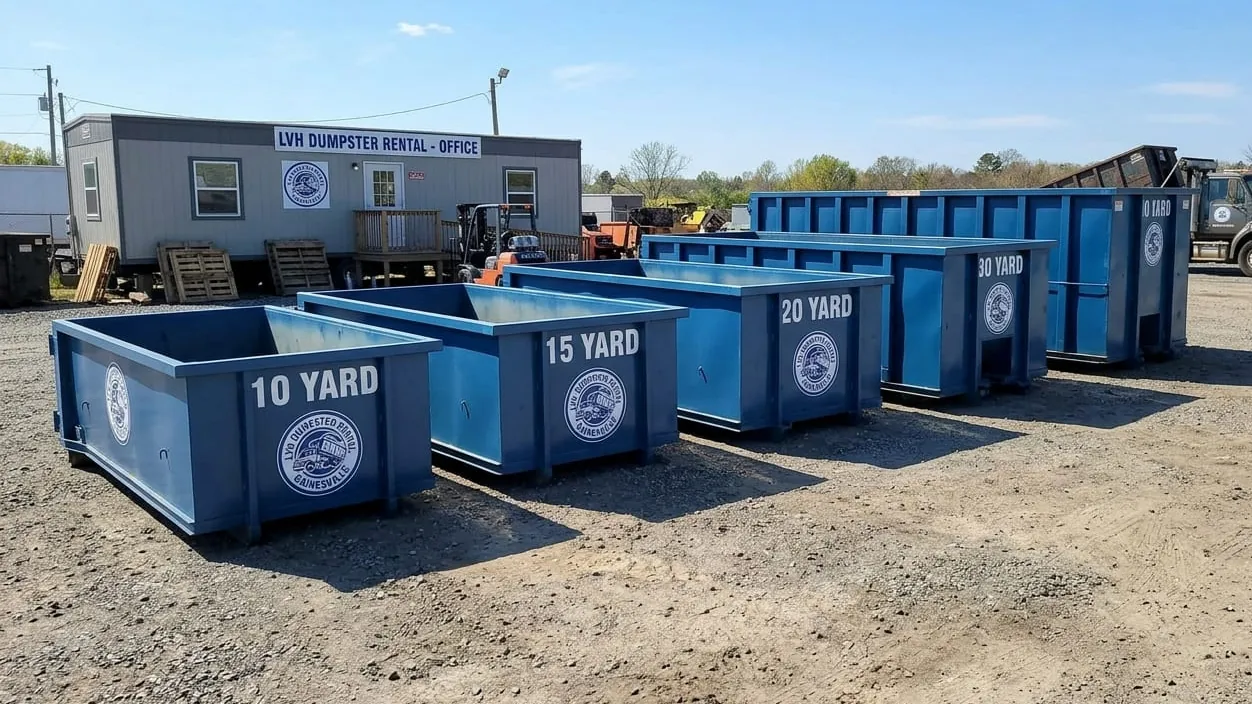
Most people call and give me a size before they give me a job. That is backwards, but it is habit, and I do not mind. In Gainesville the conversation almost always lands in the same place anyway, because most of the houses here have something underneath them. A basement. A crawlspace. A daylight walkout with thirty years of boxes stacked against the block wall.
That one building fact decides more container sizes in Hall County than anything else. So start there, and the rest of the sizing falls out of it.
The 20 yard is the Gainesville default
North Georgia builds on deep, well drained residuum. There is more than 60 inches to bedrock under most of this county, the ground rolls, and the city sits at roughly 1,214 feet. That combination is exactly what makes a daylight basement practical, and builders here have used it for a century. Basements and crawlspaces are normal in Hall County. They are not an exotic upgrade.
The practical result is that the average residential cleanout in Gainesville has two floors of accumulation in it instead of one. A basement, an attic, and usually a detached shed or a carport bay. That is a 20 yard job nine times out of ten.
A 20 gives you roughly the volume of six pickup loads with sides that a person can still throw over. It fits on a normal driveway. It holds a full basement plus an attic without a swap. And it is the size that most often ends a two day project in two days instead of four.
When the 20 is not enough
If you are gutting a whole house, taking down interior walls, or clearing an estate where nobody has thrown anything away since the mill closed, step to the 30. If it is a commercial interior or a framed addition, the 40 is the honest answer, and it needs the most room to set and the most room for the truck to pull the cable.
The five sizes, side by side
| Size | Typical Gainesville job | What usually decides it |
|---|---|---|
| 10 yard | Concrete, block, brick, wet clay spoil, a small bath | Weight, not volume |
| 15 yard | One room, a small tear-off, a single basement bay | Driveway length |
| 20 yard | Basement and attic clear-out, multi-room remodel | Two floors of accumulation |
| 30 yard | Large remodel, full estate cleanout, deck and shed demo | Bulk of light debris |
| 40 yard | Commercial interiors, new construction, roof and framing together | Site room and truck access |
Those descriptions hold for most jobs. They stop holding the moment the load turns heavy, which is the next section and the one people skip.
One thing worth saying about the 15. It is an underrated size in the older parts of the city. Green Street, the streets around downtown and the mill village housing at Chicopee and New Holland were laid out long before anybody was thinking about a truck with a 22 foot rail bed. A 15 sets in a shorter footprint and needs less swing room. If your driveway is a single lane with a stone wall on one side, the 15 is often the largest box that can actually get in there, and the size you wanted is beside the point.
The 10 yard is a weight box, not a small box
A 10 yard container is not simply a 20 cut in half. It is the box we bring when the material is dense enough that volume stops mattering. Broken concrete. Block. Brick. Rock. Dirt and wet clay spoil out of a footing trench or a failed retaining wall.
Red clay is heavier than people expect, and in this county it is almost always damp. Cecil clay runs 35 to 70 percent clay through the subsoil. A cubic yard of saturated Piedmont spoil will outweigh a cubic yard of drywall several times over. Fill a 30 yard container with it and nobody is legally moving that box down Jesse Jewell Parkway.
So on a masonry or excavation job the 10 is the right call even when it looks comically small next to the pile. You will do more swaps. You will not do a rejected load, an overweight ticket, or a driveway you have to repour.
Mixed loads on a heavy job
If you have block coming out of a basement wall and cabinets coming out of a kitchen in the same week, run two boxes or run them in sequence. Keep the heavy material clean and separate. There is a legal reason for that as well as a weight reason, and it is worth understanding before you order.
Sorting decides the size before volume does
Georgia does not treat all disposal sites as one thing. The state recognizes three landfill classes: municipal solid waste, construction and demolition under Ga. Comp. R. & Regs. 391-3-4-.07(4)(b), and inert under 391-3-4-.07(4)(c). An inert facility takes earth, concrete, cured asphalt, rock, brick, yard trimmings and land clearing debris. An MSW landfill takes household waste but must keep yard trimmings out, under O.C.G.A. § 12-8-40.2.
Which means a clean load and a mixed load are not the same product. A container full of nothing but broken concrete can go to an inert facility. Throw a bag of kitchen trash and a pile of brush on top of that same concrete and it is now a mixed load with a different, more expensive destination.
The sizing consequence is simple. Two clean 10 yard loads often beat one contaminated 20. Tell me what is in the pile before you tell me how big the pile is, and the size question usually answers itself. There is more on this in our guide to Georgia disposal and recycling rules.
What you cannot do with the material instead
People ask about sizes because they are trying to decide whether they need a container at all. In Hall County the honest answer is that the alternatives mostly do not exist.
- Hall County provides no residential curbside collection. What exists instead is a system of 12 compactor sites plus the landfill.
- Those compactor sites take bagged household garbage only, in bags of 39 gallons or less, and they exclude commercial haulers.
- City of Gainesville Code Sec. 4-3-9 lists building materials, roofing debris, lumber, siding, carpet, tubs, toilets and crossties as things the city will not collect.
- The Hall County landfill rejects bulk concrete and asphalt, and it rejects yard debris.
- Georgia EPD runs a summer open burn ban from 1 May to 30 September under Ga. Comp. R. & Regs. 391-3-1-.02(5), and Hall County prohibits burning building materials, furniture, plastic, rubber, tires and garbage year round.
Four separate rules, written by four different bodies, all pointing at the same answer. That is not a sales pitch. It is just what the codes say.
Where to check the rules yourself
None of that is hidden. The state disposal bans and the summer burn ban are published by Georgia EPD, and the compactor site rules, the landfill restrictions and the published tipping schedule sit with Hall County. Read them before you plan a disposal route, not after. Fees and site rules change, so treat any number you find, including ours, as published rather than permanent.
Where the box actually sits
Sizing is half about the debris and half about the ground. In this county the ground is red clay, and clay behaves differently from anything in a coastal market.
Cecil clay has low shrink-swell. It is kaolinitic, not the expansive stuff you read about in other regions, so it is not going to heave a slab. What it does instead is rut. Wet clay is slick and it takes an impression, and a loaded 30 yard container running past ten tons gross will sink into a saturated lawn and stay there. Dry summer clay bakes hard and bears weight fine.
North Georgia gets about 53 inches of rain a year spread through the calendar, so the ground here is often just wet enough to be a problem. Practical rules:
- Driveway placement, on plywood or timber mats under the rails.
- No lawn placement after rain. That is a February rule especially.
- Long, curving, sloping driveways are common here. Measure the tight spot, not the wide spot.
- Tracking mud out onto a city street is its own violation under City Code Sec. 4-4-2(b), so keep the approach clean.
On a lot with a daylight basement, think about the walkout. Every step you save on a hand carry is worth more than a few extra cubic yards of container. See driveway protection on delivery day for how we set on clay.
The hand carry is the real cost
Nobody sizes a container around walking distance, and they should. A basement cleanout means every item comes up a set of stairs. An attic cleanout means it comes down a second set, usually a folding ladder with a bad hinge. If the container is 80 feet from the walkout, that distance gets walked several hundred times over a weekend, and by Sunday afternoon people start leaving things behind or piling them beside the box instead of in it.
So we would rather set a smaller container in the right spot than a larger one at the end of the driveway. If the only good placement is tight, tell us, and we will bring a box that fits the spot instead of the spec sheet.
Clearance from the building
Georgia adopts the International Fire Code, 2024 edition, through the Safety Fire Commissioner at Ga. Comp. R. & Regs. 120-3-3-.04. Section 304.3.4 of that code says containers with an individual capacity of 1.0 cubic yard, which is 200 gallons, or more are not to be stored in buildings or placed within five feet of combustible walls, openings or combustible roof eave lines.
Every roll-off we bring is well past 1.0 cubic yard. So five feet off the siding, five feet off the eave, five feet off a door or window. On a narrow driveway beside a house that clearance can be the constraint that picks your size, not the debris volume. Say so on the phone and we will bring a box that fits the gap.
How to pick a size in one phone call
Here is what actually helps when you call (470) 691-8287:
- What the material is. Household, construction, roofing, brush, or masonry.
- Whether it is one stream or mixed. This decides the destination, and sometimes the size.
- How many floors it is coming out of, and whether a basement is involved.
- Driveway width, slope, and what the overhead looks like. Wires and limbs matter.
- Whether the address is inside the Gainesville city limits or in unincorporated Hall County. The rules are genuinely different.
With those five answers a size is usually obvious inside a minute. If the job is on the line between two sizes, take the larger one. A container with room left in it costs less trouble than a swap you did not plan for. If the job is on the line between one heavy box and two, take two.
A note on renters and landlords
Owner-occupancy in Hall County runs 68.6 percent, but inside the Gainesville city limits it is only 39.2 percent. Those are two different markets. A city turnover cleanout between tenants is usually a 15 or a 20 and it is on a schedule. A county homeowner clearing a basement is usually a 20 or a 30 and it is on a weekend. We size those jobs differently because they are different jobs.
Full specs on every box are on our dumpster sizes page, and the residential side of the business is covered under residential dumpster rental. If you are not sure, describe the pile and let us do the arithmetic. We have been doing it off Northside Drive since 2013.
Questions this guide did not answer? Call (470) 691-8287. We would rather spend two minutes on the phone than have you order the wrong container.